Indus Valley Script Mystery
 By Team Random Read
14 min read
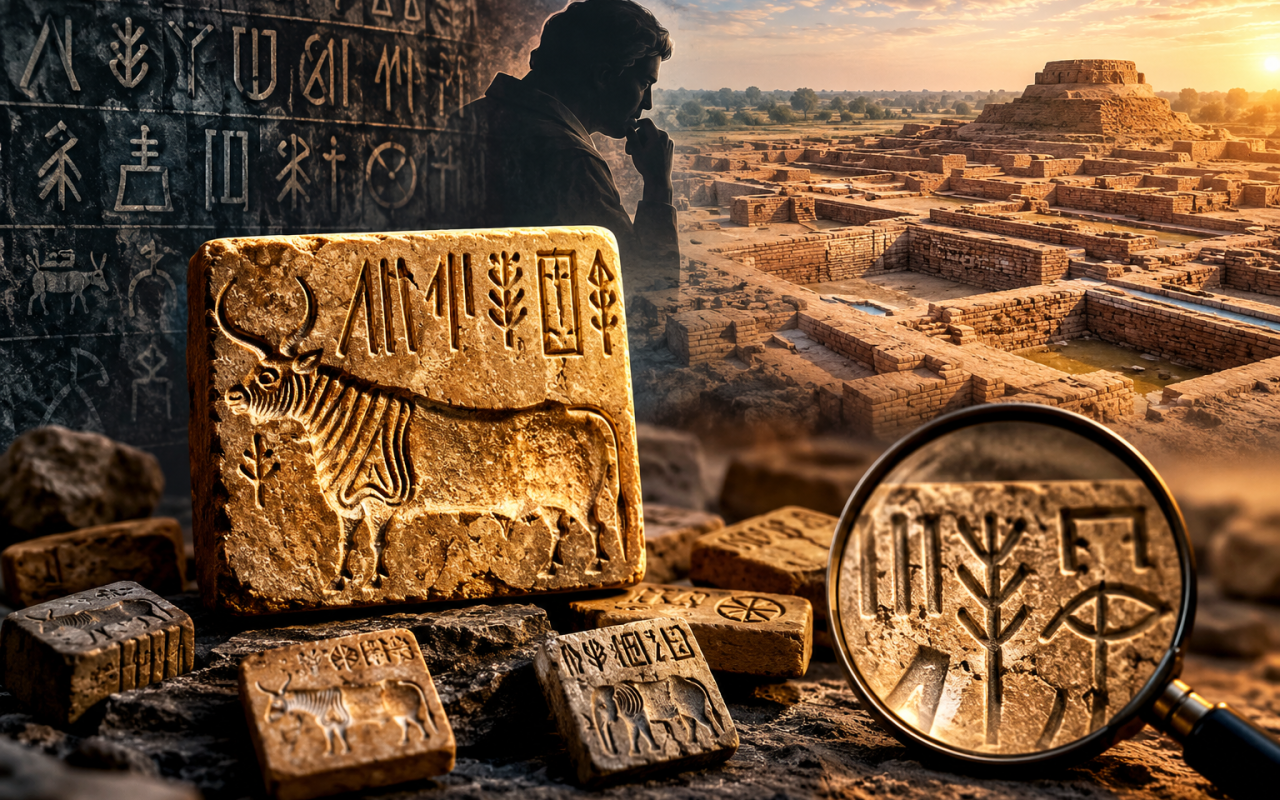
The Unsolved Mystery of the Indus Valley Script
Quick answer
The Indus Valley script remains undeciphered because its inscriptions are extremely short, no long texts have been found, and no bilingual key like the Rosetta Stone exists. The underlying language is also unknown. Scholars have proposed many readings, but none is accepted by the field.
Key takeaways
• The Indus Valley script is one of the world’s best-known undeciphered writing systems.
• Most inscriptions are very short, often found on stamp seals, which limits what scholars can analyze.
• No bilingual text and no known language connection means there is no reliable key to the signs.
• Debates continue over whether the signs encode language at all, and many claimed decipherments have not won acceptance.
• Cracking it would reshape our understanding of South Asia’s earliest cities and their legacy.
Imagine a civilization that laid out its cities on tidy grids, built sophisticated drainage systems, and traded goods across hundreds of miles, yet never left behind a single text we can read. That is the strange pull of the Indus Valley. More than four thousand years ago, its people raised great urban centers like Mohenjo-daro and Harappa in what is now Pakistan and northwest India, and then, somehow, their voices went silent.
Not entirely, though. They did write, or at least they left marks. Thousands of small inscriptions survive, mostly on stamp seals, pottery, and tablets, each carrying short strings of signs that look deliberate, orderly, and tantalizingly meaningful. Archaeologists have dug them up for roughly a century. And still, nobody can say with confidence what they say.
So why has this script resisted every attempt to crack it? Is it a lack of material, a missing key, or something stranger about the signs themselves? Let’s dig into the puzzle, one clue at a time, and see why it continues to frustrate some of the sharpest minds in the field.
What Was the Indus Valley Civilization?
Before we get tangled up in mysterious symbols, it helps to know who made them. The Indus Valley civilization, also called the Harappan civilization, was one of the world’s earliest urban cultures. Scholars generally agree that its mature phase flourished roughly between 2600 and 1900 BCE, putting it in the same broad era as early Mesopotamia and Old Kingdom Egypt. Yet it is far less famous than either, partly because we can’t read its words.
The civilization spread across a huge area of what is now Pakistan and northwestern India, with sites reaching into Afghanistan as well. It wasn’t confined to the Indus River itself. Many settlements sat along other river systems, including the now-seasonal Ghaggar-Hakra channel, and others lay near the coast of Gujarat. That is a vast territory, and the cultural similarities across it are striking.
Two cities usually steal the spotlight: Harappa, which gave the civilization its alternate name, and Mohenjo-daro. Other major sites include Dholavira, Rakhigarhi, and Ganweriwala. Excavations at these places reveal some remarkable features:
• Planned streets: Many towns show grid-like layouts, suggesting deliberate urban planning.
• Water management: Houses often connected to covered drains, and Mohenjo-daro’s so-called Great Bath is one of the best-known structures of the ancient world.
• Standardized goods: Fired bricks were made in consistent proportions, and carefully made stone weights suggest a shared system of measurement.
• Craft and trade: Artisans produced beads of carnelian and other stones, along with copper and bronze objects, and finds in Mesopotamia point to long-distance contact.
What’s missing is just as interesting. Compared with its contemporaries, the Indus world has yielded few obvious palaces or grand royal monuments, and nothing that clearly tells us who ruled or how. Archaeologists still debate how power, religion, and social organization worked here, and the evidence doesn’t hand over easy answers.
Around 1900 BCE, the mature cities began to decline. Scholars have proposed several contributing factors, including shifting river courses and changing climate, but there is no single settled explanation. Rather than vanishing overnight, the culture appears to have transformed gradually, with populations dispersing into smaller settlements.
So why does it matter? Because this was a sophisticated society that managed cities, crafts, and trade across a continental-scale landscape, and the one thing that might let it speak for itself is the script on its seals. Without that key, we are left reading a civilization from the outside, through bricks, beads, and broken pots.
What Does the Indus Script Actually Look Like?
Picture a small square of polished stone, roughly the size of a postage stamp or a bit larger. Carved into its face is a powerful animal, and above it runs a short row of tiny symbols. That, in a nutshell, is the classic Indus inscription. It is modest to look at, but it has kept scholars busy for over a century.
The script is made up of a few hundred distinct signs, though the exact count depends on who is doing the counting. Different researchers lump or split similar-looking symbols in different ways, so published sign lists vary quite a bit. Some signs are pictorial and easy to describe: what look like fish, jars, human figures, or wheel-like shapes. Others are abstract strokes, crosshatches, and geometric forms. Most inscriptions seem to run from right to left, a conclusion drawn partly from how signs are crowded at one end of a line when the carver ran short of space.
The Seals and Their Animals
The most famous carriers of the script are stamp seals, typically made of steatite, a soft stone that could be carved and then hardened by firing. The animal motifs are striking. The most common by far is the so-called “unicorn,” a bull-like creature shown in profile with a single horn. Other seals show humped zebu cattle, elephants, rhinoceroses, buffalo, and tigers. A few depict mysterious composite beasts or seated figures, including the well-known “Pashupati” seal, whose interpretation remains hotly debated.
Seals were probably used to mark ownership or authenticate goods, and many have been found with clay impressions called sealings, which suggests they were pressed into material attached to bundles or containers.
Where Inscriptions Turn Up
Writing appears well beyond seals. Inscriptions have been found on pottery, copper tablets, bronze tools, bangles, and small molded tablets. Major finds come from Mohenjo-daro and Harappa, but also from Dholavira, Lothal, and Kalibangan. A few seals have even surfaced in Mesopotamia, hinting at long-distance trade. Dholavira offers one of the most unusual finds: a large signboard with big letters, apparently once mounted above a gateway.
The Problem of Brevity
Here is the real catch: the texts are tiny. Most inscriptions are only a handful of signs long, and the longest on a single surface runs to roughly two dozen or so. There is no known long narrative, no dictionary, and no widely accepted bilingual text like the Rosetta Stone. For decipherment, that is a serious handicap. Short strings give very little grammar to analyze, and statistical patterns are harder to trust when each sample is so slight. In other words, the script is plentiful, but it is frustratingly quiet.
Why Has No One Cracked the Code?
If you strip the puzzle down to its essentials, three problems stand in the way, and each one would be daunting alone. Together, they have kept the Indus script locked for roughly a century since its modern rediscovery.
The first is the missing key. Egyptian hieroglyphs fell into place largely because of the Rosetta Stone, which carries the same decree in hieroglyphic, Demotic, and ancient Greek. Scholars could read the Greek, so they had a foothold. Nothing comparable has turned up for the Indus script. Some seals and objects have been found in Mesopotamia, and Mesopotamian scribes left plenty of cuneiform records about trade with a distant land called Meluhha, which many researchers link to the Indus region. But no inscription is known that pairs Indus signs with a readable translation.
The second problem, as we just saw, is brevity. Short texts offer little to work with. Linear B, the script of Bronze Age Greece, was cracked in the early 1950s by Michael Ventris, but he had thousands of tablets to analyze, and many of them were long lists with repeated patterns. That mass of material let researchers spot word endings and test ideas against each other. The Indus corpus has thousands of inscribed objects too, but the individual texts say so little that every theory is hard to check.
The third obstacle may be the biggest: we do not know what language the script records. Linear B turned out to be an early form of Greek, a language already understood, which made the final breakthrough possible. Maya glyphs were eventually read in large part because living Mayan languages could guide scholars toward the sounds. For the Indus script, candidates include early Dravidian, Indo-Aryan, Munda, or a language that has vanished without a trace. Without knowing which, there is no way to assign sound values to signs and confirm them.
How Other Decipherments Compare
• Egyptian hieroglyphs: a bilingual text, plus the later survival of the Coptic language, which helped link signs to sounds.
• Linear B: a large body of tablets and a language that turned out to be Greek.
• Maya script: long inscriptions, calendar information, and living descendant languages.
The Indus script has none of these advantages in any strong form, which is why the problem remains open.
Is It Even Writing? The Great Scholarly Debate
Here’s a twist that surprises many people: not everyone agrees the Indus signs encode language at all. The default assumption, held by most researchers for decades, is that they do. But a vocal minority has argued that we might be looking at something closer to a system of emblems, labels, or religious and political symbols, which would explain why no one can “read” it.
Let’s start with the case for a true script. Supporters point to the sheer regularity of the signs. Roughly four hundred or so distinct signs are commonly catalogued, a number that falls between a purely alphabetic system and a large logographic one, and the exact count varies by scholar. The signs also tend to appear in consistent orders, and most inscriptions run right to left, judging by how the text is compressed at one end when space ran short. Some signs cluster at the beginnings of inscriptions, others at the ends, which looks like grammar or at least fixed formulae. Supporters also note that the same sign sequences turn up across a vast geographic area, on seals, pottery, and tablets, suggesting a shared convention rather than local doodling.
The skeptics have their own evidence, and it is not trivial. The most striking point is how short the inscriptions are. Most are only a handful of signs long, and the longest known are still quite brief compared with the extended texts that unlocked other ancient scripts. Critics also note the absence of anything resembling a long narrative, letter, or administrative archive. The most prominent version of this argument, put forward by Steve Farmer, Richard Sproat, and Michael Witzel in 2004, compared the signs to non-linguistic systems that carry meaning without recording speech. They also highlighted that the script seems to vanish with the civilization, rather than evolving visibly into later writing.
Where the Debate Stands
Defenders of the linguistic view have pushed back. Statistical studies of sign sequences, including work by Rajesh Rao and colleagues, suggested the patterns have structure that falls between random and rigidly fixed, though others have questioned how much those methods can really prove. Short texts are not unusual for early writing either, since seals naturally carry brief messages such as names or titles.
The honest summary is that neither camp has delivered a knockout blow. The linguistic reading fits the visible patterns, yet it has produced no accepted translation. The non-linguistic reading explains the silence, yet it struggles to account for the script’s complexity and wide use. Without more or longer texts, the question stays open.
Famous Decipherment Claims and Why They Haven’t Stuck
If you search for “Indus script deciphered,” you’ll find a surprisingly long list of confident announcements. Since the script was brought to wider attention in the 1920s, scholars and enthusiasts have proposed many solutions. What they share is that none has won broad acceptance. It helps to sort them by approach rather than chase each one.
Dravidian-based proposals
One of the most influential lines of work assumes the underlying language was an early form of Dravidian, the family that includes Tamil and Telugu. The Finnish scholar Asko Parpola and a Soviet team led by Yuri Knorozov both pursued versions of this idea. A common technique is the rebus principle, where a sign’s picture stands for a word that sounds like another word. For example, a fish sign might be read through the Dravidian word for “fish,” which resembles the word for “star.” Critics point out that this approach gives researchers a lot of freedom. Without a bilingual text to check against, a reading can’t easily be confirmed or ruled out.
Indo-Aryan and Sanskrit-based proposals
Other researchers argue the language was an early Indo-Aryan one, sometimes linked to Vedic Sanskrit. These claims often carry cultural or political weight, since they bear on debates about the origins of South Asian traditions. Scholars have raised a common objection: the Indus cities flourished well before the period usually associated with Vedic texts, and the material culture doesn’t clearly match them. Some of these proposals have also relied on reshaping or reinterpreting signs in ways that other specialists find unconvincing.
Computational approaches
More recent work uses statistics and computing to study sign frequencies, sign order, and how often signs appear together. Such studies can test whether the sequences behave like language, but they generally can’t tell us what the signs mean. Some researchers have also tried machine-assisted pattern matching. These tools are only as good as the corpus, and the corpus is small and made up mostly of short seal inscriptions.
Several recurring problems explain why nothing has stuck:
• No bilingual key. There is nothing like the Rosetta Stone to anchor a reading.
• Unknown language. Every proposal must first guess the language family, and the guess shapes the result.
• Short texts. Brief inscriptions give little room to test a hypothesis.
• Lack of independent verification. Readings that work for one author often fail when others try to apply them consistently.
A convincing decipherment would need to read many inscriptions consistently, produce sensible meanings in context, and let other scholars reproduce the results. So far, no claim has met all three tests.
Why the Mystery Still Matters Today
It’s easy to treat the Indus script as a puzzle for specialists, a tangle of tiny signs on seals and pottery. But the question of what those signs say reaches well beyond the academic world, especially in South Asia, where the Indus Valley is tied up with questions of heritage and identity.
The civilization’s major sites, including Mohenjo-daro and Harappa in present-day Pakistan and Dholavira and Rakhigarhi in India, now sit in different modern nations. Each country takes pride in this shared ancient past, and the script sits at the center of that pride. Because nobody can read it, though, it also becomes a kind of blank canvas. Different groups have proposed that the language was an early form of Dravidian, an Indo-Aryan tongue, or something else entirely, and these arguments are sometimes shaped by present-day politics as much as by evidence. That is one reason careful scholars insist on the reproducibility test we just discussed: a reading that suits a particular narrative isn’t the same as a reading that works.
There is also a global angle. Writing appeared independently in only a few places, and Mesopotamia, Egypt, China, and Mesoamerica are the usual examples. If the Indus signs do encode language, that would add another major tradition to the story of how humans invented literacy. If they don’t, that tells us something just as interesting about how a complex, urban society could organize trade, authority, and identity without recorded speech.
What a Breakthrough Might (and Might Not) Tell Us
It’s tempting to imagine a decipherment unlocking epic poems or royal histories. That may be too optimistic. Most of the surviving inscriptions are very short, and they appear on seals, tablets, and tokens. Even a full reading might mainly give us names, titles, commodities, or ownership marks. Compare the many early Mesopotamian tablets that turned out to be administrative records rather than literature.
• What it could reveal: the language family, personal names, how trade was managed, and possibly religious or political terms.
• What it probably wouldn’t: a detailed narrative history, unless longer texts turn up in future excavations.
Still, even modest answers would transform how we understand one of the world’s earliest urban societies. And new digs, new imaging techniques, and fresh computational approaches keep adding material for the search. Somewhere, perhaps in a site not yet excavated, a longer inscription or even a bilingual text could be waiting. Until then, those small, patient signs keep asking us to look closer.
Still Waiting for the Indus Valley to Speak
So here we are, standing in front of thousands of tiny inscriptions that almost tell us something. The Indus Valley script hasn’t surrendered its secrets, and the reasons are surprisingly human: the texts are short, there’s no bilingual key, and we don’t know what language lay behind the signs. Even whether it’s full writing at all remains a lively argument.
Maybe that’s the real insight. Not every ancient voice comes with a translation, and the silence itself is worth sitting with. A people built carefully planned cities, traded across great distances, and left behind a system of marks they clearly cared about. We can see their effort, even if we can’t read their words. So the next time you look at a small stamped seal, ask yourself: what would you most want it to say?
Frequently asked questions
Has the Indus Valley script been deciphered?
No. Despite many proposed decipherments over the last century, none has gained general acceptance among scholars. The script’s brevity, the lack of a bilingual text, and uncertainty about the underlying language all prevent verification of any proposed reading.
Where was Indus Valley writing found?
Inscriptions appear at sites of the Indus Valley civilization across what is now Pakistan and northwestern India, including Harappa and Mohenjo-daro. They turn up mainly on stamp seals, but also on pottery, tablets, and other small objects.
Why is the Indus script so hard to decipher?
Most known inscriptions are only a few signs long, so there is little text to analyze for patterns. There is also no bilingual inscription, and the language behind the script is unknown, which removes the usual footholds decipherers rely on.
Was the Indus script real writing?
This is debated. Many scholars think it encoded a language, while some argue it was a non-linguistic system of symbols, such as signs of identity or status. The question remains open because the evidence is limited and can be read either way.
What would deciphering the Indus script tell us?
A reading could reveal the language spoken, how the cities were governed, what the seals meant, and how trade worked. It could also clarify the civilization’s relationship to later South Asian cultures, though that depends on what the texts actually say.

Team Random Read
Random Read is an independent general-interest blog covering history, current affairs, nature, psychology, science and pop culture. About us
More like this
Historical Myths Debunked: 15 Popular “Facts” Everyone Gets Wrong.
History is full of extraordinary stories. Some are so memorable that they become part of popular culture: Julius Caesar was born by…

5 Everyday Inventions That Were Total Accidents (Including Microwave Ovens & Post-it Notes)
We like to imagine that great inventions are born from brilliant minds following carefully drawn plans. A scientist develops a theory. An…
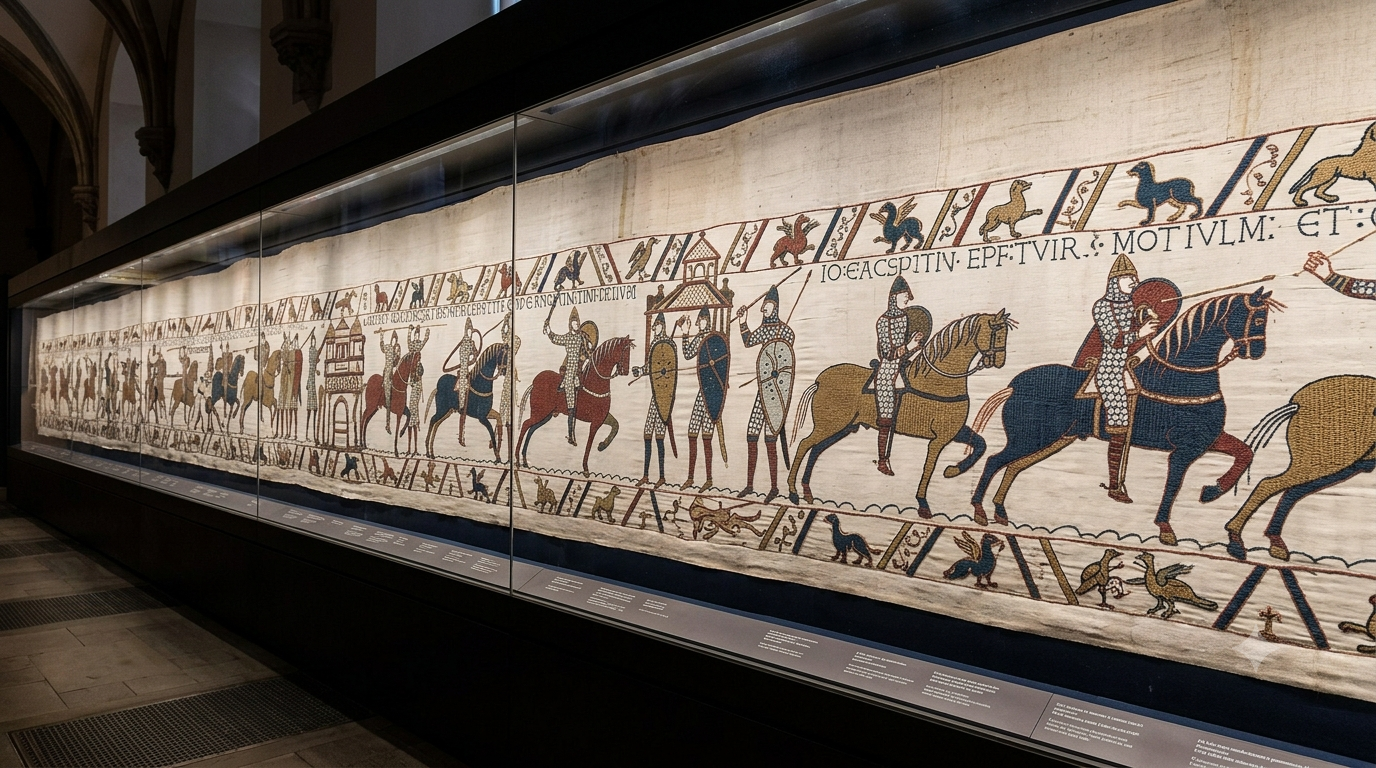
The Bayeux Tapestry: The 1,000-Year-Old Story of 1066, William the Conqueror and the Battle of Hastings
Few historical objects tell a story as vividly as the Bayeux Tapestry. Nearly 1,000 years old, this extraordinary piece of medieval embroidery…