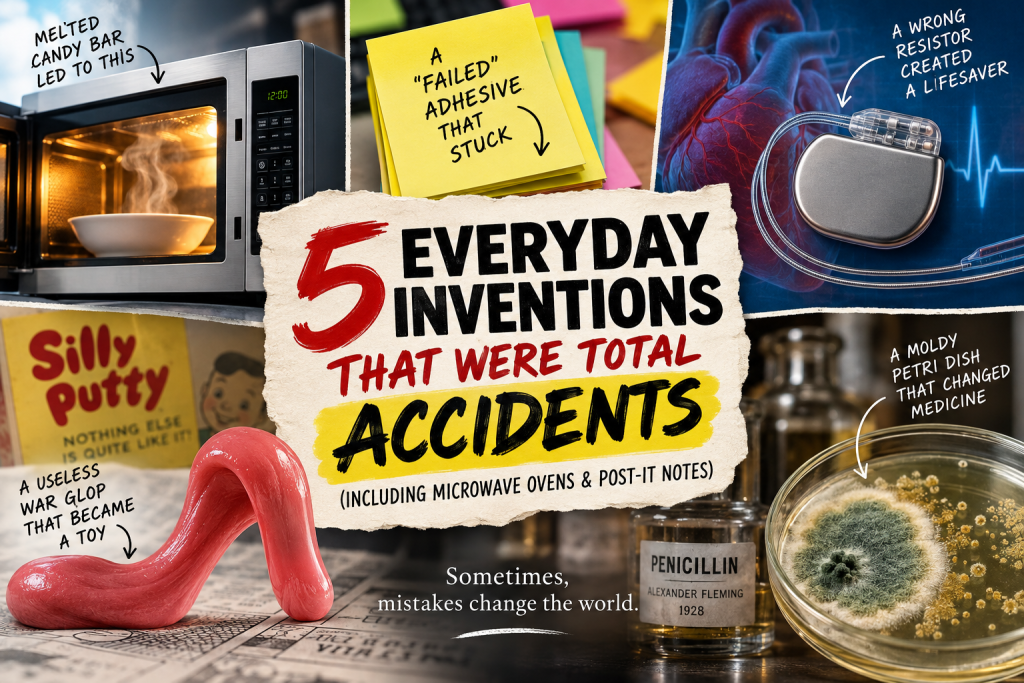
We like to imagine that great inventions are born from brilliant minds following carefully drawn plans.
A scientist develops a theory. An engineer builds a prototype. Researchers spend years testing it. Eventually, after countless calculations, experiments, failures, and refinements, the finished invention enters the world.
Sometimes, that is exactly how it happens.
But history has another, much stranger way of creating the things we use every day: accidentally.
A misplaced component, an adhesive that was considered too weak, a failed wartime experiment, a forgotten laboratory sample, or an unexpected reaction can sometimes produce something nobody was looking for.
Some of these discoveries were initially considered useless. Others happened while researchers were working on completely unrelated problems. In several cases, the inventor didn’t immediately understand what they had created.
Yet these accidents eventually changed everyday life.
The microwave oven transformed how millions of people prepare food. Post-it Notes became one of the world’s most recognizable office products. Pacemakers revolutionized the treatment of abnormal heart rhythms. Silly Putty went from failed wartime material to an iconic toy. And penicillin helped launch the antibiotic era.
Here are five remarkable examples of inventions and discoveries that emerged from unexpected mistakes, observations, and failures.
1. The Microwave Oven: A Melted Candy Bar in a Lab
Imagine discovering a technology that would eventually become a standard appliance in kitchens around the world because something in your pocket unexpectedly melted.
That is essentially what happened to American engineer Percy Spencer in the 1940s.
During World War II, Spencer worked for the Raytheon Company, where he was involved in developing radar technology. Radar systems relied on devices called magnetrons, which generate electromagnetic waves in the microwave portion of the spectrum.
Magnetrons were extremely important during the war because radar helped military forces detect aircraft and ships.
But Spencer noticed something unusual while working near an active magnetron.
Something in his pocket had become warm.
According to the famous account, Spencer was carrying a peanut butter candy bar when he discovered that it had melted while he was working near the equipment.
Rather than simply cleaning up the mess, Spencer became curious.
Why had the candy melted?
The answer appeared to involve the microwave radiation generated by the magnetron.
From candy to popcorn
Spencer decided to investigate further.
He placed some popcorn kernels near the equipment.
The kernels heated up and popped.
This was a much more dramatic demonstration than a melted candy bar.
He then experimented with other foods, including an egg. The egg heated rapidly enough that it eventually exploded.
These experiments convinced Spencer that microwave energy could be used to heat food.
The underlying science was not literally that microwaves simply “cook food from the inside out,” as the popular description sometimes suggests. Microwave energy causes certain molecules—particularly polar molecules such as water—to respond to the rapidly changing electromagnetic field, producing heat throughout the food.
That discovery opened the door to an entirely new way of cooking.
The first microwave oven
Raytheon developed a device based on Spencer’s work, and in 1945 the company filed a patent for using microwave energy to heat food.
The first commercial microwave ovens were enormous compared with the compact appliances found in modern kitchens. One early Raytheon model, introduced in the late 1940s, stood roughly six feet tall and weighed hundreds of pounds.
It was also extremely expensive.
Clearly, this was not yet an appliance for the average household.
Over the following decades, improvements in technology, manufacturing, and cost gradually made microwave ovens smaller and more affordable.
By the late 20th century, they had become common household appliances.
The strange lesson
The microwave oven wasn’t invented because Spencer woke up one morning and decided to revolutionize cooking.
He was working on radar.
The important breakthrough came because he noticed something unexpected and asked a simple question:
“Why did that happen?”
That habit—paying attention to an unexpected result instead of immediately dismissing it—is one of the most important themes in accidental discoveries.
Accidental invention lesson: Sometimes the most valuable part of an experiment isn’t the result you were looking for, but the result you weren’t expecting.
2. Post-it Notes: The Adhesive That Was “Too Weak”
Few office supplies are as recognizable as the humble Post-it Note.
You have probably used one to leave a reminder, mark a page, write down a phone number, organize a project, or stick a message to someone’s computer monitor.
But the adhesive that makes Post-it Notes useful was originally considered a failure.
The story begins at 3M in 1968.
Chemist Spencer Silver was working on adhesives. The goal was to create an extremely strong adhesive that could potentially be useful in demanding applications.
Instead, Silver created something almost the opposite.
His adhesive could stick to surfaces, but it wasn’t especially strong. More importantly, it could be peeled away and reused without leaving much adhesive behind.
From the perspective of someone trying to create a powerful permanent adhesive, this looked like a disappointing result.
Silver, however, didn’t simply throw away the idea.
He continued talking about his unusual adhesive within 3M, hoping somebody might find a practical application for it.
For several years, nobody had the right problem.
Then another 3M employee came along.
His name was Art Fry.
A bookmark problem
Fry sang in a church choir.
He had a small but annoying problem: the paper bookmarks he used to mark pages in his hymnal often fell out.
One day, he remembered Silver’s unusual adhesive.
What if the adhesive could be applied to a piece of paper?
The paper could stick securely to the page, but it could also be removed without damaging the book.
That simple idea became the foundation of the product that eventually became Post-it Notes.
From experiment to product
Turning the idea into a successful commercial product wasn’t immediate.
3M had to work out how to manufacture the adhesive and apply it effectively. Early product tests also showed that consumers needed to understand what the strange little adhesive notes were actually for.
Eventually, the company developed a product that could be stuck to surfaces, removed, and repositioned.
And then came another important piece of the Post-it Note story: its color.
The familiar pale yellow color is often described as a completely random accident. The more accurate version is somewhat less dramatic.
During development, the team used yellow paper because a neighboring laboratory had yellow scrap paper available.
The color worked.
It also became distinctive.
Today, the bright little notes are so familiar that their shape and color have become almost symbolic of reminders and organization.
The failure that wasn’t a failure
Spencer Silver’s adhesive wasn’t necessarily a failure in itself.
It simply failed to solve the problem Silver originally wanted it to solve.
That distinction is important.
An invention can be completely useless for one purpose and extraordinarily valuable for another.
The Post-it Note is a perfect example.
A “weak” adhesive became more useful precisely because it was weak.
Its inability to create a permanent bond was its greatest strength.
Accidental invention lesson: A failed solution can become a successful invention when someone discovers a completely different problem it solves.
3. The Pacemaker: A Wrong Resistor Creates a New Rhythm
The modern pacemaker is a remarkable piece of medical technology.
A tiny electronic device can monitor a person’s heart rhythm and deliver electrical impulses when necessary to help maintain an appropriate heartbeat.
But one of the key breakthroughs that led to the implantable pacemaker began with something surprisingly ordinary:
the wrong electronic component.
In 1956, engineer Wilson Greatbatch was working at the University of Buffalo on an electronic device intended to record heart sounds.
Greatbatch was experimenting with circuits that could detect and record electrical activity associated with the heart.
While assembling the circuit, he reached into a box of electronic components.
He accidentally selected the wrong resistor.
Instead of the component he intended to use, he inserted a resistor with a different resistance value.
The circuit behaved differently.
Instead of producing the expected result, it generated electrical pulses.
And those pulses had an intriguing rhythm.
A heartbeat-like signal
Greatbatch recognized that the electrical pulses resembled the kind of timing that might be useful for stimulating a heart.
This was the crucial insight.
The human heart normally beats because specialized cardiac cells generate and conduct electrical signals. When that electrical system malfunctions, the heart may beat too slowly or irregularly.
An artificial electrical pulse could potentially help stimulate the heart.
Greatbatch began modifying the device.
The first versions were large compared with modern pacemakers, and they were not yet suitable for routine implantation.
But the fundamental concept was there.
From laboratory circuit to medical device
The development of implantable pacemakers required far more than Greatbatch’s accidental resistor selection.
Researchers and physicians had to solve enormous engineering and medical challenges.
How could the device be safely implanted?
How could it operate inside the body?
How could its power supply last long enough?
How could doctors reliably connect it to the heart?
Early pacemakers had serious limitations, including relatively short battery life.
Later developments in electronics, batteries, miniaturization, and medical engineering transformed the technology.
Modern pacemakers can be extraordinarily small compared with their predecessors and can perform sophisticated monitoring and stimulation functions.
Why the story matters
The resistor wasn’t a magical mistake that instantly created the pacemaker.
The real story is more interesting.
An unexpected circuit behavior gave Greatbatch an idea.
He recognized that the “wrong” result might actually be useful.
Then years of engineering and medical development turned that observation into practical technology.
This is a recurring pattern in scientific history.
The accident creates the clue.
Human curiosity turns the clue into an idea.
Engineering turns the idea into a device.
Accidental invention lesson: Accidents rarely produce finished inventions by themselves. They provide unexpected clues that creative people can recognize and develop.
4. Silly Putty: The Wartime “Failure” That Became a Toy
During World War II, rubber was an extremely important strategic material.
Rubber was needed for tires, seals, hoses, boots, military equipment, and countless other applications.
Wartime disruptions created shortages, leading researchers to search for synthetic alternatives.
In 1943, American engineer James Wright, working for General Electric, was attempting to develop a synthetic rubber substitute.
Instead, he created something completely different.
It was strange.
It stretched.
It bounced.
It could deform.
It could flow slowly under certain conditions.
It could even pick up images from printed material.
But it wasn’t good enough to replace rubber.
In other words, Wright had apparently failed.
The strange material finds an audience
The substance didn’t immediately have an obvious commercial purpose.
That might have been the end of the story.
But the material was unusual enough to attract attention.
It became something of a curiosity.
Eventually, toy marketer Peter Hodgson saw its potential.
Hodgson realized that people might enjoy playing with the strange substance even if it wasn’t useful as industrial rubber.
He packaged it in small plastic eggs and marketed it as a novelty.
The product became known as Silly Putty.
And it became a sensation.
Why was Silly Putty so strange?
Silly Putty displays unusual physical behavior because it is a viscoelastic material.
That means it has properties associated with both liquids and solids.
Pull it slowly, and it can stretch.
Pull it rapidly, and it can behave more like a brittle solid.
Leave it alone, and it can gradually flow.
Drop it, and it can bounce.
Press it against a printed page, and it can sometimes transfer portions of the image onto the putty.
These properties made it fascinating to children—and adults.
The material eventually became far more successful as a toy than it would ever have been as a rubber substitute.
From military research to popular culture
Silly Putty even developed an unexpected connection with space exploration.
During the Apollo missions, versions of the material were reportedly used as a novelty and as a way to help secure small objects in zero gravity.
A material originally developed during a wartime search for synthetic rubber had become a toy associated with space exploration.
The irony is hard to miss.
Researchers were trying to solve a serious industrial problem.
They failed.
Their failure became a toy.
That toy became a cultural icon.
Accidental invention lesson: “Useless” depends entirely on the problem you’re trying to solve. A material can fail as an industrial product and succeed brilliantly as something else.
5. Penicillin: The Mold That Changed Medicine
Few accidental discoveries have had a greater impact on human health than penicillin.
The story begins in London in 1928 with Scottish physician and bacteriologist Alexander Fleming.
Fleming was studying bacteria, particularly Staphylococcus, when something unexpected appeared in one of his laboratory cultures.
A mold had contaminated a Petri dish.
For many researchers, contamination would simply mean throwing away the experiment.
But Fleming noticed something unusual.
The bacteria surrounding the mold were not growing normally.
There was a clear area around the mold where the bacterial colonies had been destroyed or inhibited.
The contaminant was a species of mold belonging to the genus Penicillium.
Fleming investigated further.
He concluded that the mold was producing a substance capable of inhibiting certain bacteria.
He called the substance penicillin.
The famous “messy laboratory” story
The popular version of the story often says that Fleming was a famously careless scientist who left his Petri dishes uncovered near an open window and accidentally discovered antibiotics.
Reality is more complicated.
Fleming’s laboratory observations were indeed prompted by contamination, but the development of penicillin into a practical medicine required enormous additional work by other scientists.
Fleming himself recognized the significance of the mold’s antibacterial activity, but penicillin was difficult to produce and purify in useful quantities.
The breakthrough came years later.
During World War II, researchers including Howard Florey, Ernst Chain, and their colleagues worked on developing penicillin into a usable therapeutic drug.
They developed methods to produce, purify, test, and manufacture it on a much larger scale.
From laboratory curiosity to medical revolution
The consequences were enormous.
Before effective antibiotics, bacterial infections could be devastating.
An infection following a wound, surgery, childbirth, or pneumonia could become life-threatening.
Penicillin provided doctors with a powerful new weapon against many bacterial infections.
Its success helped usher in the antibiotic era.
The discovery and development of antibiotics dramatically changed medicine, making many previously dangerous infections treatable.
But there is an important modern lesson here too.
Antibiotics are not universally effective against every infection, and bacteria can evolve resistance when antibiotics are misused or overused.
So the story of penicillin is not simply about a miracle drug.
It is also a story about scientific observation, persistence, manufacturing, and the continuing struggle between medicine and microbial evolution.
Accidental invention lesson: An unexpected observation can change the world—but recognizing it, proving it, and turning it into something useful can take decades of additional work.
What These Five “Accidents” Have in Common
The microwave oven, Post-it Note, pacemaker, Silly Putty, and penicillin seem completely unrelated.
One cooks food.
One holds pieces of paper.
One helps regulate the heart.
One is a toy.
One fights bacterial infections.
Yet their stories share a remarkable pattern.
None of these breakthroughs came simply from someone making a random mistake and becoming instantly successful.
Instead, they followed a more interesting formula:
Unexpected result + curiosity + experimentation + persistence = discovery.
The accident gets attention.
The inventor asks why.
More experiments follow.
Eventually, somebody realizes that the unexpected result might solve a different problem.
That distinction is important because it changes how we think about failure.
Failure isn’t always the opposite of success
When an experiment doesn’t produce the expected result, it is tempting to label it a failure.
But scientists and engineers often learn something from unexpected results.
Spencer wasn’t trying to invent a microwave oven when his candy melted.
Silver wasn’t trying to create an adhesive for office notes.
Greatbatch wasn’t trying to invent a pacemaker when he inserted the wrong resistor.
Wright wasn’t trying to create a children’s toy.
Fleming wasn’t trying to discover a complete modern antibiotic treatment when he noticed mold growing in a bacterial culture.
The original objectives were different.
The breakthrough came from recognizing that the unexpected result might have value.
The Power of Paying Attention
Perhaps the most important lesson from these accidental inventions isn’t about technology at all.
It’s about observation.
Every day, people encounter unexpected results.
Something doesn’t work.
A machine behaves strangely.
A material changes unexpectedly.
A mistake produces a surprising result.
Most of these events are insignificant.
But occasionally, one of them contains an important clue.
The difference between an ordinary mistake and a historic discovery can be the person who notices it.
Percy Spencer could have thrown away the melted candy.
Spencer Silver could have forgotten about his strange adhesive.
Wilson Greatbatch could have corrected the resistor and moved on.
James Wright could have abandoned his rubber substitute.
Alexander Fleming could have discarded the contaminated Petri dish.
Instead, they—or the people who followed them—asked questions.
And those questions eventually changed the world.
The Accidental Invention Hall of Fame
These five stories also demonstrate that invention doesn’t always follow a straight line.
| Invention | Original Goal | Unexpected Result | What It Became |
|---|---|---|---|
| Microwave oven | Radar technology | Food heated near a magnetron | A revolutionary kitchen appliance |
| Post-it Notes | Strong adhesive | Repositionable weak adhesive | A global office and household product |
| Pacemaker | Heart-monitoring circuit | Unexpected electrical pulses | Life-saving cardiac technology |
| Silly Putty | Synthetic rubber | Strange viscoelastic material | An iconic toy |
| Penicillin | Bacterial research | Mold inhibited bacterial growth | A foundation of modern antibiotic medicine |
What looks like a mistake in one context can become a breakthrough in another.
That may be the most fascinating thing about these inventions.
Conclusion: Sometimes the Wrong Answer Is the Right Discovery
History is full of inventions that appear inevitable when we look backward.
Today, it seems obvious that microwave ovens belong in kitchens, Post-it Notes belong on desks, pacemakers belong in modern medicine, and Silly Putty belongs in toy stores.
But none of those outcomes was obvious at the beginning.
The microwave started with an unexpected melted snack.
Post-it Notes came from an adhesive that wasn’t strong enough for its original purpose.
The pacemaker’s development was sparked by an incorrectly selected electronic component.
Silly Putty emerged from a failed attempt to create synthetic rubber.
Penicillin began with an unwanted mold contaminating a bacterial culture.
The important lesson isn’t that mistakes automatically lead to inventions.
They don’t.
Most mistakes are simply mistakes.
The lesson is that unexpected results deserve attention.
A failed experiment can contain useful information. A strange result can reveal something nobody anticipated. A product that fails at one job may be perfect for another.
Innovation is not always about following a perfect plan.
Sometimes it’s about being curious enough to stop, look at the unexpected result, and ask:
“What if this isn’t a mistake after all?”
And sometimes, that question is where history begins.