Aphantasia Cannot Visualize Images Mind
 By Team Random Read
15 min read
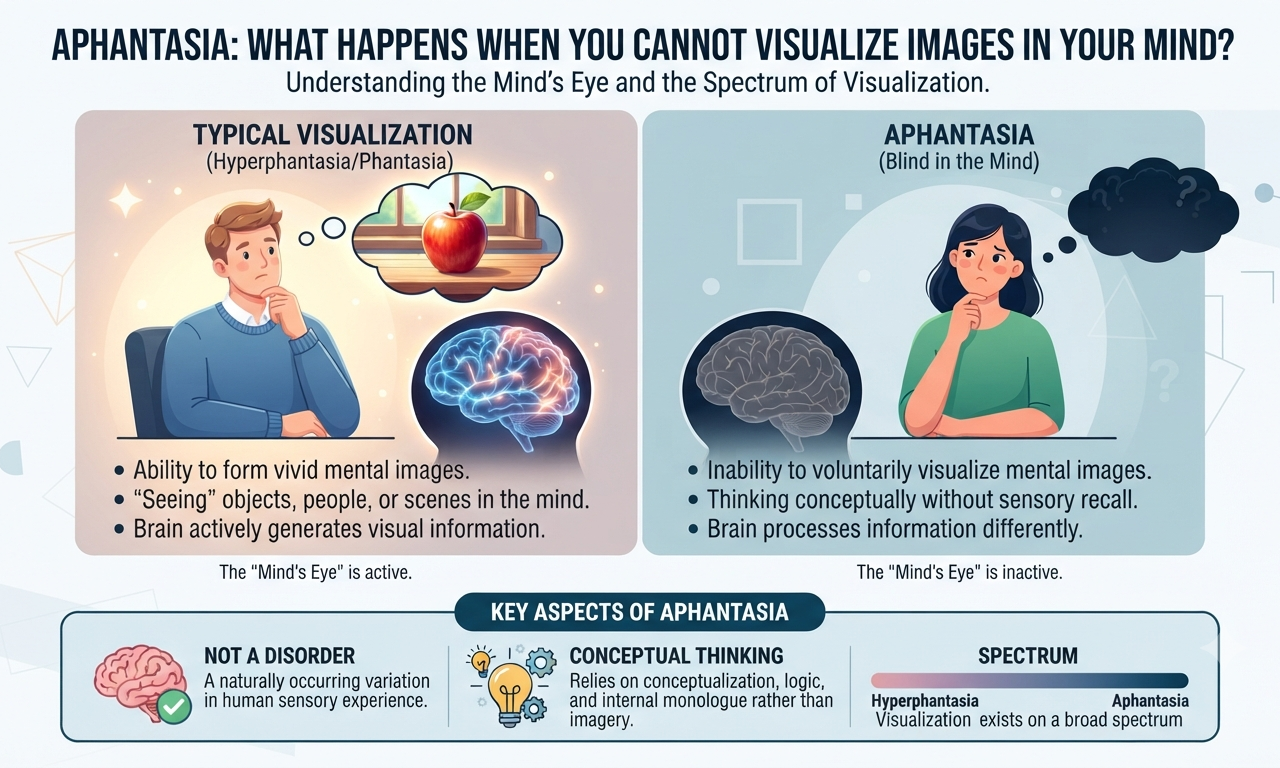
Aphantasia: What Happens When You Cannot Visualize Images in Your Mind?
Quick answer
Aphantasia is the inability to voluntarily form mental images, so a person cannot “see” a face, place or object in their mind’s eye. It is not a disease or a vision problem. Many people with aphantasia still think, remember, dream and work creatively, just without a conscious inner picture.
Key takeaways
• Aphantasia means little or no voluntary visual imagery, and it is a variation in how minds work rather than a recognized disease.
• It is different from poor eyesight or memory loss; people with aphantasia can often recall facts and experiences in non-visual ways.
• Many people with aphantasia still dream, though dream imagery may be reduced or varies from person to person.
• Memory can rely on facts, words, spatial layout, concepts and feelings instead of mental pictures.
• The term was popularized by researcher Adam Zeman and colleagues, and the science is still developing, so many questions remain open.
Close your eyes and picture an apple. Maybe it’s glossy and red, with a little stem and a highlight where the light hits it. Now try something harder: picture the face of someone you love. For most people, some version of that image appears, whether it’s vivid and detailed or faint and fleeting. But for some people, the mental screen stays completely blank. That experience is called aphantasia, and it’s far more intriguing than it first sounds.
If you’ve always assumed that “picture this” is just a figure of speech, you may be in for a surprise. Many people with aphantasia grow up believing that everyone else is speaking metaphorically when they talk about seeing things in the mind’s eye. They think about apples and faces just fine. They know what an apple is, what it tastes like, and who they love. They simply don’t experience an image when they do.
So what is going on inside a mind like that? How do people with aphantasia dream, remember, and imagine? Let’s explore this curious quirk of human thinking together.
What Is Aphantasia?
Aphantasia is the term for a lack of voluntary mental imagery. Most people can, if asked, call up a picture of a beach at sunset or their front door and “see” it in some form, even if it’s faint or fuzzy. Someone with aphantasia can’t do that on purpose. When they’re asked to picture the beach, they may think about it in words, facts, or concepts: sand, waves, orange sky. But there is no inner picture to go with them.
It helps to be clear about what aphantasia is not. It is not an eyesight problem. People with aphantasia can see the world around them perfectly well, and many have sharp vision, while others wear glasses like anyone else. The difference lies in what happens when the eyes are closed or the object is absent. Seeing is about processing what is in front of you. Mental imagery is about generating a sensory-like experience without any outside input. Aphantasia affects the second, not the first.
The word itself is fairly new. It was popularized in 2015 by the neurologist Adam Zeman and his colleagues at the University of Exeter, who built on earlier observations. The idea that some people lack a mind’s eye was noted in the nineteenth century by Francis Galton, who found that some of the people he surveyed reported little or no visual imagery. Zeman’s team gave the condition a name and brought it into wide scientific and public attention. The name combines the Greek phantasia, roughly meaning imagination or appearance, with the prefix “a-,” meaning without.
Aphantasia also sits on a spectrum. Imagery vividness varies enormously from person to person:
• Aphantasia: little or no voluntary mental imagery.
• Typical imagery: pictures that are present but often partial, dim, or fleeting.
• Hyperphantasia: imagery so vivid it can feel almost like real seeing.
Most of us fall somewhere in the middle, and where you land can be surprising. Because we can’t look inside anyone else’s head, many people go decades without realizing their inner experience differs from their friends’. Aphantasia isn’t only about vision, either. Some people report that other senses, like imagined sounds or smells, are muted too, though this varies from person to person.
How Do People Discover They Have Aphantasia?
For most people, the discovery happens by accident, and it usually comes with a jolt. Someone mentions “counting sheep” to fall asleep, or a friend says to close your eyes and picture a beach, and you quietly realize you have been taking that as a figure of speech. You may have assumed everyone else was doing the same thing you were: thinking about a beach, knowing facts about it, maybe feeling a vague mood, but not actually seeing anything. Then you learn that for many people, the picture is real in some sense. It can be a bit of a head-spinning moment.
That reaction is common because the difference is so hard to spot. Nobody hands you a manual for how your own mind works, and you can’t compare experiences directly. The term “aphantasia” was only coined in 2015 by the neurologist Adam Zeman and colleagues, after earlier work describing people who reported no voluntary mental imagery. Public awareness grew afterward, and many people say a news article or a social media thread was what finally gave them words for something they had always lived with.
Simple Ways People Test Themselves
Once the idea clicks, curiosity usually kicks in. A few informal approaches are popular:
• The Vividness of Visual Imagery Questionnaire (VVIQ): A widely used research tool that asks you to imagine scenes, such as a sunrise or a familiar face, and rate how clear each image is on a scale. Low scores across the board are often associated with aphantasia.
• The apple test: Try to picture an apple, then ask yourself whether you can see its color, shine, or shape, or whether you only know what an apple is like.
• The familiar-face test: Try to bring a close friend’s face to mind. Can you see it, even faintly, or do you only recall facts about it, like hair color or how they laugh?
These exercises can be a fun way to compare notes with friends, and the differences in answers are often surprising.
It is worth being clear about their limits, though. A questionnaire relies on self-report, which means you are judging your own experience using words and scales that other people may interpret differently. Your score can also shift with your mood, how tired you are, or how you read the instructions. So think of these tools as conversation starters rather than diagnoses. Aphantasia is not a formal medical diagnosis, and a quiz result cannot confirm it. If the difference worries you, or if you suddenly lost the ability to visualize after an illness or injury, it is sensible to talk with a doctor.
Can People With Aphantasia Dream?
Here is a question that sounds like a trick: if you cannot picture a beach on command, what happens when you fall asleep and your brain throws you onto one? The short answer is that many people with aphantasia do report dreaming. The longer answer is more interesting, because their dreams do not all look the same.
Some people with aphantasia describe dreams that are rich and visual, with colors, faces, and settings that feel as real as anything they see while awake. Others describe dreams that are thinner, closer to a sense of knowing what is happening than to watching a scene unfold. A person might dream that they are arguing with a sibling in a kitchen without being able to say what the kitchen looked like. And some people say they rarely recall dreams at all, though that is also true of plenty of people who can visualize.
Why the Gap Between Waking and Sleeping Matters
The most curious detail is the apparent split between two kinds of imagery. When you are awake and asked to picture an apple, you are making a deliberate, voluntary effort. In a dream, images arrive on their own, with no effort or instruction from you. Many people with aphantasia say the first kind is unavailable to them, while the second can still happen.
That pattern hints that voluntary imagery and involuntary imagery may rely on somewhat different processes in the brain. Think of it as the difference between deliberately flipping a light switch and having the lights come on automatically on a timer. The wiring that produces a dream image may not depend on the same conscious “summon an image” step that fails during a visualization exercise.
Some people with aphantasia also report brief, spontaneous images as they drift off to sleep, even though they cannot produce them at will. Reports like these are part of why researchers see the condition as more nuanced than a simple absence of pictures.
What Researchers Are Still Working Out
It is worth being honest that this area is still being studied. Much of what we know comes from self-report, and dreams are hard to measure because we only know about them through memory and description. Two people might use the word “vivid” to mean quite different things. Researchers are still investigating how dream content in aphantasia compares with that of people who visualize easily, and whether the differences are real or partly a matter of how people describe their experiences.
So if you have aphantasia and your dreams are full of imagery, you are not unusual. If your dreams are quiet and conceptual, that is within the range people report too.
How Do People With Aphantasia Remember Things?
Here is a question that surprises many people: if you cannot picture your childhood bedroom, how do you know what was in it? The answer is that remembering and visualizing are not the same thing. Visual replay is one way the brain can retrieve a memory, but it is not the only one. People with aphantasia often describe knowing a fact, an event or a place without seeing anything at all.
Think of the difference between knowing that something is true and seeing it again. Someone with aphantasia may be able to tell you that their grandmother’s kitchen had yellow walls, a wooden table and a window over the sink. The information is there and often accurate. What is missing is the internal picture that others might use to read those details off. The memory arrives as knowledge rather than as a scene.
In practice, people tend to lean on several other routes into the past:
• Facts and concepts: Remembering that a holiday took place in July, that the hotel was near a harbor, and that it rained on the second day.
• Language: Describing events in words, silently narrating them, or relying on lists, labels and stories to hold information together.
• Spatial layout: Knowing where things are and how to get from one place to another, without any mental image of the route. Some people find they can sense the arrangement of a room, even though they cannot see it.
• Emotion: Recalling how an occasion felt, such as the nervousness before a performance or the warmth of a family gathering, which can anchor a memory even when no image comes with it.
Many people with aphantasia describe their autobiographical memory as being more factual and less sensory than they suspect other people’s is. Some studies have found that people with aphantasia report fewer vivid, detailed memories of their past, though this rests largely on self-report, and the picture is not uniform.
That last point matters. Memory in aphantasia varies from person to person. Some people say they struggle to relive past events or to recognize faces, while others report no noticeable difficulty and do well on everyday memory tasks. Aphantasia also does not automatically affect other senses. One person may lack visual imagery but still be able to imagine sounds or music, while another has a quieter mind in several senses at once.
So the useful takeaway is not that people with aphantasia remember worse or better. It is that they often remember differently, building the past out of meaning, words, space and feeling rather than a replayed film.
What Causes Aphantasia, and Is It a Problem?
Here is the honest answer to the first question: nobody knows for sure. Aphantasia was only given its name in 2015, and research is still young. Most people who have it report that they have always had it, which suggests that for many it is present from birth, or at least from very early in life. Some people also notice that other family members have it, so researchers have wondered whether genetics play a role, though no specific gene has been identified.
Brain imaging studies hint at differences in how visual areas communicate with regions involved in attention and planning. One idea is that the visual system works normally, but the signal that would produce an inner picture is weaker or never fully “switches on.” That is a working hypothesis, not a settled explanation.
There is also a rarer, acquired form. Some people lose the ability to visualize after a brain injury, a stroke, or certain illnesses, and a few cases have been linked to psychological distress. This sudden change is quite different from lifelong aphantasia and is usually noticed right away.
Is It a Disorder?
Generally, no. Aphantasia is not listed as a medical diagnosis, and most people with lifelong aphantasia function well. It is better understood as a variation in how minds work, much like differences in perfect pitch or handedness. Many people are surprised to learn they have it, because their way of thinking has always felt normal to them.
Work and creativity are not closed doors. People with aphantasia succeed as writers, scientists, programmers, designers and artists. Some may lean on strengths like verbal reasoning, spatial understanding or abstract thinking. Certain tasks, such as mentally rotating objects, may be approached by different routes, but the outcome can still be strong.
Emotions can be a more nuanced area. Some people say they feel less vivid emotional reactions to imagined scenes, or that they cannot summon a comforting picture of a loved one. Others feel deeply and notice no gap at all. Experiences vary widely.
When to See a Doctor
If you have had aphantasia as long as you can remember and it does not trouble you, there is generally nothing to treat. It is worth speaking to a doctor if:
• Your ability to visualize disappears suddenly or changes noticeably.
• The change comes with headaches, vision problems, memory loss, confusion or weakness.
• You feel distressed about the change, or it follows a head injury or illness.
In those cases, a prompt medical check is a sensible step.
Living and Thinking Without a Mind’s Eye
For most people with aphantasia, daily life looks much like anyone else’s. They work, parent, study, travel and make things. The difference is usually in the route their thinking takes, not in where it ends up. Many people only realize they are doing something differently when they learn that others “see” images when they think.
At work, people with aphantasia often lean on other strengths. Some think in words, lists or diagrams drawn on paper. Others rely on spatial awareness, a sense of how things relate without picturing them, or on logic and patterns. An architect might work from measurements and sketches, while a writer might build scenes from ideas, emotions and dialogue rather than imagery. Researchers have noted that people with aphantasia work in a wide range of fields, including creative and scientific ones, so there is no job that is closed off to them.
Hobbies tend to follow the same pattern. Someone might love drawing but need a reference in front of them. A reader may enjoy a novel for its voice and plot while not picturing the characters at all. Musicians, cooks, gardeners and athletes often rely on movement, sound, taste and touch, which do not require a mental picture.
Practical Ways of Working With It
• Externalize your thoughts. Notes, sketches, mind maps and checklists can do the job a mental image might do for someone else.
• Use other senses. Describing, talking through or physically rehearsing a task can help you plan and remember.
• Explain it to others. A short, plain description often clears up confusion and saves awkward moments.
Relationships can bring small surprises. A friend might say, “Just picture the room,” and you may have nothing to picture. A partner may be amazed that you cannot call up a face on request. These moments usually lead to curious conversations rather than problems, especially when both people accept that minds work differently. Parents with aphantasia sometimes mention that they cannot “see” their children when apart, yet feel just as close to them. Feeling and memory are not the same as imagery.
It helps to remember that visualizing is only one way of imagining. People think in words, sounds, movements, concepts and feelings, and many people mix several at once. Aphantasia is one point on a broad spectrum of inner experience, not a lack of imagination.
If you would like to read more, reputable sources include the University of Exeter’s research on aphantasia, led by Professor Adam Zeman, as well as the Aphantasia Network, which shares research summaries and personal accounts. Peer-reviewed articles in journals such as Cortex can be found through PubMed, and your doctor can answer questions about your own health.
A Different Way of Seeing the World
Here is the thing that stays with me about aphantasia: for most of history, nobody thought to ask. People assumed that when someone said “picture a beach,” everyone saw the same thing behind their eyes. It turns out the inner lives of the people sitting next to us may be far more varied than we ever guessed.
That variety is the real story. Some people see vivid scenes, some see faint hints, and some think in words, sounds, movements or pure ideas. None of these is the “correct” way to imagine. So the next time you close your eyes and think of a familiar place, you might wonder: what exactly is happening in your mind, and how different might it be from the person next to you? What would they say if you asked?
Frequently asked questions
What is aphantasia in simple terms?
Aphantasia is the absence or severe weakness of voluntary mental imagery. If you are asked to picture an apple, you may understand the idea and know what an apple looks like, but you do not experience a visual image in your mind. It is a variation in cognition, not an illness.
Is aphantasia a disorder or disease?
Aphantasia is generally described as a variation in how people experience imagination, not a disease. It is not a vision problem, and many people with it live full lives. Anyone worried about sudden changes in imagery or memory should speak with a doctor.
Can people with aphantasia dream?
Many people with aphantasia report that they do dream. Some describe dreams with less visual detail, while others report vivid dreams despite having no waking imagery. Experiences vary, and researchers are still studying why involuntary imagery in dreams can differ from voluntary imagery while awake.
How do people with aphantasia remember things?
They tend to rely on facts, words, concepts, spatial relationships and emotional associations rather than mental pictures. For example, someone may remember where objects are in a room or the details of an event as knowledge, without replaying a visual scene in the mind.
How do you know if you have aphantasia?
A common starting point is a self-report questionnaire such as the Vividness of Visual Imagery Questionnaire, which asks you to rate how vivid your mental images are. It is not a medical diagnosis, but it can help you describe your experience to others or a professional.

Team Random Read
Random Read is an independent general-interest blog covering history, current affairs, nature, psychology, science and pop culture. About us
More like this
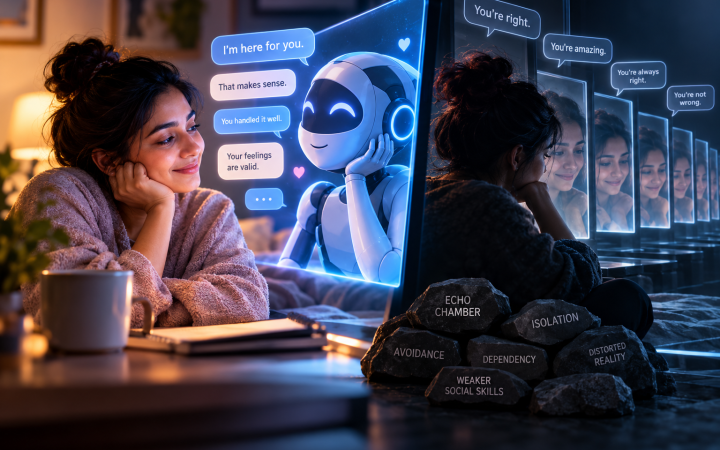
The Psychology of AI Companionship: Why Millions Are Quietly Bonding With Algorithms
We live in an era where millions of people don't just use AI to write emails or debug code. They talk to…

The Dark Triad in Everyday Life: Why You Keep Falling for Charming People.
You meet someone who is confident, funny, attentive, and unusually good at making you feel interesting. They remember small details, tell compelling…
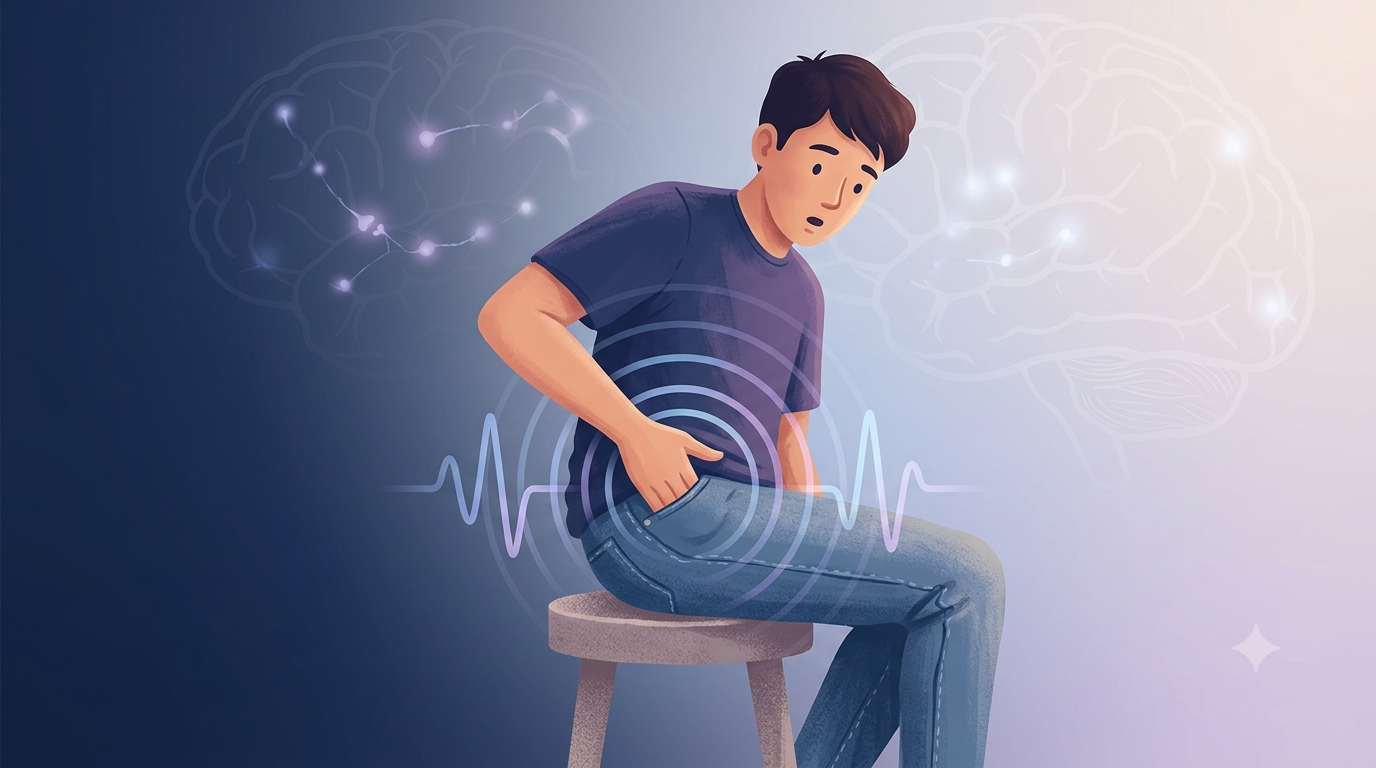
Phantom Vibration Syndrome: The Psychology Behind Feeling a Buzz That Never Happened.
You're at your desk, or on the bus, or halfway through a meeting, and you feel it — that unmistakable little rumble…