Solar Powered Agriculture Agrivoltaics
 By Team Random Read
15 min read
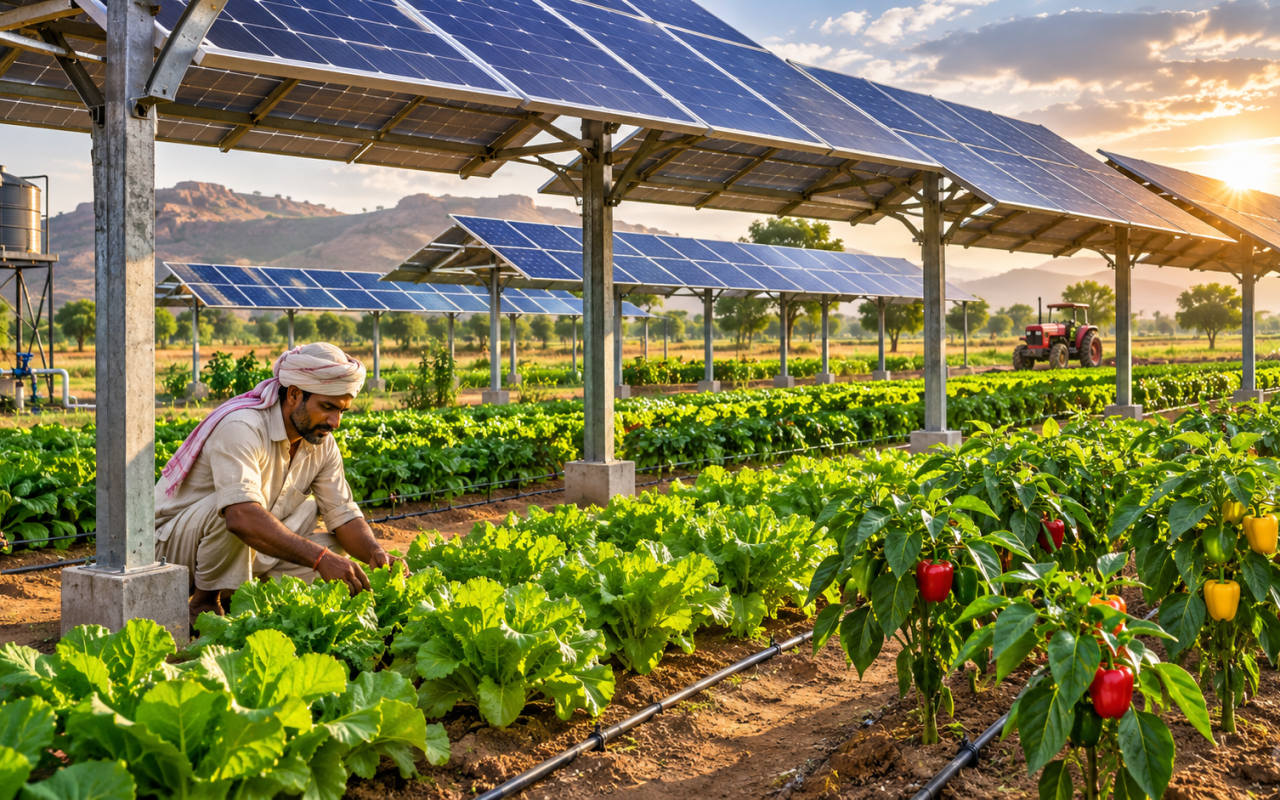
Solar-Powered Agriculture & Agrivoltaics: How Dual-Use Solar Farms Cool Crops, Save Water and Generate Clean Energy
Quick answer
Agrivoltaics combines solar panels and farming on the same land. In arid regions, panel shade can lower crop heat stress and reduce evaporation, so some crops need less irrigation, while the panels generate electricity. Results vary by crop, climate and system design, and not every crop benefits from shade.
Key takeaways
• Agrivoltaics uses one parcel of land for both crop or livestock production and solar electricity.
• Partial shade can reduce heat stress and evaporation in hot, dry climates, which may lower irrigation needs for some crops.
• Shade-tolerant crops such as leafy greens, some peppers and tomatoes tend to suit these systems better than sun-hungry grains.
• Panel height, spacing and tracking technology determine how much light reaches plants and how much power is produced.
• Costs, farm machinery access, permitting and land-use policy are the main barriers to wider adoption.
Every acre of land has to do more work than it used to. Expanding clean electricity means building solar at scale, yet that growth competes with food production for land, and both depend on water that is increasingly scarce in many regions. Solar-Powered Agriculture & Agrivoltaics offers a direct response to this conflict: instead of choosing between a solar array and a field, it places both on the same ground.
Agrivoltaics is the practice of combining solar energy generation with agricultural activity, whether crop cultivation, grazing, or pollinator habitat, on a single parcel. Panels are mounted higher, spaced wider, or arranged differently than in conventional solar farms, so that sunlight, shade, and rainfall can still reach plants and animals below. Research and pilot projects in several countries suggest that, in some settings, the shade the panels cast can moderate heat stress and reduce evaporation. Results vary with climate, crop, and system design, and the approach involves real trade-offs.
This article examines how dual-use solar farms work, how panels may cool crops in hot, dry climates, and what the evidence says about water conservation. It then looks at which crops and livestock suit panel-covered land, weighs the energy and economic trade-offs, and considers the barriers and future prospects for agrivoltaics.
What Is Agrivoltaics and How Do Dual-Use Solar Farms Work?
Agrivoltaics, also called agrophotovoltaics or solar sharing, is the practice of using the same parcel of land for both solar electricity generation and agricultural production. Instead of treating farmland and solar development as competing uses, the approach places photovoltaic (PV) panels in, above, or alongside crops, pasture, or pollinator habitat. The goal is to raise the total productivity of a given area, a concept researchers often express as a land equivalent ratio.
The idea was first proposed in 1981 by Adolf Goetzberger and Armin Zastrow of Germany’s Fraunhofer Institute for Solar Energy Systems, who suggested that elevated panels could allow crops to grow beneath them. Early experimental work followed in Japan, where Akira Nagashima developed “solar sharing” in the early 2000s, and in France, Italy, and the United States. The term “agrivoltaics” itself became common in the 2010s as pilot sites multiplied.
Main System Configurations
• Raised panels over crops: Panels are mounted on tall structures, often several meters above the ground, so that tractors and harvesters can pass underneath. Some systems use fixed tilt angles, while others use trackers that follow the sun or adjust to give crops more light at critical growth stages.
• Interspersed rows: Panels are installed in widely spaced rows, with crops grown in the alleys between them. This design suits standard-height structures and conventional machinery, though it generally requires more land per unit of electricity than conventional solar arrays.
• Grazing systems: Sheep are the most common livestock on solar sites, since they fit beneath low panels and can manage vegetation. Grazing can replace mowing, and the panels offer shade for the animals.
• Pollinator habitat: Native flowering plants are established beneath and around panels to support bees, butterflies, and other insects. Several U.S. states have developed scoring tools or standards for pollinator-friendly solar sites.
Basic Engineering Choices
Designing an agrivoltaic system means balancing light for plants against output for the panels. Key decisions include panel height, row spacing, tilt angle, and whether the array is fixed or tracking. Taller structures and wider spacing allow more sunlight and easier machinery access but raise steel and installation costs. Panel type matters as well: semi-transparent and bifacial modules, which capture light from both sides, are being tested to let more usable light reach plants. Designers must also consider drainage, irrigation, wind loading, and the needs of the specific crop or animals, since a layout that suits lettuce may be unsuitable for a cereal crop or a flock of sheep.
How Can Solar Panels Cool Crops in Hot, Dry Climates?
In hot, arid regions, the main threat to many crops is not a shortage of sunlight but an excess of it. When air temperatures climb and radiation is intense, plants can absorb more light than they can use for photosynthesis. Leaves may then heat well above the surrounding air, enzymes involved in carbon fixation become less efficient, and stomata close to limit water loss, which in turn restricts the uptake of carbon dioxide. The result is heat stress: reduced growth, sunscald on fruit, flower drop, and lower yield or quality. Partial shade from solar panels can ease these pressures by reducing the radiation that reaches the canopy during the hottest hours of the day.
The relationship between light and photosynthesis explains why this can work. Many plants reach light saturation, a point beyond which additional sunlight adds little or nothing to carbon fixation. Under strong midday sun, a crop may be well past that threshold, so intercepting a portion of the light costs little in productivity while lowering leaf temperature and water demand. Shade-tolerant and moderately shade-tolerant crops, such as many leafy greens, some peppers and tomatoes, are commonly studied for this reason. Field trials in several countries have reported benefits for certain crops in hot conditions, though results are not uniform.
Why light management matters
Shade is not automatically beneficial. Photosynthesis depends on light quantity, timing, and quality, and a crop that is shaded too heavily, or during cooler and cloudier periods, can lose yield. Panel density, height, tilt, and spacing determine how much light reaches plants and when. Tracking systems can be programmed to adjust panel angle, allowing more light through during sensitive growth stages and more shading during heat waves. Semi-transparent and bifacial modules, mentioned earlier, add further ways to tune the light environment.
Panels also alter the local microclimate in ways that go beyond shade. They can reduce daytime soil and canopy temperatures, change wind patterns at crop level, and affect humidity near the ground. At night, panels can slow radiative heat loss, which may keep the air beneath them slightly warmer and, in some settings, reduce frost risk. Dew formation and the timing of leaf wetness may also shift, which can matter for disease pressure.
Outcomes therefore depend on the crop, the climate, the season, and the design of the array. A heat-sensitive vegetable in a desert may benefit, while a sun-demanding cereal in a temperate region may see yield losses. Reliable conclusions come from site-specific trials rather than general assumptions.
Can Agrivoltaics Really Conserve Water?
The water case for agrivoltaics rests on a simple mechanism. Panels reduce the solar radiation reaching the soil and plants, which lowers soil temperature and the evaporative demand on the crop canopy. Less water is lost from the soil surface, and plants under partial shade may transpire less during the hottest hours. In arid and semi-arid regions, where irrigation accounts for most agricultural water use, even modest reductions can matter.
Field evidence supports part of this picture. Research at the University of Arizona’s Biosphere 2 site, published in 2019 by Barron-Gafford and colleagues, studied cherry tomatoes, jalapeños and chiltepin peppers under panels. It reported that some crops showed improved water-use efficiency, and that soil moisture was retained better beneath the array than in open plots. Other studies in hot, dry settings have reported similar patterns for shade-tolerant vegetables. These results are specific to particular crops, sites and seasons, and should not be read as a universal savings figure.
Documented Findings and Open Questions
What is reasonably well documented is reduced soil evaporation and lower canopy stress under partial shade in hot climates. What remains uncertain is how much total irrigation can be cut over a full growing cycle, and whether savings persist in cooler or wetter regions, where shade may simply slow growth without saving meaningful water. Panels also redistribute rainfall, concentrating runoff at their drip edges, which can create uneven soil moisture and erosion unless the design accounts for it. Long-term, multi-season trials across varied climates are still limited.
Solar power can also improve water management indirectly. Photovoltaic-powered pumps are widely used for irrigation, particularly where grid access is poor or diesel is costly. Paired with drip systems and soil-moisture sensors, they can deliver water in measured amounts when it is needed. The efficiency gain here comes from the irrigation method and controls rather than from the panels’ shade, so the two benefits should be assessed separately.
Panel-Cleaning Water Use
Water is also consumed by the panels themselves. Dust and pollen reduce output, and in dusty regions operators may wash arrays regularly. Washing can use a meaningful volume of water, which partly offsets agricultural savings, although the amount varies widely with site conditions, cleaning frequency and method. Alternatives include dry brushing, robotic cleaning, anti-soiling coatings and relying on rainfall where it is sufficient. Some designs reuse rinse water for crops, though this requires checking for detergent residues. A credible water assessment should therefore account for both irrigation reductions and cleaning demand.
Which Crops and Livestock Work Best Under Solar Panels?
Crop suitability under panels depends mainly on how much shade a plant can tolerate and on whether heat or water stress is the larger limit on yield at a given site. Research in the United States, Europe and Asia has found that shade-tolerant and heat-sensitive crops tend to perform best, while crops that need full sun for grain or fruit production often struggle.
Leafy greens such as lettuce, spinach and chard, along with many brassicas, generally cope well with partial shade. Several fruiting vegetables, including peppers and tomatoes, have performed well in trials in hot, dry conditions, where reduced heat and light stress can help. Root crops, certain herbs and some berries have also shown promise. Studies at the University of Arizona’s Biosphere 2 site, for example, examined chiltepin peppers, tomatoes and jalapeños under panels and reported favorable results for some of them. By contrast, staple crops that depend on high light intensity, such as maize, wheat and rice, have often shown yield penalties under dense panel layouts, though results vary with panel spacing, height and climate.
Grazing and Pollinator Uses
Livestock integrate easily with solar arrays, and sheep grazing is the most established example. Sheep keep vegetation under control, reducing mowing costs, and their small size lets them move beneath panels without damaging equipment. Panels can also give animals shade in hot weather. Cattle are used less often because of their size and the risk of damage to infrastructure, so such projects typically need higher mounting structures and sturdier fencing. Poultry have also been trialed under arrays, with the panels offering shelter from sun and some predators.
Another common use is pollinator habitat. Many solar sites are seeded with native flowering plants to support bees, butterflies and other insects. Several US states have developed pollinator-friendly scorecards for solar developments. Healthy pollinator populations can also benefit neighboring farmland, although the size of that benefit depends on the local landscape and the species involved.
Why Field Trials and Tailored Designs Matter
Because results differ by crop, variety, climate and system design, general rules are not enough. Light needs vary even among varieties of the same species, and the amount of shade that helps in one region may hurt in a cooler, cloudier one. Field trials measure yield, quality, water use and timing of harvest under real conditions across multiple seasons.
Trial results increasingly inform the hardware. Designers can adjust panel height, row spacing, tilt, tracking behavior and panel transparency to suit a specific crop. Some systems use sun-tracking panels that can be tilted to give crops more light during critical growth stages, while others use semi-transparent modules that pass particular wavelengths. Matching the design to the crop, rather than adding crops to an existing solar layout, is generally the most reliable way to protect both farm income and energy output.
What Are the Energy and Economic Trade-Offs?
Agrivoltaic systems rarely match a conventional ground-mounted solar farm on cost per unit of electricity, and they rarely match farming alone on crop yield per acre. The business case rests on whether combined revenue from both activities exceeds what either would earn separately, or whether the system lowers risk enough to justify the added expense.
Compared with a standard utility-scale array, a dual-use installation typically costs more to build. Panels are usually mounted higher so that tractors, harvesters or grazing animals can pass beneath them, which requires taller posts, stronger foundations and more steel. Wider row spacing, used to let light reach crops, means fewer panels per acre and therefore lower electricity output per unit of land. Designs with trackers, bifacial modules or semi-transparent panels can add further equipment and engineering costs. Developers and farmers also need to plan around cable routing, irrigation lines and machinery access, which adds design and labor complexity.
Against this, the comparison with farming alone looks different. Electricity sales can provide a steady income stream that is largely independent of weather, commodity prices and harvest outcomes. For farms facing heat stress, drought or volatile markets, that diversification can be as valuable as the revenue itself. Some farms also use the power on site for pumping, cooling, processing or electric equipment, reducing their own energy bills.
Factors That Shape the Business Case
• Efficiency of land use: Researchers often describe combined productivity with a land equivalent ratio, which compares the output of a shared plot with the output of separate plots for crops and solar. A ratio above 1.0 means the shared approach uses land more productively, but the result depends heavily on crop, climate and design.
• Land-lease arrangements: Solar developers commonly lease farmland for fixed annual payments. Agrivoltaic leases are more complicated because they must define who farms, who bears crop losses, and how rent is split. Structures include landowner-operated systems, developer-owned arrays with a tenant farmer, and shared-revenue models.
• Incentives: Public support can narrow the cost gap. Programs differ by jurisdiction, but some governments offer adders, bonus payments or dedicated funding for solar projects that maintain agricultural production. Standard tax credits and renewable energy incentives may also apply, though eligibility rules vary.
Because outcomes depend so strongly on local conditions, project finance for agrivoltaics generally requires crop trial data, realistic yield assumptions and clear contracts. Lenders and farmers alike tend to favor designs where the energy revenue covers the investment even if crop yields come in lower than hoped, with the agricultural benefits treated as an additional return.
What Are the Barriers and What Comes Next for Agrivoltaics?
Despite promising results from pilot sites, agrivoltaics faces practical obstacles that slow its spread. The most immediate is machinery compatibility. Conventional tractors, sprayers and combine harvesters are built for open fields, and the mounting structures, row spacing and clearance heights of a solar array can restrict their movement. Raised designs with higher clearances and wider row gaps ease the problem, but they use more steel and cost more per megawatt than standard ground-mounted systems. Farmers must also plan for panel cleaning, vegetation management and emergency access without damaging equipment or crops.
Permitting and land-use rules present a second hurdle. In many jurisdictions, zoning codes classify land as either agricultural or energy-producing, and a project that is both can fall between categories. Some farmland protection programs restrict or prohibit conventional solar development, and local officials may lack clear criteria for judging whether a site still counts as farmland. Interconnection queues and landowner lease terms add further complexity.
The Problem of Defining Dual Use
Policy definitions matter because incentives and approvals often depend on them. Without agreed standards, a project could qualify as agrivoltaic while offering only token agricultural activity, such as sparse grazing beneath panels. Regulators and programs that support dual use have begun to specify requirements such as minimum panel height, limits on ground coverage, or documented crop and livestock management plans. Clear, measurable criteria help protect genuine farming while giving developers predictable rules.
Limited long-term data is another constraint. Many studies cover only a few growing seasons, a narrow range of crops or small experimental plots. Yields vary with climate, panel density and crop variety, so results from one site do not transfer reliably to another. Questions about soil health, pollinators, panel durability and multi-decade crop performance remain open.
Research is moving to fill these gaps. Priorities include:
• Multi-year, multi-site trials that compare crops under different panel layouts and climates.
• Crop varieties and planting schedules suited to partial shade.
• Dynamic systems, such as tracking panels that adjust angle to balance electricity generation with plant needs.
• Semi-transparent or spectrally selective panels that pass more useful light to plants.
For arid regions, where shade and reduced evaporation may offer the greatest benefit, scaling will likely depend on shared, open datasets, standardized definitions of dual use, and financing models that accept the variability of local results. Equipment designed for agrivoltaic rows, extension services that train farmers in managing shaded fields, and policies that reward verified agricultural output would also help. As trial data accumulates, developers and growers will be better placed to match designs to local conditions rather than relying on assumptions drawn from elsewhere.
The Bottom Line: Is Agrivoltaics the Future of Farming in Arid Regions?
Agrivoltaics offers a credible answer to a pressing question: how can scarce land, water, and sunlight serve both food and energy needs at once? In hot, dry climates, shade and reduced evaporation give the approach a clear logic, yet results vary by crop, panel design, and location. That variability is not a flaw so much as a reason for careful, locally grounded testing. The technology works best where it is matched to the conditions in front of it.
The deeper question is less about whether panels and plants can share a field and more about how success will be measured. If agricultural output is verified rather than assumed, dual-use farms can become a genuine land-use strategy rather than a label. For growers, developers, and policymakers in arid regions, the real choice may be whether to wait for perfect answers or to build the evidence base that produces them.
Frequently asked questions
What is agrivoltaics?
Agrivoltaics is the practice of using the same land for solar power generation and agriculture. Panels are mounted high enough or spaced widely enough to allow crops, grazing animals or pollinator habitat beneath or between them, so the land produces food and electricity together.
How do solar panels help crops in arid regions?
Panels create partial shade that can lower plant heat stress and slow soil moisture evaporation. In hot, dry climates this may reduce irrigation demand for certain crops. The benefit depends on the crop, panel layout and local weather, so it is not universal.
Do all crops grow well under solar panels?
No. Shade-tolerant crops, including many leafy greens and some fruiting vegetables, generally perform better than crops needing full sun, such as many cereal grains. Trials are used to match crops to panel designs and local conditions before large-scale planting.
Does agrivoltaics reduce solar energy output?
It can go either way depending on design. Wider panel spacing or higher mounting may lower the power density per acre compared with a standard solar farm. Cooler conditions from vegetation may slightly improve panel efficiency, though the effect varies by site.
What are the main challenges of agrivoltaics?
Key challenges include higher installation costs for raised structures, designing layouts that work with farm machinery, matching crops to shade levels, and navigating land-use rules and incentives. Farmers also need confidence that crop yields will hold up before committing land.

Team Random Read
Random Read is an independent general-interest blog covering history, current affairs, nature, psychology, science and pop culture. About us
More like this
3D Bioprinting Real Organs: How Lab-Printed Tissues Are Changing Medicine
Bioprinting stacks living cells layer by layer to build tissue. Here's the history, what it can do today, and how far we…

5 Everyday Inventions That Were Total Accidents (Including Microwave Ovens & Post-it Notes)
We like to imagine that great inventions are born from brilliant minds following carefully drawn plans. A scientist develops a theory. An…

The AI Revolution for Everyday Professionals: Beyond the Headlines, Into Your Workflow
Every week brings another AI headline — a new model, a new benchmark, a new warning about jobs disappearing. But scroll past…