The Bayeux Tapestry: The 1,000-Year-Old Story of 1066, William the Conqueror and the Battle of Hastings
 By Team Random Read
16 min read
By Team Random Read
16 min read
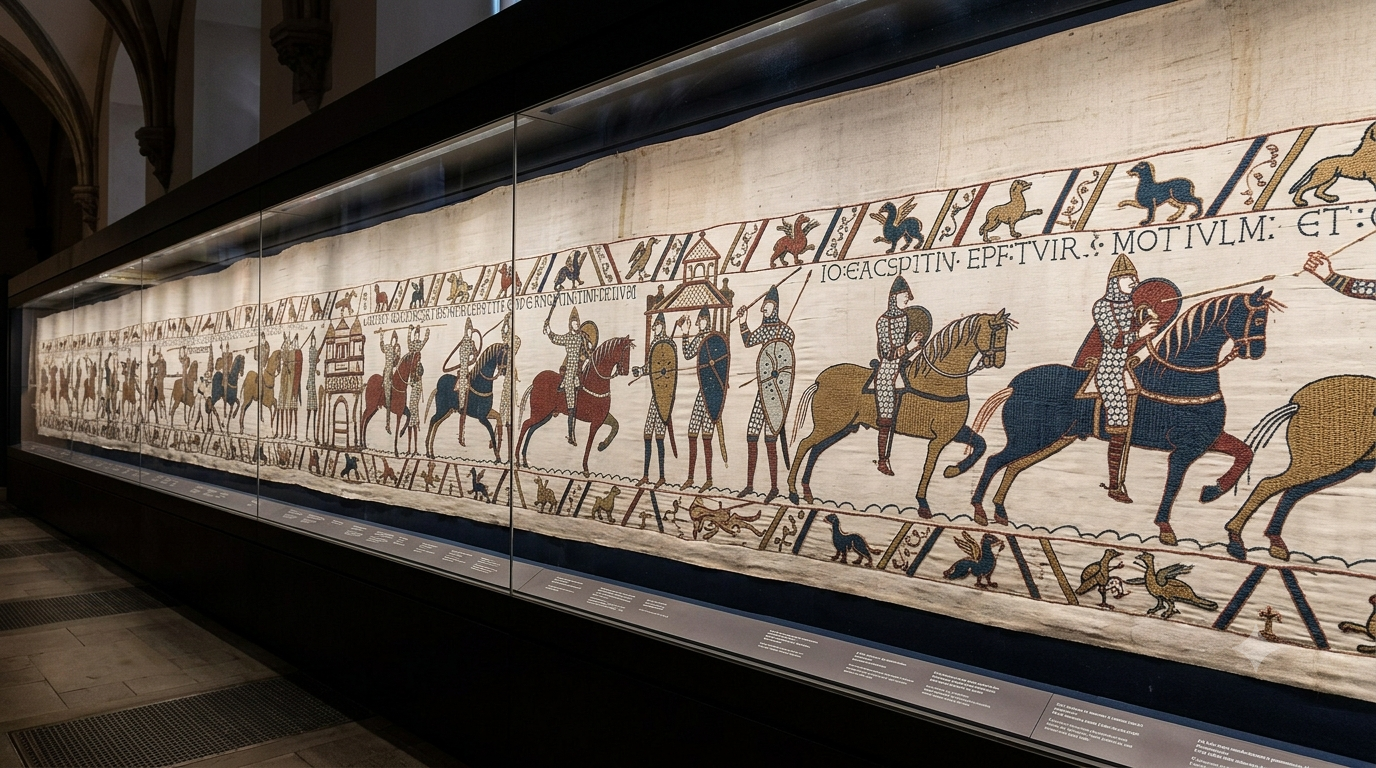
Few historical objects tell a story as vividly as the Bayeux Tapestry. Nearly 1,000 years old, this extraordinary piece of medieval embroidery stretches for almost 70 metres and depicts one of the most consequential events in English history: the Norman Conquest of England in 1066.
In this article
- What Is the Bayeux Tapestry?
- The Story of the Bayeux Tapestry
- Who Was William the Conqueror?
- The Battle of Hastings
- Why Was 1066 So Important?
- Who Made the Bayeux Tapestry?
- How Was the Bayeux Tapestry Made?
- The Bayeux Tapestry Is Filled With Details
- The Mysterious Halley's Comet
- The Strange Animals in the Borders
- Is the Bayeux Tapestry Norman Propaganda?
- The Missing Ending
- How Did the Bayeux Tapestry Survive?
- The Bayeux Tapestry During World War II
- Where Is the Bayeux Tapestry Today?
- Why the Bayeux Tapestry Matters Today
- Bayeux Tapestry: 10 Fascinating Facts
- The Bayeux Tapestry as a Medieval Graphic Novel
- A Historical Story Told by the Victors
- A 1,000-Year-Old Object That Still Has More to Reveal
- Final Thoughts
Rather than being a conventional tapestry, the Bayeux Tapestry is actually an enormous embroidery made with wool thread on linen. Across dozens of scenes, it follows the dramatic events that led to the Battle of Hastings, from the reign of Edward the Confessor and Harold Godwinson’s journey to Normandy to William, Duke of Normandy’s invasion of England and his eventual victory.
But the Bayeux Tapestry is much more than an illustrated account of a medieval battle. It is a window into the world of the 11th century, revealing medieval ships, castles, weapons, clothing, food, animals, religious beliefs and social customs.
It is also a fascinating historical puzzle. Who commissioned it? Where exactly was it made? Why does it tell the story largely from the Norman point of view? And what happened to its missing ending?
Today, the Bayeux Tapestry remains one of the world’s most important surviving medieval artworks and is listed on UNESCO’s Memory of the World Register.
What Is the Bayeux Tapestry?
The Bayeux Tapestry is an embroidered linen cloth that tells the story of the events surrounding the Norman conquest of England in 1066.
Despite its name, it is technically not a tapestry. A tapestry is normally produced by weaving coloured threads into a fabric, whereas the Bayeux Tapestry was created by stitching coloured wool onto linen.
The surviving embroidery is approximately 68.8 metres (225 feet) long and 50 centimetres high. It contains around 58 major scenes, hundreds of human and animal figures, ships, buildings and weapons, along with Latin inscriptions explaining parts of the story. UNESCO describes it as both a historical account and an important documentary source for understanding medieval life.
The artwork is divided into a sequence of scenes rather than individual framed pictures. The result resembles a giant medieval picture book—or, as modern viewers sometimes describe it, a kind of 11th-century graphic novel.
Its central narrative concerns the struggle between Harold Godwinson, who became King of England in January 1066, and William, Duke of Normandy, who claimed that the English throne rightfully belonged to him.
Their conflict culminated in the Battle of Hastings on 14 October 1066, when William’s Norman army defeated Harold’s forces.

The Story of the Bayeux Tapestry
To understand the embroidery, it helps to understand the political crisis that preceded the Norman Conquest.
The story begins during the reign of Edward the Confessor, King of England. Edward had strong connections with Normandy and spent part of his youth there. His lack of a direct heir eventually created a succession crisis.
The Bayeux Tapestry then introduces Harold Godwinson, one of the most powerful men in England.
According to the narrative embroidered into the cloth, Harold travels to Normandy and meets William. At some point, Harold appears to swear an oath to William.
The exact circumstances and meaning of this oath remain controversial.
The Norman interpretation was that Harold had promised to support William’s claim to the English throne. Harold’s later accession therefore gave William a justification for invading England.
After Edward the Confessor’s death in January 1066, Harold was crowned king.
William did not accept this decision.
He gathered an invasion fleet and army in Normandy. The Bayeux Tapestry depicts the preparations in remarkable detail: ships are built, horses are loaded and soldiers cross the English Channel.
The resulting campaign changed English history forever.
Who Was William the Conqueror?
William the Conqueror, originally William, Duke of Normandy, was born around 1028 and became one of the most powerful rulers in medieval Europe.
His claim to the English throne was based partly on his relationship with Edward the Confessor and, according to Norman accounts, Harold’s oath.
William assembled a large invasion force and crossed the English Channel in September 1066.
The Bayeux Tapestry shows the expedition as an enormous military undertaking. Horses are transported aboard ships, soldiers carry shields and weapons, and provisions are loaded for the campaign.
William’s army eventually landed at Pevensey on the south coast of England.
Harold, meanwhile, faced an extraordinary military challenge.
He had already fought and defeated a Norwegian invasion under King Harald Hardrada at the Battle of Stamford Bridge in northern England. Almost immediately afterward, he had to march his exhausted army south to confront William.
The two armies met near Hastings.
The Battle of Hastings
The Battle of Hastings took place on 14 October 1066.
The battle was fought between Harold’s English army and William’s Norman forces. Harold’s troops initially occupied a strong defensive position on high ground.
The Bayeux Tapestry depicts the fighting with astonishing energy.
Mounted Norman knights charge toward the English shield wall. Archers fire into the English ranks. Horses fall beneath their riders. Soldiers fight with swords, spears and shields.
The embroidery does not simply present a clean military victory. It depicts the confusion and brutality of medieval warfare.
One of the most famous scenes shows Harold’s death.
The Latin inscription identifies the event with the words “HIC HAROLD REX INTERFECTVS EST”, meaning approximately, “Here King Harold has been killed.”
Exactly how Harold died has been debated for centuries. The tapestry shows a figure associated with Harold appearing to receive an arrow near the eye, followed by another figure being struck by a sword.
Whether the arrow actually represents Harold’s death or is symbolic remains uncertain.
What is clear is that Harold died during the battle and William’s forces ultimately won.
The Norman victory opened the way for William to become King of England.
Why Was 1066 So Important?
The year 1066 is one of the most famous dates in British history because the Norman Conquest fundamentally transformed England.
William was crowned king at Westminster Abbey on Christmas Day 1066.
The conquest brought major political, social and cultural changes.
Norman rulers replaced much of the existing Anglo-Saxon aristocracy. Norman French became an important language among the ruling classes, while Latin continued to dominate religious and scholarly writing.
The English landscape also changed.
William and his successors constructed numerous castles, churches and administrative buildings. The famous Domesday Book, completed in 1086, was another major instrument of Norman government.
The effects of the conquest extended far beyond William’s lifetime.
English language, architecture, law, aristocratic culture and political institutions were all influenced by the Norman settlement.
The Bayeux Tapestry is therefore more than a record of one battle. It captures the beginning of a transformation that would shape England for centuries.
Who Made the Bayeux Tapestry?
This is one of the greatest mysteries surrounding the Bayeux Tapestry.
The exact identity of its designer, commissioner and embroiderers is not known.
For centuries, the artwork was associated with Bayeux, and tradition suggested that it may have been commissioned by Bishop Odo of Bayeux, William the Conqueror’s half-brother.
Odo was an important figure in Norman England. He participated in the invasion and was present at the Battle of Hastings.
The theory that Odo commissioned the embroidery is plausible because the tapestry appears to contain details that could flatter William’s cause and because Odo held considerable power in both Normandy and England.
However, historians cannot say with absolute certainty that Odo commissioned it.
Another fascinating question concerns where it was actually produced.
Although the Bayeux Tapestry has been preserved in Normandy for centuries, considerable evidence suggests that it may have been embroidered in England, possibly by English craftspeople.
The British Museum describes it as likely commissioned by a Norman patron but made by English embroiderers, potentially drawing on manuscript traditions associated with Canterbury.
This possibility makes the object even more intriguing: an artwork celebrating the Norman conquest may have been physically produced by people from the society that had just been conquered.
How Was the Bayeux Tapestry Made?
Creating the Bayeux Tapestry would have required extraordinary skill.
The main material is linen, while the images were embroidered using coloured wool.
The figures were constructed with relatively simple but highly effective stitches. Artists used outlines and filled areas to create recognizable people, animals, buildings and objects.
The limited colour palette did not prevent the embroiderers from creating a surprisingly expressive narrative.
Faces are simplified, but gestures and body positions communicate emotion and action.
Horses rear, ships sail, soldiers fight and people feast.
The simplicity of the figures is actually part of the artwork’s strength. Viewers can understand the action even without realistic perspective or sophisticated shading.
The Bayeux Museum notes that the embroidery contains approximately 1,500 designs, hundreds of characters and animals, around 200 horses and 50 trees. The surviving work is made from nine successive pieces of linen.
The scenes are accompanied by embroidered Latin text, helping viewers follow the story.
The Bayeux Tapestry Is Filled With Details
One reason historians continue to study the Bayeux Tapestry is that it contains an enormous amount of information about medieval life.
The embroidery shows:
- Medieval ships
- Weapons and armour
- Horses and saddles
- Castles and fortifications
- Feasts and food
- Clothing
- Religious ceremonies
- Agricultural activity
- Medieval architecture
- Military tactics
- Animals and mythical creatures
- Ships crossing the English Channel
Many of these details would be difficult to reconstruct from written sources alone.
For example, the ships provide clues about medieval shipbuilding and naval technology. The weapons and armour help researchers understand how warriors were equipped.
Even apparently minor details can be valuable.
The embroidery therefore functions simultaneously as art, propaganda, storytelling and historical evidence.
The Mysterious Halley’s Comet
One of the most famous images in the Bayeux Tapestry is a strange celestial object appearing in the sky.
The object is generally interpreted as Halley’s Comet, which was visible in the spring of 1066.
The appearance of the comet is important because medieval people often interpreted unusual astronomical events as signs or omens.
In the embroidery, people appear to react with alarm to the phenomenon.
Its inclusion helps establish the atmosphere of uncertainty surrounding England’s political crisis.
It also demonstrates how the artists incorporated contemporary events into the narrative.
The Bayeux Museum identifies the celestial object as Halley’s Comet and includes it among the notable details that can be explored in the tapestry’s high-resolution digital version.
The Strange Animals in the Borders
If you look closely at the Bayeux Tapestry, the central story is not the only thing happening.
The upper and lower borders contain an extraordinary collection of animals and other figures.
There are horses, dogs, birds and lions, along with mythical creatures and scenes that appear unrelated to the main military narrative.
Some images may simply be decorative. Others may have symbolic or narrative significance.
Scholars have suggested connections between some of these scenes and medieval fables, including stories associated with Aesop.
The borders make the tapestry particularly fascinating because they encourage viewers to look beyond the obvious story.
While kings, knights and battles dominate the central narrative, the borders provide glimpses of another medieval visual world.
Is the Bayeux Tapestry Norman Propaganda?
Perhaps the most important question to ask when studying the Bayeux Tapestry is whether it should be considered propaganda.
The answer is complicated.
The narrative clearly presents William’s invasion from a perspective sympathetic to the Norman claim.
Harold is shown swearing an oath to William, and William’s invasion is presented as the culmination of a political dispute.
The embroidery does not tell the story from the perspective of the conquered English population.
This makes it tempting to describe the work as Norman propaganda.
However, the tapestry is more nuanced than a simple propaganda poster.
Harold is not portrayed as a cartoon villain. He is shown participating in important events, exercising authority and fighting bravely.
The artwork also contains moments of humour, tragedy and everyday life.
The destruction and human cost of warfare are visible.
This complexity is one reason historians continue to debate how the tapestry should be interpreted.
It may have been created to support the Norman claim to England, but its visual narrative is sophisticated enough to leave room for multiple interpretations.
The Missing Ending
One of the biggest mysteries of the Bayeux Tapestry is that it does not survive in its complete original form.
The surviving embroidery ends shortly after the Battle of Hastings.
The story does not show William’s coronation or the full aftermath of the Norman victory.
This missing ending has led to centuries of speculation.
Was the final section deliberately removed?
Was it lost through damage?
Did it ever exist?
No one knows for certain.
The missing portion is particularly frustrating because the tapestry’s surviving narrative seems designed to lead naturally toward William’s victory and coronation.
If an original ending did exist, it could have contained some of the most historically important scenes in the entire story.
How Did the Bayeux Tapestry Survive?
The survival of the embroidery for nearly a millennium is remarkable.
Over the centuries, it experienced numerous threats.
Historical records indicate that it was associated with Bayeux Cathedral, where it was displayed on particular occasions.
A 15th-century inventory records the embroidery among the cathedral’s possessions. According to the Bayeux Museum, it remained connected with the cathedral for roughly seven centuries.
The tapestry survived political upheaval and the French Revolution.
During the revolutionary period, it reportedly came close to being cut up for practical use, although the details of the famous rescue story have become part of the object’s mythology.
It was eventually protected as an important national historical artifact.
The tapestry was formally classified as a French historical monument in 1862 and was added to UNESCO’s Memory of the World Register in 2007.
Its survival is extraordinary considering how fragile textiles normally are.
The Bayeux Tapestry During World War II
The embroidery faced another dangerous period during the Second World War.
Because of its historical and symbolic significance, the tapestry became an object of interest to Nazi officials.
It was moved and protected during the war to prevent its destruction or seizure.
Its survival through the Second World War added another chapter to an already remarkable history of escapes from danger.
The Bayeux Museum describes the tapestry as having experienced multiple moments when it was at serious risk of damage or destruction.
Where Is the Bayeux Tapestry Today?
The answer is slightly unusual as of 2026.
For centuries, the Bayeux Tapestry was associated with Bayeux in Normandy, France.
However, the Bayeux Museum is currently undergoing major renovation. The museum is scheduled to reopen in 2027.
As part of an historic loan agreement between France and the United Kingdom, the tapestry is being displayed at the British Museum in London from September 2026 until July 2027.
This is particularly significant because it is the first time the nearly 1,000-year-old embroidery has returned to England since it was created.
For visitors interested in seeing the original during this period, the British Museum exhibition offers an extraordinary opportunity to view one of Europe’s most famous medieval objects in the country whose conquest it depicts.
After the loan, the tapestry is expected to return to Bayeux for the reopening of its renovated museum.
Why the Bayeux Tapestry Matters Today
The Bayeux Tapestry has survived because it is much more than an old piece of fabric.
It is simultaneously:
A historical document: It records the events surrounding one of the most important invasions in English history.
A work of art: Its composition, embroidery and storytelling remain extraordinary.
A political document: It reveals how the Norman conquest could be presented from the conqueror’s perspective.
A record of medieval life: Its details provide evidence about clothing, ships, weapons, buildings and customs.
A storytelling experiment: Its sequence of images resembles forms of visual storytelling that remain familiar today.
A historical mystery: Its exact origins, patronage, missing ending and intended meaning continue to generate debate.
UNESCO describes the Bayeux Tapestry as a unique documentary record with no directly comparable surviving work. Its significance comes not only from its historical subject but also from its unusual combination of narrative, symbolism and visual information.
Bayeux Tapestry: 10 Fascinating Facts
- It is not technically a tapestry. It is an embroidery made with wool thread on linen.
- It is nearly 70 metres long. UNESCO records its length as approximately 68.8 metres.
- It depicts the events surrounding the Norman Conquest of England in 1066.
- The Battle of Hastings is its dramatic climax.
- William the Conqueror is one of its central figures.
- Harold Godwinson’s death is depicted near the end of the surviving narrative.
- Halley’s Comet appears in the embroidery.
- The artwork contains hundreds of people and animals and around 200 horses.
- Its original creator and exact commission remain uncertain.
- It was added to UNESCO’s Memory of the World Register in 2007.
The Bayeux Tapestry as a Medieval Graphic Novel
Perhaps the most interesting way to appreciate the Bayeux Tapestry today is to think of it as a form of medieval visual storytelling.
Modern audiences are accustomed to comics, graphic novels, storyboards and animated films.
The Bayeux Tapestry uses some surprisingly similar principles.
It moves from one scene to another.
Characters recur throughout the narrative.
Text identifies important people and events.
Action is conveyed through movement and composition.
Major moments are emphasized visually.
The viewer’s eye travels across the cloth, reconstructing the story as it goes.
Of course, the embroidery was created in a completely different cultural environment from modern comics.
Yet its basic storytelling power remains remarkably accessible.
You do not need to be an expert in medieval history to understand what is happening when a fleet of ships crosses the sea or when mounted soldiers charge an opposing army.
That is one of the reasons the Bayeux Tapestry has remained so powerful for almost a thousand years.
A Historical Story Told by the Victors
There is also an important lesson hidden within the Bayeux Tapestry.
History is rarely neutral.
The people who create historical records decide what to show, what to emphasize and what to leave out.
The Bayeux Tapestry gives considerable attention to William’s claim and Harold’s oath. It does not provide an equally detailed account of how the English population experienced the conquest.
This does not make the tapestry useless as historical evidence.
Quite the opposite.
Its biases are themselves historically valuable.
By examining what the embroidery chooses to show, historians can learn about how the Norman ruling class wanted the events of 1066 to be understood.
The tapestry therefore tells us two stories at once.
It tells us about what happened in 1066, and it tells us about how people wanted those events to be remembered.
A 1,000-Year-Old Object That Still Has More to Reveal
Perhaps the most remarkable thing about the Bayeux Tapestry is that, despite centuries of study, it still contains unanswered questions.
We do not know exactly who designed it.
We do not know with certainty who commissioned it.
We continue to debate where every part of it was produced.
We do not know exactly why certain scenes appear in the borders.
We do not know what happened to the missing ending.
And we cannot always determine precisely what the artists intended particular images to mean.
Yet those mysteries are part of the tapestry’s appeal.
The embroidery has survived wars, revolutions, political upheaval and the passage of almost a thousand years.
Its colours, stitches and figures continue to tell the story of a pivotal moment when the fate of England was decided on a battlefield in southern England.
Final Thoughts
The Bayeux Tapestry is one of the rare historical objects that can be appreciated simultaneously as art, evidence and storytelling.
It brings the events of 1066 to life in a way that few written chronicles can match.
Through its embroidered scenes, we see Harold Godwinson, William the Conqueror, medieval soldiers, ships crossing the Channel, Norman cavalry, English warriors, feasts, castles, animals and even a mysterious comet appearing in the sky.
But its greatest value may lie in its imperfections and unanswered questions.
The tapestry does not give us an objective account of the Norman Conquest. It gives us a carefully constructed version of history, probably created in the generation after the conquest and shaped by the politics and culture of its time.
That makes it even more fascinating.
Almost 1,000 years after the events it depicts, the Bayeux Tapestry still asks us to look closely—not only at the battle, the kings and the conquerors, but also at the people who created the story and the society they wanted future generations to remember.
And perhaps that is why this extraordinary strip of linen continues to fascinate us.
The Norman Conquest lasted days.
The story embroidered into the Bayeux Tapestry has lasted nearly a millennium.

Team Random Read
Random Read is an independent general-interest blog covering history, current affairs, nature, psychology, science and pop culture. About us
More like this

Historical Myths Debunked: 15 Popular “Facts” Everyone Gets Wrong.
History is full of extraordinary stories. Some are so memorable that they become part of popular culture: Julius Caesar was born by…

5 Everyday Inventions That Were Total Accidents (Including Microwave Ovens & Post-it Notes)
We like to imagine that great inventions are born from brilliant minds following carefully drawn plans. A scientist develops a theory. An…
The Unsolved Mystery of the Oak Island Money Pit: 200 Years of Traps and Theories.
Off the coast of Nova Scotia sits a small, unremarkable, oak-covered island that has swallowed more money than most of the treasure…