The Real History Behind Halloween Traditions: From Samhain Bonfires to Carved Pumpkins
 By Team Random Read
15 min read
Quick answer
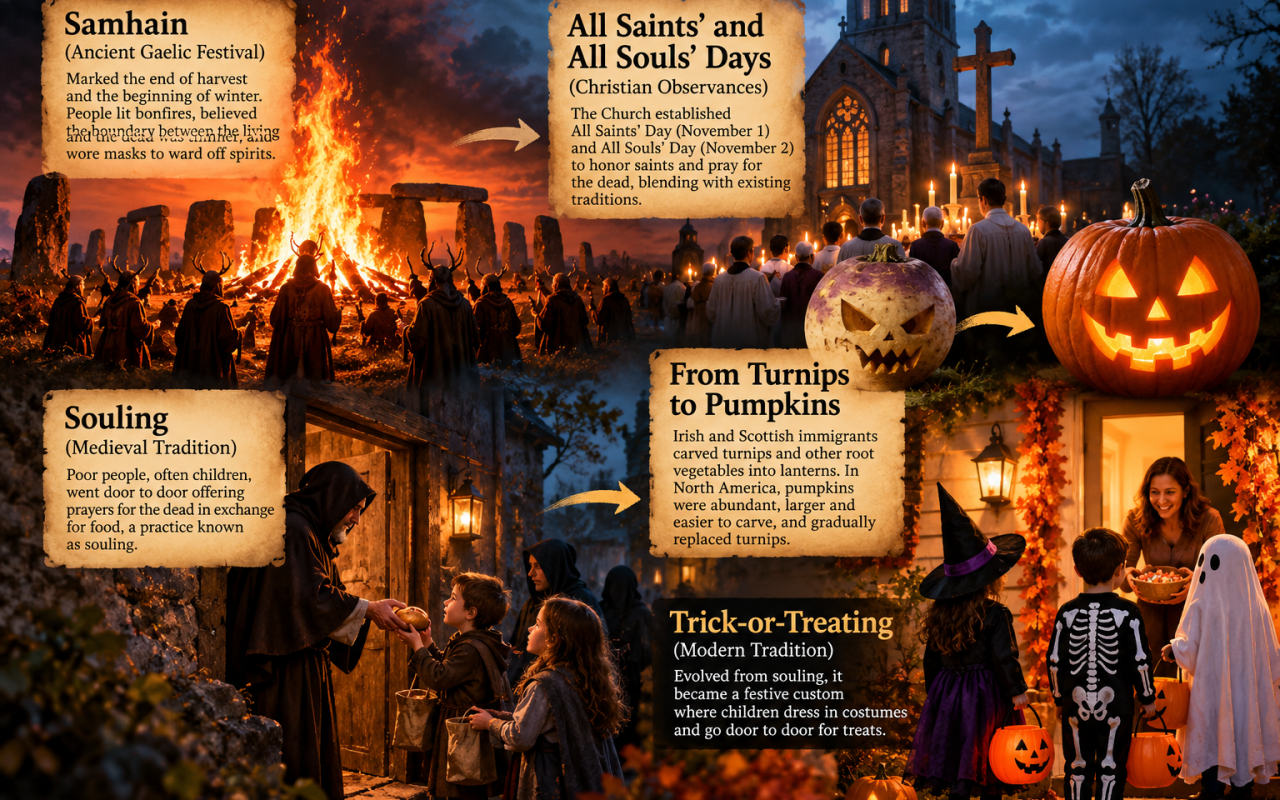
Halloween grew from the Gaelic festival of Samhain, marking the end of harvest, blended with the Christian All Saints' and All Souls' observances. Trick-or-treating descends from medieval souling, and pumpkins replaced carved turnips when Irish and Scottish immigrants found them abundant in North America.
In this article
- Quick answer
- Key takeaways
- What Was Samhain? The Celtic Festival at the Heart of Halloween
- What the Early Texts Actually Say
- Did the Druids Really Invent Halloween? Separating Fact from Myth
- How the Nineteenth Century Filled the Silence
- How Christianity Reshaped the Night: All Saints' and All Souls'
- From All Hallows' Eve to Halloween
- Souling and Guising: Where Trick-or-Treating Really Comes From
- Guising, Mumming, and the Power of a Disguise
- Crossing the Atlantic
- What We Know and What We Assume
- Turnip Lanterns in the Old Country
- The Pumpkin Takes Over
- How Halloween Became a Modern Holiday
- The Shape of the Modern Night
- The Long Night Still Glows: What Halloween's History Teaches Us
- Frequently asked questions
Key takeaways
• Halloween blends the Gaelic festival of Samhain with the Christian feasts of All Saints' and All Souls'.
• Samhain is well attested in medieval Irish texts, but how much of it was ancient pagan practice is debated by historians.
• Trick-or-treating descends from souling, guising and similar customs of begging and performing for treats, later popularized in North America.
• Turnips and other root vegetables were carved into lanterns in Ireland and Britain before pumpkins took over.
• The story of Halloween shows traditions are rarely invented once; they are continually reshaped by migration and local culture.
The porch light flickers, and a small figure in a bedsheet ghost costume lifts a fist to knock. Behind her, the October wind rattles dry leaves down the street, and somewhere a jack-o'-lantern grins from a neighbor's step. The door creaks open. "Trick or treat!" she calls, and the whole strange, delightful ritual of Halloween begins again, just as it has for generations.
But rewind far enough, and that doorway looks very different. The child becomes a costumed wanderer reciting verses for a bit of food. The candle behind the pumpkin's grin becomes a flame inside a hollowed turnip. The chill in the air carries the smell of smoke from autumn fires, and the dead feel unusually close.
So how did a harvest-end festival, a medieval prayer for the dead, and a glowing turnip merge into the Halloween we know today? The answer winds through Celtic fields, Christian calendars, village customs, and the pockets of immigrants crossing the Atlantic. Some of the story is well documented, some is tangled in legend, and all of it is stranger than the candy-filled version suggests.
What Was Samhain? The Celtic Festival at the Heart of Halloween
Picture a hillside in Ireland as the last days of October close in. The summer grazing is over. Cattle, sheep, and pigs are driven down from upland pastures, and the herders count what the year has left them. Some animals will be kept for breeding, and others will be slaughtered so there is meat to last through the dark months. The light fades earlier each evening. This was the moment the Gaelic world called Samhain, the hinge between the farming year and the winter half.
The name is usually linked to the Old Irish samain, and in modern Irish the month of November is still Samhain. Gaelic tradition divided the year into a bright half and a dark half, and Samhain, around 1 November, opened the dark one. Its counterpart, Beltaine, opened the summer half in early May. Many scholars see Samhain as the most important of the four seasonal markers, along with Imbolc, Beltaine, and Lughnasadh.
What the Early Texts Actually Say
Our evidence comes mostly from medieval Irish literature, written down by Christian monks centuries after the events they describe. Samhain turns up repeatedly in these stories, and it is often a time when ordinary rules loosen. In tales such as Tochmarc Emire and the Ulster Cycle, it is a season of gatherings, and in many stories supernatural events cluster around it. The otherworld, often imagined as sídhe mounds, seems to open, and strange visitors cross over.
Other sources point to a real, practical festival. Medieval texts associate Samhain with a great assembly at the Hill of Tara, called the Feast of Tara in some accounts, where kings, nobles, and their followers met to settle disputes and affirm obligations. Tradition also links the season with the lighting of ceremonial fires, most famously on the Hill of Ward (Tlachtga) in County Meath. Feasting, farm business, and the new season's rents and agreements all appear to have been tied to the date.
It helps to be careful here. The texts are literary, not eyewitness reports. They were shaped by Christian authors, and they describe an older world through a later lens. So we can say with confidence that Samhain was a major date in the Gaelic calendar, marked by gathering, feasting, and a sense that boundaries grew thin. Claims about specific pagan rituals, however, rest on much shakier ground, a problem the next section takes up directly.
Did the Druids Really Invent Halloween? Separating Fact from Myth
Ask almost anyone online where Halloween comes from, and a confident story appears: white-robed Druids lit sacred fires on the last night of October, honored Samhain, the Celtic lord of the dead, and called up the spirits of the departed. It is a gripping picture. It is also built on very little.
Start with the god. Popular writing often names "Samhain" as a deity who judged the dead. No surviving medieval Irish text describes such a figure. In the sources we have, Samhain is the name of a season and a festival, not a god. The idea of a lord of the dead called Samhain appears to have been a later invention, and it spread through repetition rather than evidence.
The Druids are a harder case. Greek and Roman authors, including Julius Caesar, wrote about Druids in Gaul and Britain, and they mention rituals, learning, and sacrifice. But these writers were outsiders, often with political motives, and none of them links the Druids to a festival called Samhain. The Irish texts that do mention Samhain were written down centuries later by Christian monks. Between the Druids of the classical accounts and the Samhain of the manuscripts lies a gap that no one has been able to bridge with firm documents. The Druids left no writings of their own.
How the Nineteenth Century Filled the Silence
Where evidence runs thin, imagination tends to rush in, and in the 1700s and 1800s it did so eagerly. Antiquarians and amateur scholars were captivated by the "ancient Celts," and many treated folk customs as fossils of a lost pagan religion. Several habits shaped the story:
• Stonehenge fantasies. Writers such as John Aubrey and William Stukeley linked Druids to prehistoric monuments, though those monuments were built long before any known Druids.
• Romantic nationalism. As Ireland, Scotland, and Wales searched for distinctive national pasts, a mystical Celtic heritage was appealing.
• Folklore as relic. Collectors assumed that any odd rural custom must be a survival from pagan times, even when no chain of evidence connected the two.
The Victorian era gave us the sacrificial bonfire, the robed priest, and the solemn night of the dead, all of it more theatrical than documented. Later popular books and websites copied these claims, often without checking where they began.
None of this means Samhain was unimportant or that old beliefs played no part. Historians simply ask for the line between source and claim. What survives is a real festival, a real sense of thinning boundaries, and a great deal of later embroidery.
How Christianity Reshaped the Night: All Saints' and All Souls'
If Samhain gave Halloween its sense of a threshold, the medieval church gave it a calendar, a vocabulary, and a set of rituals. The story is less a conquest than a slow layering, in which Christian feasts settled into a season already crowded with harvest customs and beliefs about the dead.
The first layer was All Saints' Day, a feast honoring all the martyrs and saints, known and unknown. Its roots go back to the early centuries of the church, when communities remembered martyrs on set days. A familiar tradition holds that Pope Gregory III (731-741) dedicated a chapel to all saints in St. Peter's in Rome and linked the feast to 1 November. Over time, the observance spread across Western Europe, and by the ninth century it was widely kept on that date.
The evening before a major feast was itself part of the celebration, a vigil of prayer. That vigil was All Hallows' Eve, the night of 31 October. "Hallow" is an old English word for a holy person or saint, and "All Hallows" simply meant All Saints.
From All Hallows' Eve to Halloween
The word Halloween is a worn-down form of that phrase. "All Hallows' Eve" became "All Hallow Even," then was contracted in Scots speech to "Hallowe'en," and eventually lost its apostrophe in common modern spelling. "Even" is an old poetic word for evening, which is why the name preserves a trace of medieval English.
The second layer was All Souls' Day on 2 November. The practice is often credited to Abbot Odilo of Cluny, who around the year 998 urged his monasteries to pray for all the faithful departed. The idea spread widely. Medieval Christians believed that prayers, Masses, and charitable gifts could help souls undergoing purification after death, so the day carried real emotional weight for families.
Bells were central to this. Parish churches rang them through the night of All Saints' and into All Souls' to call for prayers for the dead. In parts of England and Europe, the custom lasted for centuries, and bell-ringers were sometimes rewarded with food or drink. The sound turned the whole village into a community of mourners, remembering those who had no one else to pray for them.
This is where overlap becomes plausible. Early November already marked the end of the farming year, when stores were counted and winter loomed. Placing feasts of remembrance there gave older seasonal habits a Christian frame. Bonfires, gatherings, and food for the dead could continue under new meanings. How much was deliberate adaptation and how much was coincidence of timing is hard to prove, but the pattern of fire, bells, prayer, and food set the stage for what came next.
Souling and Guising: Where Trick-or-Treating Really Comes From
Picture a cold November evening in sixteenth-century England. Children and poor adults trudge from door to door, knocking and singing for small round cakes. In return, they promise to pray for the household's dead. This was souling, and it is the earliest ancestor of trick-or-treating that we can point to with some confidence.
The soul cake itself was a modest spiced bun, sometimes marked with a cross. Records and folk accounts place the custom around All Souls' Day, 2 November, in parts of England, and a related practice appears in other parts of Europe. A seventeenth-century verse tradition survives in the song "A Soul Cake," whose refrain asks for "a soul cake" in exchange for prayers. The logic was a bargain: food for the living, intercession for the dead. Documentation is real here, though much of it is scattered, and the precise age of the custom is debated.
Guising, Mumming, and the Power of a Disguise
A second thread comes from disguise. In Scotland and Ireland, people went guising around Halloween, wearing masks or costumes and performing songs, jokes, or recitations for treats. Written accounts from Scotland describe such guising by the late nineteenth century, and the practice of performing for a reward is central: the visitor earned the gift.
Mumming is a cousin of this tradition. Mummers were costumed performers who staged short folk plays or visited houses at festive seasons, most famously around Christmas. Because the plays were tied to other times of year, linking them directly to Halloween is a matter of resemblance rather than proof. The shared elements, though, are striking: disguise, performance, house-to-house visits, and a reward.
Crossing the Atlantic
Irish and Scottish immigrants carried Halloween customs to North America, especially in the nineteenth century. Yet early American Halloween was often more mischief than sweets, with pranks, gate-lifting, and rowdy neighborhood tricks. The phrase "trick or treat" appears in print in North America in the 1920s and 1930s, and by the late 1940s and 1950s the practice had become a widely recognized children's ritual, helped along by community organizers seeking to steer youthful mischief into safer fun.
What We Know and What We Assume
• Documented: soul-cake begging in England, guising in Scotland and Ireland, and the printed rise of "trick or treat" in the twentieth century.
• Assumed: a direct, unbroken line from these customs to modern trick-or-treating, and any claim that souling descends from pre-Christian practice.
The likeliest story is a blending of streams rather than a single inheritance. Prayers for the dead, performed disguise, and neighborhood mischief all fed a custom that took its final shape in American suburbs.
Why Do We Carve Pumpkins Instead of Turnips?
Long before anyone scooped seeds from a pumpkin, a trickster named Jack was said to wander the Irish countryside with a glowing coal. The folktale of "Stingy Jack" survives in several versions, but the bones of it are consistent. Jack was a miserly drunk who tricked the Devil, once by persuading him to climb a tree and then carving a cross into the trunk so he could not come down. Jack freed him only after extracting a promise that the Devil would never claim his soul.
When Jack died, the story goes, heaven refused him because of his wicked life, and hell refused him because of the Devil's promise. Cast into the dark between the two, he begged for light. The Devil tossed him an ember from the fires of hell, and Jack tucked it inside a hollowed-out turnip, the vegetable he happened to be carrying. He has drifted ever since, a restless figure known as "Jack of the Lantern," or Jack-o'-lantern.
Turnip Lanterns in the Old Country
The tale gave a name to a real custom. In parts of Ireland, Scotland, and England, people hollowed out turnips, mangelwurzels, and other root vegetables, carved rough faces into them, and set a candle or coal inside. Carrying one through the dark was practical, and on autumn nights it also suited the eerie mood of the season. Such lanterns are documented in the nineteenth century, though the exact age of the custom is harder to pin down. Anyone who has tried to carve a turnip will understand why: the flesh is dense and stubborn, and the work is hard on the wrists.
The Pumpkin Takes Over
Irish and Scottish immigrants who arrived in North America, especially after the Great Famine of the 1840s, brought their lantern customs with them. They found a native crop that suited the job far better. Pumpkins were plentiful, cheap, and ripe in the fall, just when the festivities called for them.
The qualities that made the pumpkin ideal are easy to list:
• Size: a large pumpkin offers a broad surface for expressive faces.
• Soft flesh: the walls cut with a knife far more easily than a turnip's.
• Hollow interior: a mass of seeds and strings scoops out, leaving room for a candle.
• Timing: the harvest arrives right as Halloween approaches.
The jack-o'-lantern gradually shed its link to the old tale and became a seasonal emblem of its own, a grinning face glowing on porches across the country.
How Halloween Became a Modern Holiday
For most of the nineteenth century, Halloween in North America was a patchwork. Scottish and Irish immigrants carried their divination games, bonfires, and ghost stories across the Atlantic, and the largest wave arrived after the Irish famine of the 1840s. In rural farmhouses, young people bobbed for apples, roasted nuts in the hearth, and tried to glimpse a future spouse in a mirror. Each region kept its own version of the night, and none of them looked much like the holiday we know now.
By the late 1800s, the night had also acquired a rowdier reputation. Gangs of young people treated the evening as license for mischief: unhinging gates, tipping over outhouses, soaping windows, and hauling wagons onto rooftops. In some towns the pranks escalated into real vandalism. By the early twentieth century, civic leaders, schools, and parent groups were pushing back, hoping to steer the energy of the night toward something safer.
Their answer was to move Halloween indoors and into the neighborhood. Community parties, school pageants, and parades gave young people an organized outlet, and magazines and publishers encouraged themed gatherings with decorations, games, and refreshments. The holiday was slowly becoming a children's celebration rather than a night of pranks.
Commerce followed quickly. Companies began producing Halloween postcards, paper decorations, and party goods in the early 1900s. Store-bought costumes appeared in the following decades, offering an alternative to homemade disguises stitched from old clothes. Door-to-door requests for treats were reported in North America in the 1920s and 1930s, and the practice spread widely after World War II, when a booming population of children and suburban neighborhoods made it easy to walk from house to house. Candy makers saw the opportunity, and individually wrapped sweets became the standard handout.
The Shape of the Modern Night
• Costumes: Witches, ghosts, and skeletons gave way over time to cartoon characters, film heroes, and whatever the year's popular culture offered.
• Candy: Wrapped treats replaced homemade goods such as popcorn balls and baked items, which many families came to view with caution.
• Community: Trunk-or-treat events, school parades, and organized neighborhood routes keep the emphasis on shared, supervised fun.
Halloween has also traveled well beyond North America. American films, television shows, and merchandise carried the holiday abroad, and in many countries it has been adopted in whole or in part, often blended with local traditions. Costume parties, themed events, and decorated shop windows now appear in places where the holiday had little history a few generations ago. A festival that began with bonfires and wandering spirits has become a worldwide celebration of imagination, still carrying traces of its older roots.
The Long Night Still Glows: What Halloween's History Teaches Us
Follow Halloween back far enough and you find a pattern: nothing about it arrived whole. A Celtic festival marking the turn toward winter met a Christian calendar of saints and souls. Door-to-door begging for soul cakes gave way to costumed guising. Carved turnips yielded to pumpkins. Each generation borrowed, blended, and reshaped what it inherited, and the holiday survived precisely because it kept changing.
That may be the quiet lesson of the Halloween story. Traditions are not museum pieces sealed behind glass; they are fires passed from hand to hand, burning a little differently each time. So when you light a jack-o'-lantern this year, ask yourself: which part of what you celebrate will someone carry forward, and what will they make of it?
Frequently asked questions
Is Halloween really an ancient Celtic festival?
Partly. Samhain was a Gaelic festival marking the start of winter, and it appears in early medieval Irish literature. Historians debate how ancient its specific rituals were, and modern Halloween also draws heavily on Christian observances and later folk customs.
What is Samhain?
Samhain is a Gaelic festival held around 31 October to 1 November, marking the end of the harvest season and the start of the darker half of the year. Medieval Irish sources link it with gatherings, feasting, and a sense that boundaries between worlds grew thin.
What is souling and how is it linked to trick-or-treating?
Souling was a medieval and later British custom in which the poor went door to door around All Souls' Day, offering prayers for the dead in exchange for soul cakes. Its begging-for-treats pattern is one of the ancestors of trick-or-treating.
Why did people carve turnips before pumpkins?
In Ireland, Scotland, and parts of Britain, turnips and similar root vegetables were plentiful and were hollowed out as lanterns, tied to folk tales like Stingy Jack. Immigrants to North America found pumpkins larger, softer, and easier to carve, so they switched.
When did trick-or-treating become popular in America?
Door-to-door Halloween begging was documented in North America in the early twentieth century, and the phrase trick or treat appeared in print by the 1920s and 1930s. It became widespread after the Second World War as a family-friendly neighborhood tradition.

Team Random Read
Random Read is an independent general-interest blog covering history, current affairs, nature, psychology, science and pop culture. About us
More like this

Why Gaming Is the New Way Gen Z and Millennials Make Real Friends
Picture this: two people on opposite sides of the world, one in Lagos and one in Manila, staying up past midnight to…

Move Over, Keto: Why “Fibermaxxing” Is Taking Over Your Feed
Every few years, a new diet trend explodes onto social media and dominates the wellness conversation. We've seen keto, intermittent fasting, carnivore…
The Psychology Behind Why We Love Watching Disasters Unfold
You are driving down the highway, and traffic suddenly grinds to a halt. For twenty minutes, you inch forward, frustrated, assuming there…