TL;DR: Beneath most forests, tree roots are linked to fungi in a partnership that’s hundreds of millions of years old. Some researchers say this “Wood Wide Web” lets trees share food, send warnings, and even nurture their young. Others say those claims have been oversold. The fungi and the trading are real. Whether forests function as caring, communicating communities is still being debated.
A Forest That Looks Like a Family
Imagine walking through an old forest. Tall trees stand with their canopies touching, and young seedlings sprout in the shade. A popular story says that below your feet, the trees are connected by a vast network of fungal threads. Through it, old “mother trees” send sugar to their seedlings, sick trees pass on warnings, and the forest behaves like one cooperative organism.
It’s a beautiful idea. It has shaped books, documentaries, and even Hollywood plots. But how much of it is proven science, and how much is wishful thinking? Let’s dig in.
Where the Idea Came From
The story begins in the 1990s with Canadian forest ecologist Suzanne Simard. In a 1997 paper in Nature, she and her colleagues tracked carbon between trees in a British Columbia forest by labeling it with isotopes. They found that carbon moved between birch and Douglas fir trees, and that fungi were likely the carrier. The journal’s cover headline gave the finding a catchy name: the “Wood Wide Web.”
Simard later argued that large, old trees act as hubs, which she called “mother trees,” that support the seedlings around them. Her 2021 book Finding the Mother Tree brought the idea to a mass audience. Another bestseller, Peter Wohlleben’s The Hidden Life of Trees, popularized similar ideas, and Richard Powers’ Pulitzer-winning novel The Overstory featured a scientist widely seen as inspired by Simard’s work.
The Science That Is Solid: Mycorrhizae
Here’s the part nobody disputes. Around 90% of land plant species form partnerships with fungi called mycorrhizae (from the Greek for “fungus roots”). Fungal threads, called hyphae, wrap around or enter plant roots. They’re much finer than roots, so they reach far more soil.
The deal is a straightforward trade:
- The fungus supplies water and nutrients such as phosphorus and nitrogen.
- The plant supplies sugars made by photosynthesis.
This partnership is ancient. Fossil evidence suggests it may have helped plants colonize land hundreds of millions of years ago. A teaspoon of healthy forest soil can contain kilometres of fungal threads.
There are two main types:
- Ectomycorrhizal fungi partner with trees such as pines, birches, oaks, and beeches. They form a sheath around the root tip.
- Arbuscular mycorrhizal fungi partner with maples, cedars, many tropical trees, and most crops. They penetrate root cells.
A single fungus can link several plants at once, forming what scientists call a common mycorrhizal network (CMN). That’s the “web” in “Wood Wide Web.”
Proven Oddballs: Plants That Live Off Fungi
There’s one case where carbon moving through fungi from tree to plant is well established: plants that don’t photosynthesize.
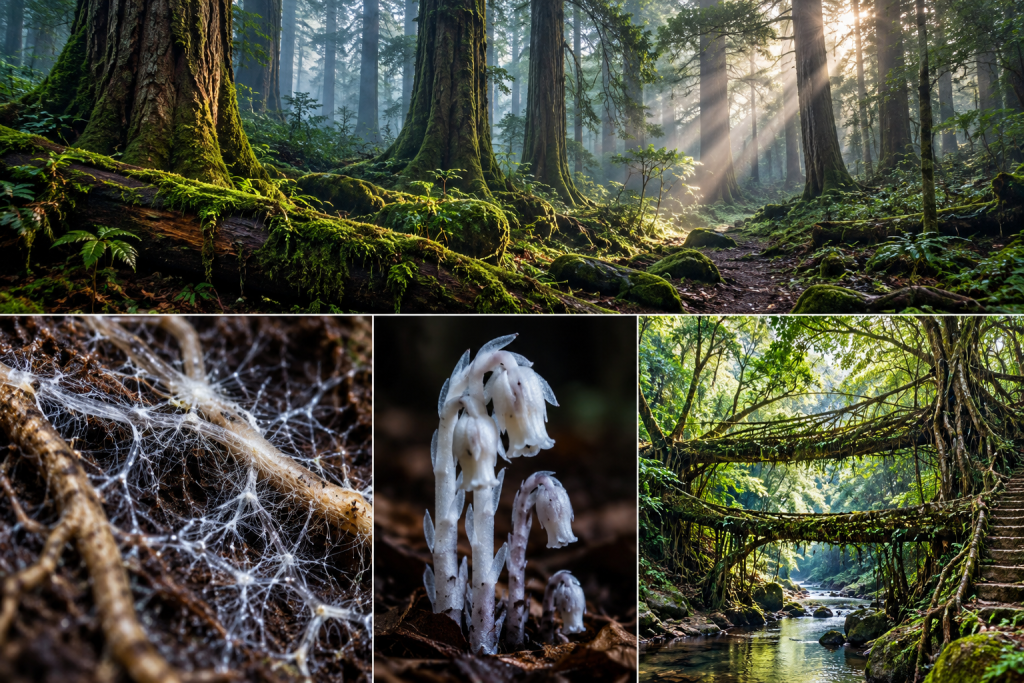
The ghost pipe (Monotropa uniflora) is a ghostly white plant with no chlorophyll. It can’t make its own food. Instead, it taps into fungi that are linked to nearby trees and takes carbon from them. Many orchids do something similar, and their dust-like seeds depend on fungi to germinate at all.
So the network can move carbon between plants. The open question is whether this matters for regular, green trees and whether it’s deliberate.
The Big Claims, and the Evidence
Three claims drive the popular “forest as family” story. Let’s test each.
Claim 1: Trees share food through the network
What supports it: Simard’s isotope experiments and others have shown that carbon can move between plants connected by fungi. Some studies have found that shaded seedlings linked to larger trees survive better, especially in dry conditions.
What complicates it: Carbon in the soil doesn’t necessarily move for the benefit of the receiving tree. Fungi take plenty of carbon for themselves and may hold much of it. Other field studies, including one in a Swiss forest, found little clear evidence of net carbon sharing between mature trees. In addition, many experiments were done in greenhouses, where conditions are simplified and the results may not match real forests.
Claim 2: Mother trees nurture their own offspring
What supports it: Some experiments suggest Douglas fir seedlings may do better when growing near related mature trees.
What complicates it: Critics say the evidence for kin-favoring is thin, and that it’s hard to prove a tree is “choosing” anything. Trees have no brains or intent. Competition, not kindness, may explain much of what looks like cooperation.
Claim 3: Trees warn each other of danger
What supports it: In lab studies, plants connected through fungi responded to an infected neighbor by switching on defense genes. Tomato plants did this when a neighbor was attacked by a fungal disease, and bean plants did it after aphid attacks.
What complicates it: Plants also release airborne chemicals when damaged, and neighbors can detect them. So when a neighbor responds to a stressed plant, it’s hard to tell whether the message traveled through the soil or the air. Both routes exist, and the airborne signals are among the better-supported findings in plant ecology.
The Scientific Pushback
In 2023, a group of forest ecologists published a high-profile critique in Nature Ecology & Evolution. They argued that popular claims about the Wood Wide Web had outrun the evidence. Their concerns included:
- A tendency for papers to cite supportive studies more than critical ones.
- Greenhouse results being presented as if they described wild forests.
- Interesting but limited findings turned into broad statements, such as “forests are cooperative superorganisms.”
Simard and her supporters have defended her work, pointing out that field experiments in forests are difficult and that the evidence for these networks keeps growing. The debate is ongoing and, in good scientific tradition, a bit messy.
A fair summary: the fungal networks exist, and resources and chemical signals can pass through them. What’s unproven is how much that matters, how often it happens, and whether it’s cooperation or just chemistry.
What About “Communication”?
The word “talk” is where things get slippery. Humans communicate with intent. When a tree’s roots leak sugar into a fungus or its leaves release a chemical, there’s no evidence that the tree “means” anything by it.
Think of it as information transfer rather than conversation. A plant releases a chemical when damaged. Another plant picks it up and prepares its defenses. Both are real, measurable biological processes. But they’re closer to a smoke alarm than to a chat.
An Indian Connection: Roots That Connect
India has some of the world’s best examples of connected trees, though not through fungi.
- Living root bridges of Meghalaya. The Khasi and Jaintia communities guide the aerial roots of the rubber fig (Ficus elastica) across rivers and let them thicken over years, producing bridges strong enough to carry people. Some are said to be centuries old. They show how roots can be shaped into living infrastructure.
- The Great Banyan. The famous banyan tree in the Acharya Jagadish Chandra Bose Indian Botanic Garden in Kolkata sends down prop roots that look like separate trunks. It’s actually a single organism.
- A scientific pioneer. Over a century ago, Indian scientist Jagadish Chandra Bose used precise instruments to show that plants respond to stimuli like touch and temperature. His work was among the earliest to hint that plants are far more responsive than they appear.
Roots can also physically fuse. Root grafts between trees of the same species are well documented. They can link neighboring trees’ plumbing directly, no fungi required.
Why It Matters for Forests
Whether or not trees “talk,” the research has already changed how scientists think about forests.
- Soil is alive. Forest health depends on fungal communities as much as on the trees above.
- Logging and disturbance. Clear-cutting and heavy soil damage can destroy fungal networks, which may make it harder for seedlings to establish.
- Old trees may matter more than their timber value. Even if the “mother tree” idea is still being tested, older trees support huge amounts of wildlife and carbon storage.
- Climate change. Fungal partnerships could affect how forests survive drought and store carbon, which is why researchers are mapping them globally.
Frequently Asked Questions
What is the Wood Wide Web?
It’s a nickname for the underground networks of fungi that link plant roots in a forest, allowing nutrients, water, and possibly chemical signals to move between plants.
Do trees really communicate with each other?
Trees can send and receive chemical signals, both through the air and, in some cases, through fungal networks. But “communication” in the human sense, with intention, hasn’t been shown.
What is a mother tree?
It’s a term popularized by Suzanne Simard for large, old trees that act as hubs in a forest network and may support younger trees nearby. It’s still a debated idea.
Are mycorrhizal networks real?
Yes. Mycorrhizal partnerships exist in the vast majority of plants. What’s debated is how extensively networks link whole forests and how much they influence trees’ survival.
Do all trees connect through fungi?
Most trees form some mycorrhizal partnership, but the type of fungus differs by species, and connections depend on the fungi present. Not every tree is linked to every other tree.
Is it true that trees share food with sick neighbors?
There’s evidence that carbon can move between connected plants, but proof that trees deliberately “help” sick neighbors is limited.
Conclusion
The Wood Wide Web is a case study in how science and storytelling collide. The core finding is real and amazing: forests rest on a hidden partnership between trees and fungi that’s been running for hundreds of millions of years. The more dramatic claims, with loving mother trees and forest-wide conversations, are exciting hypotheses that still need stronger proof.
The next time you walk through a forest, you can appreciate both stories: the one we love to tell, and the quieter, stranger one that science is still uncovering beneath your feet.
Further reading and watching:
- Finding the Mother Tree by Suzanne Simard (2021)
- The Hidden Life of Trees by Peter Wohlleben (2015, English)
- Entangled Life by Merlin Sheldrake (2020)
- The Overstory by Richard Powers (2018)
- Fantastic Fungi (documentary, 2019)