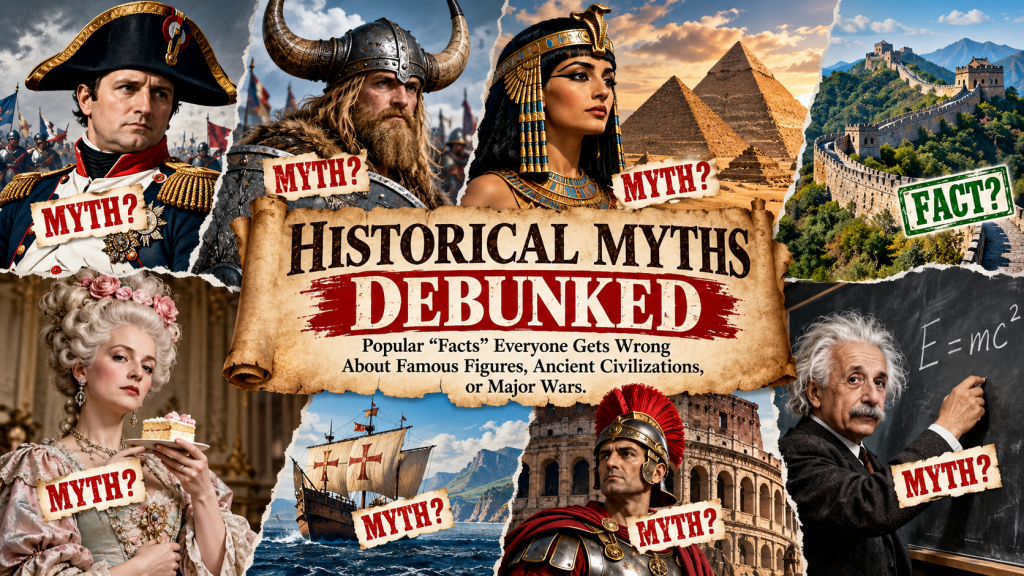
History is full of extraordinary stories. Some are so memorable that they become part of popular culture: Julius Caesar was born by cesarean section, Vikings wore horned helmets, Napoleon was extremely short, and medieval people believed the Earth was flat.
The problem?
Many of these “facts” are not facts at all.
Over centuries, legends, political propaganda, mistranslations, movies, novels, paintings, and simple misunderstandings have transformed complicated historical events into neat stories that are easy to remember—but often wrong.
That doesn’t mean history is boring. Quite the opposite. The truth is usually more fascinating than the myth.
From ancient civilizations to famous rulers and devastating wars, here are some of the most persistent historical myths debunked, along with what historians and surviving evidence actually tell us.
1. Napoleon Was Extremely Short
Few historical myths are as persistent as the idea that Napoleon Bonaparte was a tiny man who compensated for his lack of height with enormous ambition.
The phrase “Napoleon complex” has even entered modern language.
But Napoleon was not exceptionally short for his time.
Napoleon’s recorded height was approximately 5 feet 2 inches in French measurements, which has sometimes been converted incorrectly into modern English measurements. The French inch used at the time was slightly longer than the British inch.
When converted properly, Napoleon was approximately 5 feet 6 inches (around 1.68 meters) tall.
That was close to the average height of French men during his era.
So where did the myth come from?
One important contributor was British propaganda. Napoleon was frequently portrayed in British cartoons as a comically tiny figure, particularly by caricaturist James Gillray.
There was also confusion between French and British measurement systems.
The reality
Napoleon was not unusually short. His reputation as a tiny dictator is largely the product of measurement confusion and political caricature.
2. Vikings Wore Horned Helmets
Imagine a Viking raider.
For most people, the mental image probably includes a large beard, a battle axe, and a metal helmet with two enormous horns.
There is just one problem: Viking warriors almost certainly did not wear horned helmets into battle.
Archaeological evidence does not support the idea that horned helmets were standard Viking military equipment.
The famous Gjermundbu helmet, discovered in Norway and dating to the Viking Age, has a protective iron construction—but no horns.
So how did the image become so popular?
Horned helmets appeared in artistic representations of ancient Germanic and Scandinavian peoples centuries after the Viking Age. The imagery was later popularized during the 19th-century Romantic movement and through operas, particularly Richard Wagner’s Der Ring des Nibelungen.
Costume designers eventually helped transform the image into a cultural stereotype.
The reality
Vikings certainly wore helmets, but the classic horned Viking helmet is largely a 19th-century artistic invention, not an authentic battlefield uniform.
3. Medieval People Thought the Earth Was Flat
This is one of the most widespread historical misconceptions.
The popular story goes like this: ancient people believed Earth was flat, medieval Europeans continued believing it, and Christopher Columbus bravely proved them wrong by sailing west.
The historical reality is much more complicated.
Educated Europeans had known about the spherical Earth since antiquity.
Greek philosophers such as Pythagoras, Plato, and Aristotle discussed the Earth’s shape, while later scholars provided increasingly sophisticated arguments for a spherical Earth.
By the medieval period, educated scholars generally accepted that Earth was spherical.
The disagreement surrounding Columbus was not primarily about whether Earth was round.
Instead, one important issue concerned the size of Earth and the distance to Asia.
Columbus significantly underestimated Earth’s circumference and believed Asia extended much farther eastward than it actually did.
Ironically, had the Americas not been located between Europe and Asia, Columbus’s calculation could have resulted in disaster.
The reality
Medieval Europeans did not universally believe Earth was flat. The “flat Earth Middle Ages” story was greatly exaggerated by later writers.
4. Marie Antoinette Said, “Let Them Eat Cake”
Few historical quotations are more famous.
When informed that French peasants had no bread, Marie Antoinette supposedly responded:
“Let them eat cake.”
It is a devastating quote because it appears to perfectly capture aristocratic indifference toward starving people.
But there is no reliable evidence that Marie Antoinette actually said it.
The phrase appears in an earlier form in Jean-Jacques Rousseau’s Confessions, written decades before the French Revolution. Rousseau attributed the statement to an unnamed “great princess.”
The French phrase was “Qu’ils mangent de la brioche,” which refers to brioche, a rich type of bread—not literally cake.
The statement was eventually associated with Marie Antoinette, helping create an image of her as an extravagantly wealthy and uncaring queen.
The reality
Marie Antoinette’s lifestyle and political reputation certainly contributed to public anger, but the famous quotation is almost certainly not hers.
5. Julius Caesar Was Born by Caesarean Section
The name seems convincing.
Caesarean section.
Caesar.
Therefore, Julius Caesar must have been born through the operation.
Except the evidence doesn’t support it.
Roman sources indicate that Caesar’s mother, Aurelia, was alive for many years after his birth.
In ancient times, a surgical procedure that removed a baby from the mother after her death was sometimes performed in certain circumstances. But successful Caesarean delivery of a living child while the mother survived was extremely dangerous and would have been extraordinarily unusual.
The procedure was not the routine operation it is today.
There is also no contemporary evidence stating that Caesar was born by Caesarean section.
So where did the name come from?
The exact origin of the term is uncertain. One explanation connects it to the Latin verb caedere, meaning “to cut.” Later Roman traditions also connected the procedure with the Julian family.
The reality
Julius Caesar was almost certainly not born by Caesarean section.
6. Ancient Egyptians Used Slaves to Build the Pyramids
Hollywood has given us a familiar picture of thousands of slaves being whipped while dragging enormous stones across the Egyptian desert.
But archaeological discoveries suggest a very different story.
Excavations near the pyramids have uncovered settlements containing workers’ houses, bakeries, breweries, storage facilities, and evidence of organized labor.
Researchers have also discovered tombs associated with workers who helped construct the monuments.
This doesn’t mean construction was easy or that ancient Egyptian society was egalitarian. Workers could be compelled to serve the state, and labor conditions were undoubtedly demanding.
But the evidence suggests that many pyramid builders were organized laborers, craftsmen, and workers supported by the state, rather than a massive population of chained slaves.
Workers appear to have received food and other provisions while participating in large state construction projects.
The reality
The pyramids were built through an enormous system of organized labor, engineering, administration, and logistics. The simple “slaves built the pyramids” narrative dramatically oversimplifies the evidence.
7. Cleopatra Was Egyptian
Cleopatra VII is one of history’s most famous queens.
She is frequently described simply as an Egyptian queen.
Politically, that description is reasonable.
Ethnically and dynastically, however, the story is more complicated.
Cleopatra belonged to the Ptolemaic dynasty, a Macedonian Greek dynasty established in Egypt after the death of Alexander the Great.
The Ptolemies ruled Egypt for nearly three centuries.
Cleopatra was descended primarily from this Macedonian Greek ruling family, although the exact ancestry of her mother and some earlier relatives is uncertain.
What made Cleopatra unusual among her dynasty was her engagement with Egyptian culture. Unlike many of her Ptolemaic predecessors, she reportedly learned the Egyptian language and presented herself in ways that connected her with traditional Egyptian kingship.
The reality
Cleopatra was the Greek-Macedonian ruler of Egypt, deeply connected to Egyptian culture and politics.
Her identity cannot be reduced to a modern racial category.
8. The Great Wall of China Is Visible From the Moon
This may be one of the most famous myths ever told about the Great Wall of China.
According to the story, the wall is so enormous that it can be seen from the Moon with the naked eye.
It cannot.
The Great Wall is extraordinarily long, but its width is relatively small compared with the enormous distance separating Earth from the Moon.
From low Earth orbit, astronauts have sometimes reported difficulty distinguishing the wall from surrounding terrain without assistance.
From the Moon, the claim becomes even less plausible.
There is also an important distinction between something being visible and being recognizable.
An astronaut might technically detect a large structure under favorable conditions, but that doesn’t mean it would appear as an obvious line stretching across China.
The reality
The Great Wall is an extraordinary engineering achievement, but it is not visibly recognizable from the Moon with the naked eye.
9. Columbus Discovered America
In elementary school, many people learn that Christopher Columbus “discovered America” in 1492.
But the word “discovered” creates a major historical problem.
Millions of Indigenous people were already living throughout the Americas.
Complex civilizations, cities, agricultural systems, trade networks, and political states existed across the continents.
Columbus also wasn’t the first European known to reach North America.
Norse explorers, associated with Leif Erikson, established a settlement at L’Anse aux Meadows in Newfoundland centuries before Columbus’s voyage.
Columbus himself never realized that he had reached a previously unknown continent from the European perspective. He believed he had reached islands associated with Asia.
The reality
Columbus’s voyages were enormously important to world history because they initiated sustained contact between Europe and the Americas, but he did not “discover” an empty continent.
A more accurate description is that his voyages helped begin a new era of sustained transatlantic contact, conquest, colonization, migration, and exchange.
10. The Roman Empire Collapsed in One Dramatic Event
Another common misconception is that the Roman Empire simply collapsed in AD 476 when the Germanic leader Odoacer deposed the Western Roman emperor Romulus Augustulus.
The date is important.
But Roman decline was not a single event.
The Western Roman Empire experienced centuries of political instability, civil wars, economic difficulties, military pressures, demographic changes, and territorial fragmentation.
The Roman state in the East continued for another thousand years.
Modern historians generally refer to this surviving state as the Byzantine Empire, although its inhabitants continued to identify themselves as Romans.
Even in the West, Roman institutions did not suddenly disappear in 476.
Roman law, Christianity, administrative practices, architecture, language, and political traditions continued to influence European civilization.
The reality
The “fall of Rome” was a long transformation, not a single catastrophic day.
11. Einstein Failed Mathematics
This myth is particularly ironic.
Albert Einstein is one of history’s most famous scientists, yet a popular story claims that he failed mathematics at school.
The truth is almost the opposite.
Einstein demonstrated considerable mathematical ability from a young age.
The confusion partly comes from differences between Swiss and other grading systems and from stories about his school performance being repeated without sufficient context.
Einstein did experience difficulties with the rigid educational environment he encountered, and his academic path was unconventional.
But saying that Einstein “failed math” is misleading.
The reality
Einstein was not a poor mathematics student who somehow became a genius later. His revolutionary physics required substantial mathematical knowledge, and his mathematical abilities developed throughout his career.
12. George Washington Had Wooden Teeth
The image of George Washington wearing wooden dentures is almost impossible to forget.
But Washington’s dentures were not made of wood.
They were made from various materials over the course of his life, including ivory, human teeth, animal teeth, and metal components.
Washington did suffer from severe dental problems and eventually lost most or all of his natural teeth.
Some of his dentures were constructed from hippopotamus ivory, a material that was durable enough for the period.
The wooden-teeth story may have originated because old dentures can become stained and develop a wood-like appearance, or because the details of Washington’s dental history were misunderstood.
The reality
Washington’s dentures were real, and his dental problems were severe—but they weren’t wooden.
13. Napoleon Was Defeated by the Russian Winter Alone
The disastrous French invasion of Russia in 1812 is often summarized with a single explanation:
Napoleon lost because of the Russian winter.
Winter was certainly devastating.
But it wasn’t the only factor—and arguably not even the beginning of the disaster.
Napoleon’s army suffered from disease, inadequate supplies, logistical problems, hunger, exhaustion, military resistance, scorched-earth tactics, and enormous distances.
The French invasion force had already suffered substantial losses before the worst winter conditions arrived.
The retreat from Moscow turned the campaign into a catastrophe.
Russian forces also repeatedly attacked the retreating French army, while the destruction of food supplies made sustaining Napoleon’s enormous army increasingly difficult.
The reality
The Russian winter contributed significantly to Napoleon’s defeat, but the campaign was destroyed by a combination of logistics, military resistance, disease, starvation, exhaustion, distance, and weather.
14. Ancient Romans Were Constantly Wearing Togas
Movies set in ancient Rome often show almost everyone wearing white robes.
This creates the impression that Romans spent their entire lives walking around in togas.
They didn’t.
The toga was an important Roman garment, particularly associated with citizenship and formal public life.
But it was cumbersome.
Ordinary Romans also wore tunics, cloaks, sandals, and other practical clothing.
The toga became particularly associated with formal occasions and Roman civic identity.
In other words, wearing a toga was closer to wearing a formal suit today than wearing everyday clothing.
The reality
Ancient Romans certainly wore togas—but not constantly.
The toga was primarily a formal and symbolic garment.
15. Medieval Life Was Nothing but Ignorance and Filth
Perhaps the biggest historical myth of all is that the entire medieval period was a thousand-year nightmare between the glory of Rome and the rebirth of civilization during the Renaissance.
This idea has often been called the “Dark Ages” stereotype.
But medieval Europe was far more complicated.
Universities developed.
Cathedrals were engineered on an extraordinary scale.
Agricultural technology improved.
Trade expanded.
Legal systems evolved.
Philosophers and theologians produced sophisticated works.
Scholars translated and preserved ancient Greek and Roman texts.
And scientific knowledge continued to develop in Europe, the Islamic world, India, China, and elsewhere.
Medieval societies certainly faced war, famine, disease, inequality, and violence.
But describing the entire period as intellectually dead is simply inaccurate.
The reality
The Middle Ages were a diverse period lasting roughly a thousand years, containing major advances in architecture, agriculture, education, philosophy, law, mathematics, medicine, and technology.
Why Do Historical Myths Survive?
If many of these stories are wrong, why do people continue believing them?
There are several reasons.
1. Simple stories are easier to remember
History is complicated.
A war may involve economics, politics, geography, diplomacy, ideology, technology, and individual personalities.
But “Napoleon lost because of winter” is much easier to remember.
The human brain naturally prefers simple explanations.
2. Movies and television reshape history
Historical films have enormous cultural influence.
A dramatic scene can become more memorable than an academic explanation.
Once millions of people see the same historical image repeatedly, it can become difficult to separate entertainment from evidence.
3. Propaganda creates powerful myths
Political leaders have always understood the power of storytelling.
A victorious civilization may portray its enemies as barbaric.
A defeated ruler may be remembered as incompetent.
A revolution may be portrayed as either heroic liberation or terrifying chaos, depending on who is telling the story.
Historical reputation can therefore reflect power as much as evidence.
4. Old mistakes get repeated
A historian makes an error.
A later writer repeats it.
Another writer copies that writer.
Eventually, the claim appears in dozens of books and websites.
Quantity doesn’t necessarily create truth.
Sometimes it simply creates a very well-established mistake.
Why Historical Evidence Matters
Debunking historical myths doesn’t mean assuming that everything traditionally believed is false.
That would create another problem: myth-busting can itself become a myth.
Historical research requires evidence.
Historians examine:
- Archaeological discoveries
- Written records
- Inscriptions
- Coins
- Architecture
- Letters
- Government documents
- Contemporary accounts
- Oral traditions
- Material remains
- Linguistic evidence
- Scientific analysis
Even then, historians may disagree.
That’s because historical evidence is often incomplete.
A document might be biased.
An archaeological site might have been disturbed.
A surviving account might have been written decades after an event.
Sometimes the evidence simply isn’t sufficient to provide a definitive answer.
And that’s okay.
A responsible historical explanation should distinguish between:
What we know.
What we think is likely.
What remains uncertain.
The Most Dangerous Historical Myths Are the Ones That Feel True
The most persistent myths aren’t necessarily ridiculous.
They’re believable.
Napoleon was short.
Vikings had horns.
Columbus discovered America.
Napoleon lost because of winter.
Marie Antoinette said “Let them eat cake.”
Each story contains enough truth to make the myth convincing.
Napoleon really was an ambitious military ruler.
Vikings really did wear helmets.
Columbus really did make a voyage across the Atlantic.
Winter really did devastate Napoleon’s army.
Marie Antoinette really was unpopular.
The problem is that a small piece of truth can become attached to a completely misleading conclusion.
That’s why historical thinking requires more than memorizing dates and names.
It requires asking questions.
Who wrote this?
When was it written?
What evidence supports it?
Could the source have been biased?
What evidence contradicts it?
How did this story become popular?
Those questions can completely change our understanding of the past.
Frequently Asked Questions About Historical Myths
What is a historical myth?
A historical myth is a widely repeated story or belief about the past that is inaccurate, exaggerated, oversimplified, or unsupported by reliable evidence.
Historical myths can originate from propaganda, misunderstandings, legends, mistranslations, popular entertainment, or later interpretations of historical events.
Did Vikings really wear horned helmets?
There is no strong archaeological evidence that Viking warriors commonly wore horned helmets in battle. The familiar horned Viking image became popular much later, particularly through 19th-century art and popular culture.
Did medieval people believe Earth was flat?
Generally, educated medieval European scholars accepted that Earth was spherical. The idea that medieval society universally believed Earth was flat is a historical misconception.
Was Napoleon really very short?
No. Napoleon was approximately 1.68 meters tall, which was not exceptionally short for his period. His reputation for being tiny was reinforced by British caricatures and confusion over measurement systems.
Did slaves build the Egyptian pyramids?
Evidence from archaeological sites suggests that pyramid construction involved large organized labor forces, including skilled workers and laborers supported by the Egyptian state. The simplistic idea that the pyramids were built entirely by slaves is inaccurate.
Did Marie Antoinette say “Let them eat cake”?
There is no reliable evidence that Marie Antoinette said the famous phrase. A similar statement appeared in Rousseau’s writings before the French Revolution and was later associated with the queen.
Can the Great Wall of China be seen from the Moon?
No. The Great Wall is not visibly recognizable from the Moon with the naked eye. Even from low Earth orbit, astronauts have reported that distinguishing it can be difficult.
Conclusion: History Is More Interesting When We Question It
The past isn’t a collection of perfectly packaged stories.
It is messy.
People misunderstood events. Governments manipulated information. Writers exaggerated stories. Victors wrote histories. Legends grew over generations. Archaeologists discovered evidence that challenged centuries-old assumptions.
That’s what makes history fascinating.
The truth about the past is often more complicated than the myths—but complexity doesn’t make history less interesting. It makes it more human.
Napoleon wasn’t a cartoonishly tiny emperor.
Vikings didn’t need horns to look terrifying.
Medieval scholars didn’t spend a thousand years believing Earth was flat.
The pyramids weren’t simply built by armies of chained slaves.
Columbus didn’t discover an empty continent.
And Rome didn’t vanish in a single afternoon.
These myths remind us of an important lesson:
History isn’t about memorizing the stories we’ve been told. It’s about investigating whether those stories are actually true.
The next time someone tells you a historical “fact” that sounds too perfect, too dramatic, or too convenient, pause for a moment.
Ask where it came from.
Because sometimes the most fascinating historical discovery isn’t finding an ancient artifact.
It’s discovering that something you thought you knew about the past was never true in the first place.