The Unsolved Mystery of the Oak Island Money Pit: 200 Years of Traps and Theories.
 By Team Random Read
12 min read
By Team Random Read
12 min read
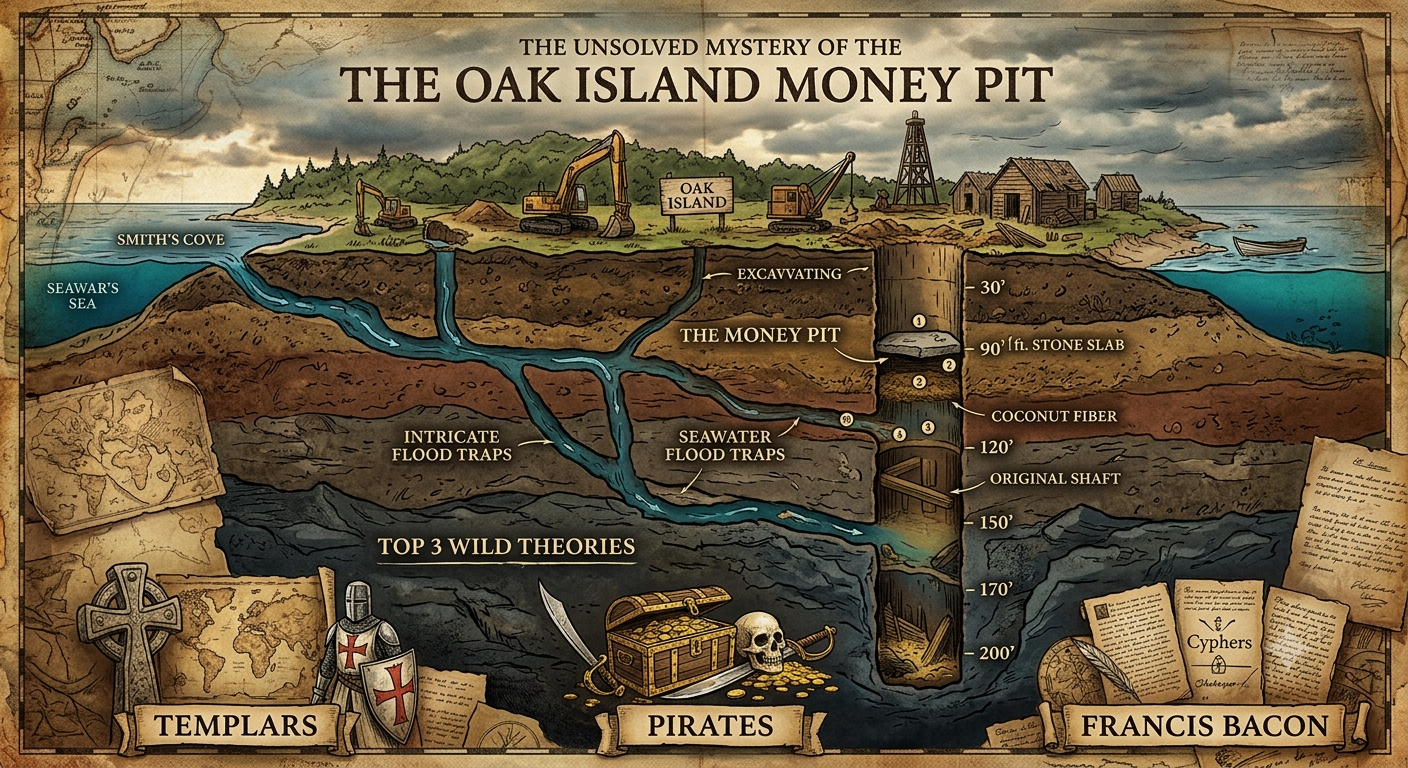
Off the coast of Nova Scotia sits a small, unremarkable, oak-covered island that has swallowed more money than most of the treasure it supposedly holds. For over two centuries, drillers, engineers, con men, actors, a future American president, and eventually a pair of Michigan brothers with a reality TV crew in tow have thrown fortunes at a single hole in the ground. That hole is known as the Money Pit, and it sits at the center of what is often called the longest-running treasure hunt in modern history.
In this article
No one has ever found the treasure. No one has even conclusively proven there is one. And yet the pit keeps flooding, the theories keep multiplying, and the digging never really stops. This is the story of how a teenager’s curiosity in 1795 turned into a 230-year obsession, the ingenious (or possibly imaginary) traps built to guard whatever lies beneath, and the three wildest theories about who put it there.
A Depression in the Forest: The Discovery of 1795
The story, as it’s been passed down through generations of Nova Scotians, begins with a teenager named Daniel McGinnis. Exploring the eastern end of Oak Island in the summer of 1795, he came across a circular depression in the ground beneath an old oak tree, with a tackle block still hanging from one of its branches, as though something heavy had once been lowered into the earth below. Curious, he returned with two friends, John Smith and Anthony Vaughan, and the trio began to dig.
What they found was strange enough to launch two centuries of obsession. A few feet down, their shovels struck a layer of flagstones that didn’t belong there naturally. Beneath the stones, the walls of the shaft bore unmistakable pick marks, and every ten feet, the diggers hit a fresh platform of oak logs. They dug through several of these layers before running out of resources, or nerve, and abandoning the site.
It’s worth noting, as more careful historians point out, that no document from the 1790s actually records this discovery. The earliest written accounts didn’t appear until newspapers picked up the story decades later, in the 1860s, after generations of oral retelling. That doesn’t mean the discovery didn’t happen roughly as described, but it’s a reminder that some of the pit’s most famous details have been embellished, or at least softened by decades of campfire storytelling, long before anyone wrote them down.
Whatever the exact truth of that first afternoon, word spread that something had been deliberately buried beneath Oak Island, and that someone had gone to extraordinary lengths to hide it. The hunt was on.
Two Centuries of Digging: A Timeline of Failure and Faith
What followed was a parade of companies, syndicates, and individual obsessives, each convinced they would succeed where the last had failed.
The Onslow Company arrived first, around 1803 to 1805, and dug the shaft down to roughly 90 feet, uncovering more log platforms along with mysterious layers of charcoal, putty, and what appeared to be coconut fiber, an odd find for a forest in Nova Scotia. Near the 90-foot mark, they reportedly recovered a large inscribed stone, later translated by a codebreaker as reading that a great sum lay buried forty feet further down. The stone itself has since vanished, and its authenticity is still disputed. Before the Onslow crew could reach it, the pit flooded with seawater almost overnight, a pattern that would repeat for the next two hundred years.
The Truro Company took over in 1849 and 1850, and it was during this expedition that workers first traced the flooding to Smith’s Cove, several hundred feet away, where they discovered an artificial beach engineered with startling precision.
The Oak Island Association followed in the 1860s, and their excavation caused the floor of the pit to collapse entirely into what may have been either a natural cavity or a deliberately engineered trap door. The island claimed its first known casualty around this time, when a pumping engine failed.
More companies followed across the decades: the Halifax Company in the late 1860s, the Oak Island Treasure Company in the 1890s (whose backer, Frederick Blair, would remain fascinated with the island for the rest of his life), and the Old Gold Salvage Company in 1909, whose expedition included a 27-year-old New York politician named Franklin D. Roosevelt. Roosevelt never forgot the island; he tracked news of it for decades afterward, even as president.
The 20th century brought William Chappell’s shaft in 1931, which turned up a miner’s pick, an axe, and the remains of an oil lamp. Gilbert Hedden and Professor Edwin Hamilton dug through the late 1930s and early 1940s. Robert Restall and his family moved onto the island in 1959 and spent six years mapping the drainage system by hand before tragedy struck in 1965. Robert Dunfield brought in heavy earth-moving equipment in the mid-1960s, gouging a massive excavation that permanently altered the island’s landscape. Then came the Triton Alliance, led by David Tobias and Dan Blankenship, from 1969 into the 2000s. Since 2006, the search has belonged to Oak Island Tours Inc., the syndicate behind the Lagina brothers and the History Channel series that introduced the mystery to a new generation of viewers.
Across more than 40 expeditions, the finds have been tantalizing but never conclusive: bits of parchment, a scrap of leather, human bone fragments of disputed age, an assortment of tools, and endless coconut fiber whose presence on a Canadian island remains one of the site’s genuine, unresolved oddities. No chest of gold has ever surfaced.
The Booby Trap That May Not Be a Booby Trap
The single detail that has done more than anything else to keep the Oak Island legend alive is the flooding. Nearly every serious excavation of the Money Pit has ended the same way: workers dig to somewhere between 90 and 100 feet, and seawater rushes in faster than it can be pumped out.
The explanation that took hold in the 19th century, and which still anchors the modern television series, is that the flooding is not an accident of geology but a deliberate defense system. According to this theory, whoever built the pit also engineered a network of tunnels connecting it to the surrounding shoreline, designed so that any excavation reaching a certain depth would trigger an inrush of seawater and drown the diggers out.
The physical evidence behind this idea is real, even if its interpretation is contested. At Smith’s Cove, early searchers found an artificial beach built with real engineering effort: five fan-shaped stone box drains, buried beneath a thick layer of coconut fiber and eelgrass, spread across roughly 145 feet of shoreline. The fiber and stonework appear to have been designed to filter seawater while resisting clogging, funneling water toward the interior of the island. Dye tests conducted in 1898, 1938, and again in 2019 all confirmed some kind of underground connection between the cove and the pit area.
What has never been proven, despite more than a century of searching, is a continuous, deliberately dug tunnel linking the two. No expedition has ever traced an unbroken shaft running the full distance from Smith’s Cove to the Money Pit itself. In 1995, a survey conducted by the Woods Hole Oceanographic Institution concluded that the recurring floods are better explained by the island’s natural geology: a porous limestone substructure, sinkholes, and the interaction between fresh groundwater and tidal seawater pressure, rather than by a man-made hydraulic trap. Sea levels were also measurably lower in the 1700s, meaning digging on the island may once have been possible without triggering the same flooding at all, which cuts both ways: it could explain why later diggers ran into water the original builders never faced, or it could simply mean there was never a trap to begin with, only an island that floods.
Even the age of the pit is disputed. Carbon dating of recovered wood has produced wildly different results depending on the study, with one 1969 analysis pointing to the late 1500s and a 1981 analysis suggesting a range roughly a century or more later. Two hundred years in, the “booby trap” that launched a thousand documentaries may be nothing more sinister than an island that was never meant to be dug.
Six Deaths and a Curse
Oak Island’s reputation isn’t built on mystery alone; it’s built on tragedy, too. Over the decades, six men have died in pursuit of whatever the pit is hiding. An early worker was killed when a pumping engine boiler exploded in 1861. In 1897, a man named Maynard Kaiser fell to his death when the rope hoisting him out of a shaft snapped.
The worst tragedy came in August 1965. Robert Restall, who had moved his family onto the island to dig full-time, was overcome by toxic fumes while checking a shaft near Smith’s Cove and collapsed. His son Bobby climbed down to save him and was overcome in turn. Two more men, Karl Graeser and Cyril Hiltz, went down after them and also died. Only one member of the rescue attempt made it out alive. All four deaths were later attributed to a pocket of hydrogen sulfide gas, and all four men drowned in the shaft’s floodwater after losing consciousness.
That single, devastating afternoon gave rise to the island’s now-famous legend: that seven people must die before Oak Island will surrender its secret. With six confirmed deaths on record, the show built around the island’s ongoing search leans hard on this framing every season. Historians who’ve dug into the claim’s origins, however, have never found a written reference to the “seven must die” prophecy predating the 1970s, which suggests it was less an old island superstition and more a piece of folklore assembled after the fact, and polished considerably by decades of television narration.
Three Theories That Refuse to Die
Ask ten Oak Island enthusiasts what’s actually down there, and you’ll likely get ten different answers. Three theories, however, have dominated the conversation for generations.
The Knights Templar. This is the theory that treats Oak Island as the final resting place of the medieval Christian military order’s legendary lost treasure, potentially including relics as significant as the Holy Grail or the Ark of the Covenant. Proponents point to symbols found carved into rock on the island, along with a large boulder formation known as Nolan’s Cross, and argue these bear resemblance to Templar or Masonic markings. The theory also leans on the broader legend that the Templars, after being suppressed and persecuted in the early 1300s, smuggled their wealth out of Europe and that some of their descendants or successors eventually carried it across the Atlantic long before Columbus. It’s a romantic story, tying Oak Island into one of history’s most enduring secret-society legends, but it suffers from an obvious problem: there is no documentary evidence placing the Templars, or anyone connected to them, in Nova Scotia at any point in their history. The symbolic “evidence” is almost entirely a matter of interpretation.
Pirates, and Captain Kidd in particular. This is the oldest and most intuitive theory, and it’s the one that likely launched the entire legend in the first place. Nova Scotia’s coastline was well known as pirate territory during the Golden Age of Piracy, and the Money Pit’s original 1857 newspaper coverage explicitly floated the idea that it held the buried fortune of Captain William Kidd, executed in London in 1701. According to the legend, a dying member of Kidd’s crew claimed a fortune worth millions had been hidden on an island matching Oak Island’s description. Other versions of the pirate theory swap in different names, including Blackbeard, or propose a Spanish galleon blown off course and forced to bury its cargo of New World gold rather than risk losing it at sea. The appeal is obvious: pirates burying treasure is exactly the kind of thing pirates are famous for. The problem is scale. The flood traps and drainage engineering found at Smith’s Cove would have required a large, organized labor force and real technical expertise, a level of coordinated infrastructure that doesn’t fit neatly with a pirate crew hastily hiding loot before a hasty getaway.
Francis Bacon and the Shakespeare manuscripts. By far the strangest of the major theories, this one holds that the 16th and 17th century English philosopher and statesman Sir Francis Bacon used the Money Pit to hide sensitive documents, potentially including original manuscripts proving that Bacon himself, not William Shakespeare, was the true author of Shakespeare’s plays. The theory gained traction in the mid-20th century and picked up an unlikely piece of supporting evidence in 1937, when a set of empty glass flasks bearing traces of mercury, consistent with Elizabethan-era chemistry equipment, were reportedly found on the island. Bacon was known to have experimented with mercury, and some researchers have also tied the theory to the Rosicrucians, a secretive philosophical society Bacon is sometimes associated with. Believers argue that coded messages within Shakespeare’s published works point toward a hidden vault, and that Oak Island is that vault. Skeptics note that the entire chain of logic depends on the long-disputed premise that Shakespeare didn’t write his own plays, a claim most literary historians reject outright, which makes this theory read less like buried history and more like a mystery layered on top of another, unrelated mystery.
Beyond these three, the island has attracted a genuinely staggering list of secondary theories over the decades, including the missing jewels of Marie Antoinette, French military engineers hiding the treasury of a captured fortress, Sir Francis Drake’s stolen Spanish gold, and even Viking exploration centuries before Columbus. Few of these hold up to serious scrutiny, but their sheer volume says something about how thoroughly Oak Island has captured the public imagination.
What the Skeptics Say
Not everyone believes there’s anything down there at all. A vocal contingent of geologists and historians argues that the entire Money Pit may be a natural sinkhole, a common feature in the region’s limestone-heavy terrain, and that the “engineered” platforms, tunnels, and artifacts found over two centuries of digging are either coincidental, contaminated by earlier excavation debris, or simply misinterpreted. The coconut fiber, often cited as the strongest piece of physical evidence for deliberate construction, has never been reliably dated to a period consistent with any of the leading treasure theories. And after more than 40 expeditions and untold millions of dollars spent, not a single verified piece of buried treasure has ever been recovered.
That hasn’t dampened enthusiasm. If anything, two centuries of failure have only deepened the island’s mystique. Every dry hole becomes further proof, in believers’ eyes, of just how well the treasure was hidden.
Conclusion
Two hundred and thirty years after Daniel McGinnis first noticed a strange depression under an oak tree, the Money Pit remains exactly what it has always been: an open question. It may be the resting place of Templar relics, pirate gold, or forbidden literary secrets. It may be nothing more than an unusually persistent sinkhole that generations of hopeful diggers turned into a legend through sheer force of storytelling. What’s certain is that Oak Island has already claimed six lives, consumed untold fortunes, and outlasted every company, syndicate, and television season sent to solve it.
Whether or not anyone ever pulls a treasure chest from that waterlogged shaft, the real find may already be sitting in plain sight: a two-century case study in how a hole in the ground, a handful of odd artifacts, and humanity’s endless appetite for a good mystery can turn a small, unremarkable island into one of the most obsessively excavated places on Earth.

Team Random Read
Random Read is an independent general-interest blog covering history, current affairs, nature, psychology, science and pop culture. About us
More like this

Historical Myths Debunked: 15 Popular “Facts” Everyone Gets Wrong.
History is full of extraordinary stories. Some are so memorable that they become part of popular culture: Julius Caesar was born by…

5 Everyday Inventions That Were Total Accidents (Including Microwave Ovens & Post-it Notes)
We like to imagine that great inventions are born from brilliant minds following carefully drawn plans. A scientist develops a theory. An…
The Bayeux Tapestry: The 1,000-Year-Old Story of 1066, William the Conqueror and the Battle of Hastings
Few historical objects tell a story as vividly as the Bayeux Tapestry. Nearly 1,000 years old, this extraordinary piece of medieval embroidery…