Foods Impossible Without High End Technology
 By Team Random Read
15 min read
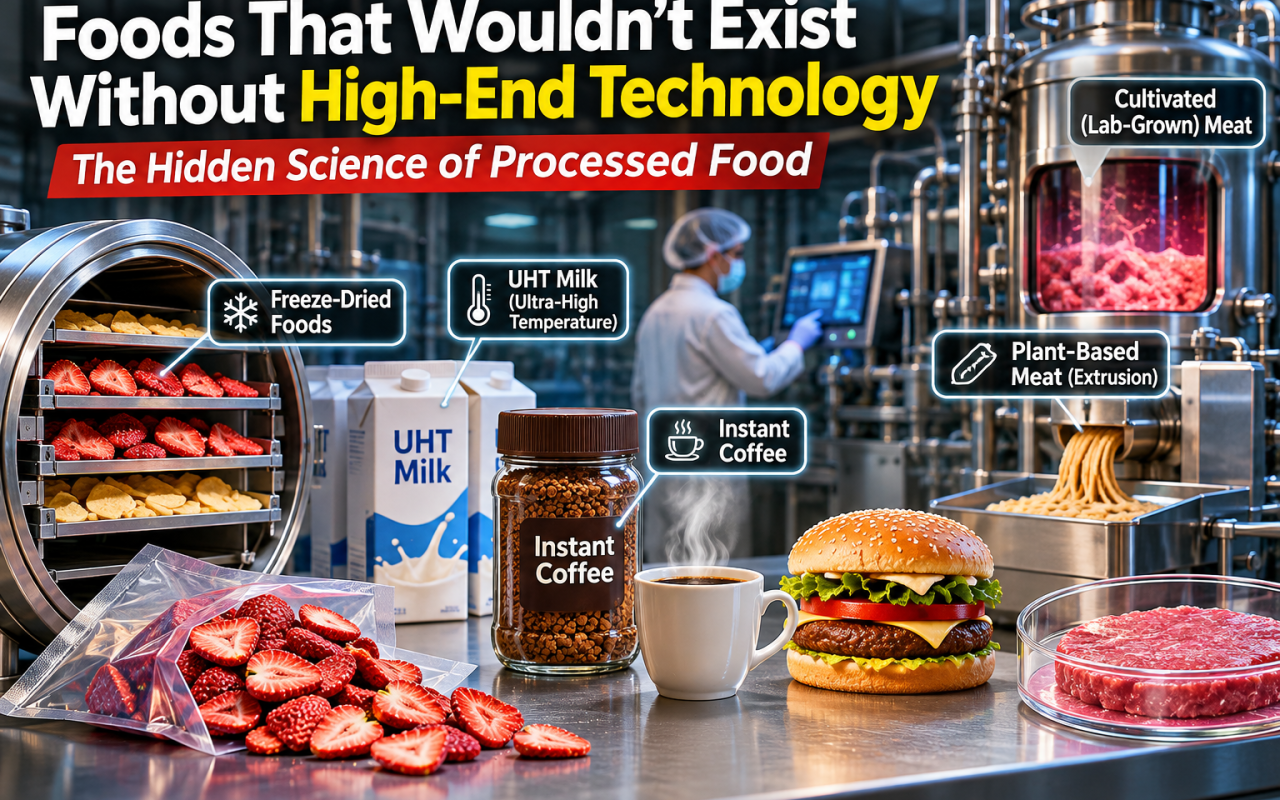
Foods That Wouldn’t Exist Without High-End Technology: The Hidden Science of Processed Food
Quick answer
Many processed foods depend on advanced technology: freeze-dried meals, instant coffee, UHT milk, extruded plant-based meat, and lab-grown meat all require specialized equipment such as vacuum chambers, high-pressure systems, extruders, or bioreactors. Without these machines, these foods could not be made, preserved, or sold at scale.
Key takeaways
• Processed food covers a wide spectrum, from simply frozen vegetables to engineered products made with industrial equipment.
• Preservation technologies like freeze-drying, UHT treatment, and high-pressure processing extend shelf life without relying only on traditional methods.
• Plant-based meat relies on extrusion and protein science to mimic the texture of animal products.
• Cultivated meat requires bioreactors and cell culture techniques that exist only in modern labs.
• Technology-dependent foods raise real questions about nutrition, labeling, cost, and consumer trust that are still being debated.
Walk down any grocery aisle and you are surrounded by foods that sophisticated machinery made possible. Shelf-stable milk, freeze-dried fruit, plant-based burgers, and the meals packed for astronauts all depend on vacuum chambers, high-pressure vessels, extruders, and other engineered equipment. Without that technology, many of these products would spoil within days or could not be made at all. Processed food is not a niche corner of the supermarket. It is a large part of how modern food systems store, transport, and diversify what people eat.
The term itself is often misunderstood, because processed food is a spectrum rather than a single category. At one end are minimally altered items, such as washed and bagged spinach, frozen vegetables, or pasteurized milk. In the middle sit foods with added ingredients, such as canned beans with salt or cheese made through culturing and aging. At the far end are formulated products built from extracted and recombined components. Classification systems like NOVA group foods by the extent and purpose of industrial processing, but no single label tells the whole story.
Understanding where a food falls on that spectrum, and which technologies shaped it, is the first step toward judging it fairly.
What Counts as Processed Food, and Where Does Technology Come In?
Almost everything we eat has been processed in some way. Washing, cutting, cooking, drying, fermenting, freezing, and milling are all forms of processing, and humans have used most of them for thousands of years. The useful question is not whether a food is processed but how, how much, and for what purpose. Processed food is better understood as a spectrum than as a single category.
The NOVA classification, developed by researchers at the University of São Paulo, sorts foods into four groups. Group 1 covers unprocessed or minimally processed foods, such as fresh fruit, plain frozen vegetables, dried beans, and pasteurized milk. Group 2 includes culinary ingredients extracted from those foods, such as oils, butter, sugar, and salt. Group 3 covers processed foods made by combining the first two groups, such as canned fish, simple breads, and cheeses. Group 4 contains ultra-processed foods: industrial formulations that typically include substances rarely used in home kitchens, such as protein isolates, modified starches, emulsifiers, and flavor additives.
NOVA is influential, but it is also debated. Critics note that it classifies by purpose and ingredients rather than nutrient content, so foods with very different nutritional profiles can land in the same group. It is a useful framework, not a verdict.
How This Article Defines Technology-Dependent Foods
For the purposes of this article, a technology-dependent food is one that could not exist, or could not exist at its current scale, quality, or shelf life, without specialized equipment or advanced science. The test is simple: could a skilled cook with traditional tools reproduce it?
• Traditional methods: Sourdough, yogurt, salami, kimchi, smoked fish, and sun-dried tomatoes rely on fermentation, salting, smoking, or air drying. These techniques are old and can be done without industrial machinery, even when factories now do them at scale.
• Technology-dependent methods: Freeze-drying under vacuum, ultra-high-temperature sterilization, high-pressure processing, extrusion of plant proteins, and cell culture in bioreactors require precisely controlled pressure, temperature, or biology that cannot be replicated by hand.
The two categories overlap with NOVA but are not identical. A freeze-dried strawberry is technology-dependent yet minimally altered in composition, while a mass-produced packaged loaf may be ultra-processed without relying on any exotic technology. Keeping these two ideas separate, how much a food is changed and how advanced the tools are, makes the examples that follow easier to judge on their own terms.
Freeze-Dried Foods: Vacuum Chambers and Space-Age Preservation
Freeze-drying, or lyophilization, removes water from food without the heat that conventional drying relies on. The process depends on sublimation, the direct transition of a substance from solid to gas. Under normal atmospheric pressure, ice melts into liquid water before it evaporates. Below a specific pressure threshold, however, ice can skip the liquid phase entirely. Freeze-drying exploits this behavior, and it is why the method is impossible without vacuum technology.
A typical cycle has three stages. First, the food is frozen, which locks its structure in place and turns its water into ice crystals. Second, in the primary drying stage, the frozen food is placed in a sealed chamber, the pressure is lowered with a vacuum pump, and gentle heat is applied so the ice sublimates into vapor. A cold condenser then captures that vapor. Third, a secondary drying stage removes the small amount of water that remains bound to the food. The result is a lightweight, porous product that keeps much of its original shape, color, and flavor, and that can be stored for long periods if sealed against moisture.
From Wartime Medicine to the Kitchen Cupboard
The principle was demonstrated in the early twentieth century, and the technique gained industrial importance during World War II, when it was used to preserve blood plasma and, later, antibiotics such as penicillin. Food applications followed. Nestlé is credited with developing freeze-dried instant coffee, which reached the market in the late 1930s and 1960s in different forms; the freeze-dried version gave a flavor closer to fresh-brewed coffee than earlier spray-dried powders, because lower temperatures preserve more volatile aroma compounds.
Today the same approach appears in several everyday products:
• Freeze-dried fruit: strawberries, raspberries, and bananas become crisp and shelf-stable with little change to their composition apart from water loss.
• Instant coffee: brewed coffee is frozen, broken into granules, and dried under vacuum.
• Camping and backpacking meals: pouches of pasta, rice dishes, and stews weigh little and rehydrate with hot water.
Spaceflight is the best-known association. NASA’s Apollo missions used freeze-dried foods that astronauts rehydrated with water, and the agency’s later programs have continued to use dehydrated and thermostabilized items. Weight and storage stability matter greatly in a spacecraft, which makes lightweight, long-lasting food a practical fit. The technology remains costly, since vacuum chambers and long drying cycles consume time and energy, which explains why freeze-dried products usually sell at a premium.
How Do UHT Milk and High-Pressure Processing Extend Shelf Life?
Refrigeration slows spoilage, but it does not stop it. Two technologies go further by dealing with microorganisms directly: one uses intense heat for a very short time, the other uses extreme pressure with little heat at all. Both are now routine in the supply chains that deliver processed food to supermarket shelves.
Ultra-high-temperature (UHT) treatment heats a liquid such as milk to at least 135°C (275°F) for only a few seconds. That is hot enough to destroy bacteria and their heat-resistant spores, which ordinary pasteurization does not reliably eliminate. Conventional pasteurization uses much lower temperatures, so pasteurized milk still needs constant refrigeration and keeps for a limited time. In UHT systems, the milk is typically heated either by injecting steam directly into it or by passing it through heat exchangers, then cooled quickly. The short exposure limits, though does not eliminate, changes in flavor and nutrient content. UHT milk often tastes slightly sweeter or more cooked than fresh pasteurized milk because of the heat-driven reactions between milk sugars and proteins.
Sterilizing the liquid is only half the task. If it is poured into a container that is not sterile, contamination can undo the work. Aseptic packaging solves this by sterilizing the packaging material separately, often with hydrogen peroxide or heat, and filling and sealing the container in a sterile environment. The multilayer cartons familiar from shelf-stable milk, soy milk, broth, and soups combine paperboard, polyethylene, and a thin aluminum foil layer that blocks light and oxygen. Unopened, these products can sit at room temperature for months, which reduces dependence on cold chains and makes distribution easier across long distances.
High-Pressure Processing: Preservation Without Heat
High-pressure processing (HPP) takes a different approach. Sealed, packaged food is placed in a steel vessel filled with water, and the pressure is raised to levels commonly around 400 to 600 megapascals, several times the pressure at the deepest ocean trenches. This pressure damages the cell structures of bacteria, yeasts, and molds, including pathogens such as Listeria, Salmonella, and E. coli. Because the process works largely without heat, it tends to preserve the fresh flavor, color, and some heat-sensitive vitamins of the food.
This is why HPP is widely used for cold-pressed juices, guacamole, deli meats, and ready-to-eat meals. A cold-pressed juice that is not heat-treated would otherwise spoil quickly or carry a safety risk. HPP products still require refrigeration, but they can last considerably longer than untreated equivalents. The process works only on packaged foods in flexible, water-tolerant containers, and the equipment is expensive, which is reflected in the price of many HPP products.
Plant-Based Meat and the Engineering of Texture
Plant-based burgers and nuggets are among the clearest examples of processed food that depends on advanced technology. Plants do not naturally contain the fibrous, juicy structure of animal muscle. Reproducing it requires separating plant proteins from their source crops, restructuring them with specialized machinery, and layering in flavor compounds that make the final product taste convincingly savory.
Protein Isolation: Starting With the Right Ingredients
The process begins with protein isolation. Crops such as soybeans, peas, and wheat are milled and then separated into their components. In wet fractionation, the flour is mixed with water, and adjustments to pH and temperature allow proteins to be separated from starch and fiber. The result is a concentrate or isolate, often a pale powder, that contains a much higher share of protein than the original crop. Pea protein and soy protein isolates are common bases for burgers, while wheat gluten is widely used where a chewy, stretchy quality is wanted.
Extrusion: Building Fibers Under Heat and Pressure
The key step in creating a meat-like texture is extrusion. In high-moisture extrusion, a mixture of protein, water, and other ingredients is fed into a twin-screw extruder, a long heated barrel containing two rotating screws. Mechanical force, heat, and pressure cause the proteins to unfold and realign. As the material passes through a cooling die at the end, the proteins set into aligned, fibrous strands that resemble muscle tissue. Adjusting screw speed, temperature, moisture, and die design changes the result, from tender shreds suited to nuggets to denser textures suited to patties. Lower-moisture extrusion produces dry textured vegetable protein, which is rehydrated later and commonly used in crumbles and ground-meat substitutes.
Flavor Science and Binding
Texture alone is not enough, because plant proteins often carry beany or bitter notes that must be masked. Food scientists use yeast extracts, natural flavors, and fats to build a meaty profile. Some products include heme, an iron-containing molecule that contributes to the taste of cooked meat; Impossible Foods, for example, uses a version of heme produced by fermentation. Fats such as coconut oil or sunflower oil are added to mimic the way animal fat melts and carries flavor during cooking. Binders such as methylcellulose hold the patty together as it heats.
None of this happens by chance. Food scientists, protein chemists, and process engineers work together, testing formulations and tuning equipment settings. Instruments that measure texture, such as devices that quantify chewiness and firmness, help them compare a prototype against conventional meat. The finished product reflects both the capability of industrial machinery and the careful, iterative work of the specialists who operate it.
Cultivated Meat and Precision Fermentation: Food Grown in Bioreactors
Two related technologies move food production from fields and barns into stainless-steel vessels. Both depend on controlled biological processes, and both would be impossible without modern bioprocess engineering, sterile handling, and real-time monitoring. They differ in what they grow and what they produce.
Cultivated meat starts with animal cells, typically taken from a biopsy or drawn from a established cell line. The cells are placed in a bioreactor and fed a nutrient medium containing amino acids, sugars, vitamins, and growth factors. Under the right temperature, oxygen, and pH conditions, they multiply. For products with structure, such as a chicken breast or steak, the cells must be grown on edible scaffolds that give them a shape to attach to and differentiate into muscle and fat. Ground-style products are simpler to make than whole cuts.
Precision fermentation works differently. Engineers insert the gene for a specific protein into a microorganism, such as a yeast or fungus. The microbes ferment in a tank and secrete the target protein, which is then separated and purified. The approach has long been used to make rennet for cheesemaking and insulin for medicine. In food, it is now applied to ingredients such as whey proteins (beta-lactoglobulin), egg proteins, and heme, the iron-containing molecule that gives some plant-based burgers a meaty flavor. The final product contains the protein, not the microbe.
Regulatory Status and Scale Limits
Regulation varies by country and product. Singapore approved the sale of cultivated chicken in 2020. In the United States, the FDA and USDA completed their review process for cultivated chicken products from two companies in 2023, allowing limited sales. Some US states have since moved to restrict or ban cultivated meat sales, and other jurisdictions, including the European Union, have been slower to authorize it. Precision-fermented proteins have generally reached markets sooner, often through existing ingredient-safety pathways, though approvals are still assessed case by case.
Scale remains the central challenge. Growth media can be costly, particularly the growth factors, and animal cells are far more fragile than yeast. Large bioreactors must maintain oxygen delivery and sterility without damaging cells. As a result, cultivated meat is currently produced in very small volumes compared with conventional meat, and prices have been difficult to bring down. Precision fermentation benefits from existing fermentation infrastructure, but capacity for food-grade production is still limited. Whether either approach can reach commodity-level volumes and prices is an open question.
Are Technology-Made Foods Good for Us?
The answer depends on which food, which process, and compared with what. “Technology-made” covers products with very different nutritional profiles, so broad verdicts tend to mislead. Evidence is strongest for some preservation methods and much thinner for newer categories.
Established findings are fairly clear for conventional preservation. Freeze-drying generally retains much of a food’s nutrient content, and UHT treatment leaves milk’s protein and calcium largely intact, although some heat-sensitive vitamins, such as certain B vitamins and vitamin C, can decline. High-pressure processing is often chosen because it can inactivate microbes with less heat. These methods mainly address food safety and spoilage, which carry real public health benefits.
The more contested debate concerns ultra-processed food. The NOVA classification, developed by Brazilian researchers, groups foods by the extent and purpose of industrial processing. Observational studies have linked high intake of ultra-processed foods with outcomes such as obesity and cardiovascular disease. However, such studies cannot easily separate processing itself from the nutrients typically found in these products, including added sugar, sodium, and saturated fat. A small controlled feeding trial from the US National Institutes of Health found that participants ate more calories on an ultra-processed diet than on an unprocessed one, but the mechanism remains unresolved. Critics also note that NOVA places foods with quite different nutritional value, such as some fortified cereals and sugary drinks, in one category.
Where the Evidence Is Still Open
• Plant-based meat: Many products are comparable to beef in protein but vary widely in sodium and saturated fat, so the label matters more than the category. Long-term health outcomes of regular consumption are not well studied.
• Cultivated meat: Few products are on the market, and there is little independent, long-term nutritional research.
• Precision fermentation: Proteins identical in structure to dairy proteins raise allergen questions that regulators evaluate case by case.
Labeling and perception also shape the picture. Rules differ by country on terms such as “meat,” “milk,” and “cultivated,” and on how novel ingredients must be disclosed. Surveys repeatedly show that consumers distrust foods they perceive as unnatural, even when the safety evidence is comparable to familiar products. That perception is not irrational in every case, since transparency about ingredients and methods remains uneven.
Cost is a practical limit. Shelf-stable and frozen foods can reduce waste and improve access to nutrition, especially where fresh produce is scarce or expensive. Newer technologies, by contrast, currently sell at premium prices or in small quantities.
A reasonable approach is to judge individual products by their nutrition panels and ingredient lists rather than by how they were made. Processing can improve safety and convenience, but it does not by itself make a food healthy or unhealthy.
The Future of Processed Food Is Engineered, Not Accidental
Every food covered in this article, from freeze-dried fruit to cultivated meat, exists because someone solved a specific problem with specific tools. Vacuum chambers, pressure vessels, extruders, and bioreactors are not shortcuts around real food. They are deliberate answers to questions about safety, shelf life, texture, and supply. That is the key insight: processed food is not a single category with a single verdict, but a spectrum of design choices.
As these technologies mature, the choices will multiply, and so will the claims made about them. The more useful question may not be whether a food is processed, but what the processing was meant to accomplish and whether the finished product delivers it. Who benefits from each design decision: the shopper, the producer, or both? That question is worth carrying to the next ingredient list you read.
Frequently asked questions
What is processed food?
Processed food is any food that has been altered from its raw state through methods such as cooking, canning, freezing, drying, fermenting, or adding ingredients. The category is broad, covering minimally processed items like bagged salad and highly formulated products like instant noodles or packaged snacks.
Is all processed food unhealthy?
No. Processing ranges widely. Frozen vegetables, canned beans, and pasteurized milk are processed yet commonly part of healthy diets. Concerns usually focus on ultra-processed products high in added sugar, sodium, or fat. Nutrition depends on the specific product, so checking labels is more useful than judging the whole category.
How does freeze-drying preserve food?
Freeze-drying freezes food, then lowers surrounding pressure in a vacuum chamber so ice turns directly into vapor, a step called sublimation. Removing nearly all moisture limits microbial growth and spoilage. The result is lightweight, shelf-stable food that rehydrates readily, which is why it suits camping and spaceflight.
How is plant-based meat made?
Manufacturers typically combine plant proteins, such as soy or pea, with fats, binders, and flavorings. Extrusion equipment applies heat, pressure, and shear to align the proteins into fibrous textures resembling muscle. Without this machinery, plant proteins would not easily achieve a meat-like bite.
What is cultivated meat and is it available?
Cultivated meat is made by growing animal cells in bioreactors rather than raising and slaughtering animals. It requires cell culture expertise and controlled equipment. Availability is limited and depends on regulatory approval, which varies by country, so readers should check current rules where they live.

Team Random Read
Random Read is an independent general-interest blog covering history, current affairs, nature, psychology, science and pop culture. About us
More like this

Classic Scooters 1960s Mod Culture
Two Wheels and a Parka: How Classic Scooters Became the Heartbeat of 1960s Mod Culture

The Real History Behind Halloween Traditions: From Samhain Bonfires to Carved Pumpkins
Halloween grew from the Gaelic festival of Samhain, marking the end of harvest, blended with the Christian All Saints' and All Souls'…

Why Gaming Is the New Way Gen Z and Millennials Make Real Friends
Picture this: two people on opposite sides of the world, one in Lagos and one in Manila, staying up past midnight to…