Neuroplasticity in Your 20s and Beyond: How Your Brain Keeps Rewiring Itself (and How to Speed It Up)
 By Team Random Read
12 min read
By Team Random Read
12 min read

There’s a persistent myth that your brain finishes “setting” sometime around your mid-twenties — that the neural wiring you have at 25 is more or less the wiring you’re stuck with for life. It’s the kind of idea that quietly discourages people from picking up a new language at 30, switching careers at 40, or learning guitar at 55.
In this article
- What Neuroplasticity Actually Means
- Does Neuroplasticity Decline With Age?
- Why Your 20s Are Still a Uniquely Good Window
- The Science-Backed Ways to Accelerate Neuroplasticity
- 1. Seek Out Genuine Novelty, Not Just Repetition
- 2. Use Deliberate, Effortful Practice — Not Passive Exposure
- 3. Protect Your Sleep — It's Not Optional
- 4. Exercise, Especially Aerobic Exercise
- 5. Bilingualism and Language Learning as a Structural Workout
- 6. Cognitive Flexibility: Train the Skill Behind the Skill
- 7. Social Connection and Enriched Environments
- Common Neuroplasticity Myths, Debunked
- Frequently Asked Questions
- Putting It Together: A Realistic Learning Routine
- The Bigger Picture
It’s also wrong.
Neuroscience has spent the last three decades dismantling the idea of a fixed, “finished” adult brain. What’s replaced it is a far more useful and, frankly, more hopeful picture: the brain is a lifelong work in progress, constantly rewiring itself in response to what you do, think, practice, and experience. This capacity is called neuroplasticity, and understanding how it actually works — not the oversimplified Instagram-infographic version — can change how you approach learning at any age.
This article breaks down what neuroplasticity really is, how it changes across your 20s, 30s, and beyond, and what the current research says actually accelerates it.
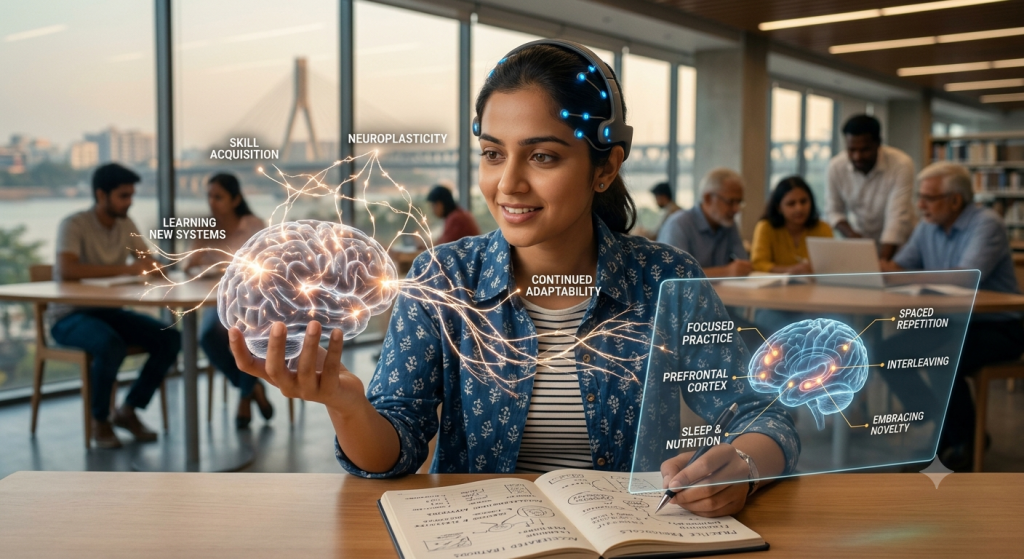
What Neuroplasticity Actually Means
Neuroplasticity refers to the brain’s ability to reorganize itself by forming new neural connections and, in some cases, strengthening or pruning existing ones. It’s not one single mechanism — it’s an umbrella term covering several distinct biological processes working together:
- Synaptic plasticity: the strengthening or weakening of connections between individual neurons based on how often they’re used (often summarized as “neurons that fire together, wire together”)
- Structural plasticity: physical changes in the shape and density of neurons, including dendrites (the branch-like extensions that receive signals) and axons (which send them)
- Neurogenesis: the birth of new neurons, which continues in specific brain regions — most notably the hippocampus, a structure central to memory and learning — well into adulthood
- Functional reorganization: the brain’s ability to shift a task from one region to another, most dramatically visible in stroke patients who relearn speech or movement using different neural circuits than before
For a long time, scientists assumed most of this activity was reserved for childhood, when the brain is famously described as being like wet cement. But research has since shown that inhibitory neurons in the adult cortex continue reshaping a meaningful percentage of their connective branches every single week, and that axon terminals keep remodeling themselves throughout life. In other words, your brain’s physical wiring is never actually “dry.”
Does Neuroplasticity Decline With Age?
Yes — but the story is more nuanced than “it goes down, full stop.”
Plasticity is highest during early childhood, when the brain is forming an enormous surplus of synaptic connections and then pruning them based on experience. There’s a second, smaller wave of intense rewiring during adolescence. By your 20s, this “raw” plasticity has slowed considerably compared to childhood — but it hasn’t disappeared. It’s simply become more dependent on effort and repetition rather than happening automatically as part of development.
Research into adult learning and brain aging consistently finds that while the rate of plastic change decreases with age, the capacity for it remains present across the lifespan, including into the seventh and eighth decades of life. Older adults engaged in demanding motor or cognitive training still show measurable cortical reorganization — it just tends to require more structured, sustained practice than it would have required at age eight.
This matters because it reframes the entire conversation. The question isn’t “can I still rewire my brain after 25?” The honest answer is: yes, but you now need to be more deliberate about triggering it. Passive exposure isn’t enough anymore — active, effortful engagement is what does the work.
Why Your 20s Are Still a Uniquely Good Window
If you’re in your 20s right now, you’re sitting in a genuinely favorable window for skill acquisition, for a few specific reasons:
1. The prefrontal cortex has just finished maturing. The prefrontal cortex — responsible for planning, impulse control, and complex decision-making — is one of the last brain regions to fully mature, typically continuing its development into the mid-twenties. Once it matures, you gain a stronger capacity for the kind of sustained, goal-directed focus that deliberate practice requires.
2. Baseline plasticity is still relatively high. You’re past adolescent volatility but haven’t yet entered the slower-plasticity terrain of later adulthood. Motor learning studies consistently show young adults acquiring new physical and cognitive skills faster than older cohorts, even when both groups are equally motivated.
3. Fewer entrenched patterns to unlearn. Plasticity isn’t just about building new pathways — it’s also about pruning old ones. The longer a habit, belief, or motor pattern has been reinforced, the more resistant it becomes to change (this is part of why a lifelong smoker has a harder time quitting than someone who picked up the habit a year ago). Being earlier in adulthood means fewer deeply grooved patterns competing for the brain’s rewiring resources.
None of this means your 30s, 40s, or 60s are wasted years for learning. It means your 20s offer slightly more favorable starting conditions — a reason to build strong learning habits now, not a ceiling on what’s possible later.
The Science-Backed Ways to Accelerate Neuroplasticity
Here’s where things get practical. Across neuroscience, physical therapy, and cognitive research, a consistent set of levers keeps showing up as genuinely effective at promoting neuroplastic change — as opposed to the vague “just try new things!” advice that dominates most wellness content.
1. Seek Out Genuine Novelty, Not Just Repetition
Plasticity is triggered by mismatch — when your brain encounters something it doesn’t already have an efficient pathway for. Repeating a skill you’ve already mastered mostly reinforces existing pathways rather than building new ones. Learning thrives on novelty: picking up an unfamiliar language, instrument, or physical skill activates plasticity because the brain has to build fresh circuitry rather than lean on old ones.
The practical implication: if you want to accelerate learning, deliberately choose things that feel a little disorienting at first. Comfort is a sign you’ve plateaued, not a sign you’re doing it right.
2. Use Deliberate, Effortful Practice — Not Passive Exposure
Simply being “around” a skill — half-listening to a podcast in a foreign language, noodling on a guitar without structure — produces far weaker plastic change than focused, effortful practice with feedback. Structured motor-skill training reliably produces cortical reorganization in ways that casual repetition does not, which is a big part of why rehabilitation programs after injury are built around targeted, progressively harder drills rather than general movement.
For skill-building, this means:
- Practice at the edge of your current ability, not comfortably within it
- Get feedback quickly (a teacher, a recording of yourself, a measurable score) so the brain knows what to correct
- Break skills into components you can drill individually before recombining them
3. Protect Your Sleep — It’s Not Optional
Plasticity isn’t just built during practice; it’s consolidated during sleep. Deep sleep stages play a central role in strengthening the synaptic changes formed during a day’s learning and pruning away the noise. Skimping on sleep during a period of intense learning doesn’t just make you tired — it measurably undercuts the neural consolidation of whatever you just practiced. If you’re trying to accelerate a new skill, treat sleep as part of the training program, not a break from it.
4. Exercise, Especially Aerobic Exercise
Physical activity is one of the most consistently replicated levers for boosting adult neuroplasticity. Aerobic exercise increases blood flow and supports the release of growth factors — most notably brain-derived neurotrophic factor (BDNF) — that support neuron survival and the formation of new synaptic connections. Regular exercise, alongside good sleep, a balanced diet, and strong social connections, is repeatedly identified as one of the core drivers of adult brain adaptability. You don’t need to train like an athlete; consistent moderate aerobic activity a few times a week appears sufficient to meaningfully support learning capacity.
5. Bilingualism and Language Learning as a Structural Workout
Learning a second language is one of the more thoroughly studied “neuroplasticity accelerators” available. Sustained engagement with a second language has been linked to measurable structural changes in the hippocampus, the brain region central to memory formation. Interestingly, this relationship isn’t simply linear — engagement appears to expand relevant brain structures during active acquisition, followed by a normalization once the skill becomes well-established, suggesting the brain “invests” resources heavily while learning and then stabilizes once a skill matures. Language learning is, in effect, one of the most complete cognitive workouts available: memory, auditory processing, motor control (for pronunciation), and social cognition all get engaged simultaneously.
6. Cognitive Flexibility: Train the Skill Behind the Skill
One layer beneath specific skills like languages or instruments is a broader trait called cognitive flexibility — the brain’s ability to shift between different concepts, rules, or ways of thinking. Unlike raw IQ, cognitive flexibility isn’t fixed; it grows through experiences that force the brain to adapt. Interestingly, this trait predicts real-world outcomes well beyond the classroom — studies have found that entrepreneurs with strong cognitive flexibility launch multiple ventures more successfully than peers of similar intelligence and age, likely because they adapt faster to changing circumstances.
Practical ways to train cognitive flexibility include:
- Deliberately switching between unrelated tasks or subjects during a study session (a technique sometimes called “interleaving”)
- Seeking out debate or perspectives that challenge your existing views
- Playing strategy games or puzzles that change their own rules mid-game
7. Social Connection and Enriched Environments
Isolated learning is measurably less effective than learning embedded in a socially engaged, “enriched” environment — one with variety, challenge, and interpersonal interaction. Across age groups, strong social connections are consistently listed among the core lifestyle factors that support neuroplasticity, alongside diet, sleep, and exercise. Practically, this might mean choosing a language class over a language app, or a climbing gym over a solo home climbing wall — the social and environmental richness does real cognitive work that solitary repetition can’t replicate.
Common Neuroplasticity Myths, Debunked
A lot of the neuroplasticity content circulating online overstates or oversimplifies the science. Before moving on, it’s worth clearing up a few persistent misconceptions.
Myth: “You only use 10% of your brain.” This has nothing to do with neuroplasticity and isn’t true. Brain imaging shows activity distributed across virtually the entire brain over the course of a day, even if not every region fires at once. Neuroplasticity is about how existing brain tissue reorganizes itself, not about unlocking unused capacity.
Myth: “Neuroplasticity means you can rewire your brain instantly with the right hack.” Genuine structural change — new dendritic branches, strengthened synaptic connections, meaningful functional reorganization — happens on the timescale of weeks and months of consistent practice, not a single meditation session or one viral “5-minute brain exercise.” Anything promising overnight rewiring is selling a supplement, not describing biology.
Myth: “Past a certain age, learning is basically pointless.” As covered above, this simply isn’t supported by the evidence. Plasticity slows with age; it doesn’t stop. Adults in their 60s, 70s, and 80s show measurable, meaningful learning-related brain changes in response to sustained training, particularly motor and language training.
Myth: “Brain games and puzzle apps are the best way to build plasticity.” Commercial brain-training apps tend to make you better at the specific puzzle you’re practicing, with limited evidence that this transfers to broader cognitive ability. Real-world, effortful skills — learning an instrument, a language, a sport, a craft — engage a much wider and more integrated set of brain networks than tapping through app-based puzzles, and the evidence for meaningful transfer is considerably stronger.
Myth: “Neuroplasticity is always a good thing.” Plasticity is a mechanism, not a moral good — it’s exactly as capable of entrenching bad habits, chronic pain patterns, or anxious thought loops as it is of building useful skills. This is part of why breaking an ingrained habit can feel so much harder than building a new one: you’re working against previously reinforced circuitry, not a blank slate.
Frequently Asked Questions
At what age does neuroplasticity peak?
Plasticity is highest during early childhood and adolescence, when the brain is forming and pruning enormous numbers of synaptic connections. It doesn’t have a hard “off switch” afterward — it gradually shifts from an automatic developmental process to one that depends more heavily on deliberate, effortful engagement.
Can you meaningfully increase neuroplasticity as an adult?
Yes. Aerobic exercise, quality sleep, deliberate practice of novel skills, and strong social engagement are the most consistently supported levers in current research. None of them require special equipment or expensive interventions.
Is neuroplasticity the same as neurogenesis?
No. Neurogenesis — the birth of entirely new neurons — is one specific mechanism that contributes to plasticity, mainly concentrated in the hippocampus. Neuroplasticity is the broader umbrella term covering neurogenesis alongside synaptic, structural, and functional reorganization.
How long does it take to see results from neuroplasticity training?
Early behavioral improvements in a new skill can appear within days to weeks, but the underlying structural brain changes tend to consolidate more gradually, often over months of consistent practice. Patience and consistency outperform intensity in the short term.
Does stress affect neuroplasticity?
Yes, and generally negatively. Chronic stress and poor sleep are associated with impaired hippocampal function and reduced neurogenesis, while manageable, novel challenges tend to support healthy plasticity. The distinction matters: stimulating difficulty helps; chronic overwhelm hurts.
Putting It Together: A Realistic Learning Routine
If you wanted to translate this research into an actual weekly approach for learning a new skill — a language, an instrument, a sport, a professional competency — it would look something like this:
- Pick something genuinely novel, not an extension of something you already do well.
- Practice in short, focused, effortful sessions (20–45 minutes of deliberate practice beats two unfocused hours) rather than long unstructured exposure.
- Get feedback fast — a tutor, an app that scores you, a mirror, a recording — so your brain has an error signal to correct against.
- Train at least 3–4 times per week. Plasticity research consistently favors frequency and consistency over occasional marathon sessions, since consolidation depends on sleep cycles between practice sessions.
- Move your body regularly, ideally with some aerobic component, on non-practice days too.
- Protect 7–9 hours of sleep, especially in the days immediately following a hard practice session.
- Build in a social or interactive element where possible — a class, a partner, a community — rather than learning in total isolation.
- Expect a slow start. Structural brain changes underlying new skills tend to build gradually and then consolidate once a skill is well-practiced; the “obvious” gains often show up later than people expect, which is exactly when most people quit.
The Bigger Picture
Perhaps the most important takeaway from decades of neuroplasticity research is a shift in framing. The old model treated the brain as a device that gets built once, in childhood, and then simply runs its programming for the rest of life. The current model treats it as something closer to a living structure that continues renovating itself — more slowly and more effortfully with age, but never fully closed for construction.
That has real implications beyond personal skill-building. It’s part of why cognitively engaged aging — continuing to learn, socialize, and physically move — is associated with better long-term cognitive outcomes, and why rehabilitation medicine increasingly builds recovery programs around targeted, skill-based retraining rather than passive rest. Whether you’re 22 and picking up your first instrument or 55 and starting a new career, the biological machinery for change is still there. It just asks a little more of you than it once did.

Team Random Read
Random Read is an independent general-interest blog covering history, current affairs, nature, psychology, science and pop culture. About us
More like this
3D Bioprinting Real Organs: How Lab-Printed Tissues Are Changing Medicine
Bioprinting stacks living cells layer by layer to build tissue. Here's the history, what it can do today, and how far we…
5 Everyday Inventions That Were Total Accidents (Including Microwave Ovens & Post-it Notes)
We like to imagine that great inventions are born from brilliant minds following carefully drawn plans. A scientist develops a theory. An…
The AI Revolution for Everyday Professionals: Beyond the Headlines, Into Your Workflow
Every week brings another AI headline — a new model, a new benchmark, a new warning about jobs disappearing. But scroll past…