3D Bioprinting Real Organs: How Lab-Printed Tissues Are Changing Medicine
 By Team Random Read
6 min read
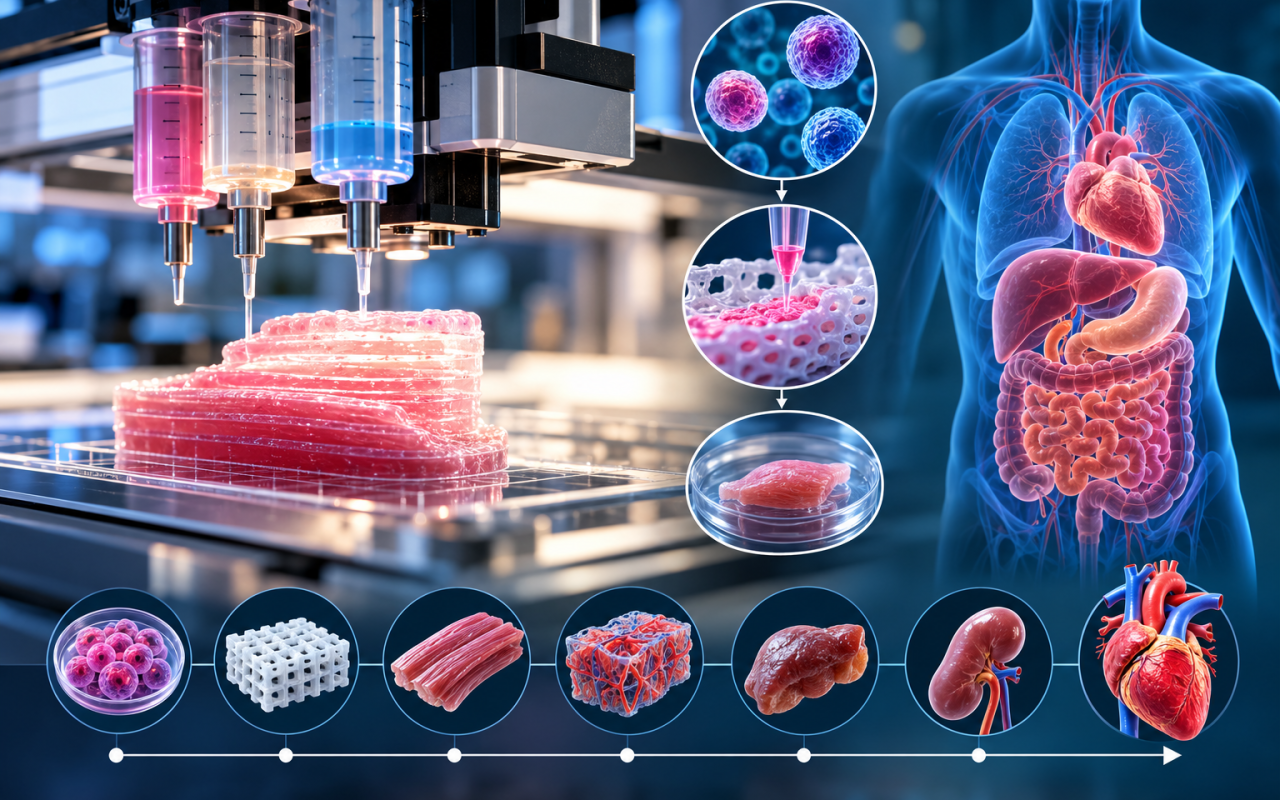
3D bioprinting uses printers that deposit living cells in a gel to build tissue layer by layer. Today it mainly speeds drug testing and disease research, while simple printed tissues are in early trials. Fully printed, transplant-ready organs are not yet available, mostly because of the challenge of building blood vessels.
In this article
- What is 3D bioprinting, exactly?
- The main printing approaches
- How did bioprinting begin?
- Why is drug discovery the first big win?
- What this makes possible
- Can we print tissues for transplants?
- Why is printing a whole organ so hard?
- Why does this matter for the transplant shortage?
- What's the near-term outlook?
- Conclusion
Can scientists really print a human organ? Not a full, transplant-ready one yet, but 3D bioprinting already produces living tissue samples that are used in research, and it is steadily moving toward implantable tissues. Think of it as a printer that uses cells mixed into a gel instead of plastic. Let’s look at where the idea came from, what works now, and what is still hard.
What is 3D bioprinting, exactly?
Bioprinting is a form of additive manufacturing. A printer deposits bioink, a material containing living cells and a supportive gel, in precise layers following a digital design. The design often comes from medical imaging such as CT or MRI scans, so the structure can be matched to anatomy.
After printing, the tissue is usually kept in a nutrient-rich environment, sometimes in a bioreactor, so the cells can mature, connect, and start behaving like real tissue. The printing is only the first step. The growing afterward matters just as much.
The main printing approaches
- Extrusion printing: pushes bioink through a nozzle like toothpaste. It handles thick, cell-dense material well.
- Inkjet printing: places tiny droplets of bioink, borrowing ideas from office printers.
- Light-based printing: uses light to harden a liquid material in precise patterns, often giving fine detail.
How did bioprinting begin?
The story starts with ordinary 3D printing, developed in the 1980s, when Charles Hull introduced stereolithography. Around the same time, the field of tissue engineering was growing, with researchers trying to build living tissue on scaffolds for patients.
In the early 2000s, researchers began adapting printing technology to place living cells. Thomas Boland, among others, was known for early work modifying inkjet printers to deposit cells. Gabor Forgacs and colleagues also contributed to the early idea of printing cells to form tissue. Companies and university labs soon followed, and the field developed its own tools, materials, and vocabulary.
One early landmark often cited is the work of Anthony Atala and colleagues, who engineered lab-grown bladders and implanted them in patients using scaffolds seeded with the patients’ own cells. That was tissue engineering rather than modern bioprinting, but it showed that lab-built tissue could function in the body and helped inspire the printing approach.
Why is drug discovery the first big win?
Developing a new medicine is slow and expensive, and many drug candidates that look promising in animals or simple cell cultures fail in people. Part of the problem is that a flat layer of cells in a dish does not behave like a three-dimensional organ.
Bioprinted tissues offer a more realistic test bed. Researchers can build small samples of liver, skin, or tumor-like tissue and expose them to compounds to see how the cells respond. Because these models can be made from human cells, they may predict human reactions better than some traditional methods.
What this makes possible
- Toxicity testing: checking whether a compound harms liver-like tissue early, before costly trials.
- Cancer research: printing tumor models to study how cancer cells grow and respond to treatments.
- Personalized testing: in principle, building models from a patient’s own cells to explore which treatment might suit them.
- Reducing animal testing: human-cell models may complement, and in some cases reduce, reliance on animal studies, though they are not a full replacement today.
Regulators have also shown growing openness to alternatives to animal testing. In the United States, a 2022 law removed the requirement that drugs be tested on animals before human trials, allowing other methods to be used where appropriate.
Can we print tissues for transplants?
This is the headline dream, and the honest answer is: partly, and mostly in the experimental stage. Simpler tissues are closer to use than complex solid organs.
Skin, cartilage, and bone are comparatively easier because they have simpler structures or need less internal plumbing. Researchers have printed these and tested them in laboratory and animal studies, and some early human work with printed implants has been reported. Printed scaffolds and implants made from non-living materials, such as custom bone or dental pieces, are already more established in clinical use, though those are not living organs.
A printed ear-shaped implant made with a patient’s own cells has been reported in a small clinical trial setting, which shows the direction of travel, but it remains early.
Why is printing a whole organ so hard?
A kidney, liver, or heart is not just a lump of cells. It is a dense, organized system, and several big problems stand in the way.
- Blood vessels: cells deeper than a fraction of a millimeter or so from a blood supply struggle to get oxygen and nutrients. Printing tiny branching vessel networks that connect to the body’s circulation is among the toughest challenges.
- Cell numbers: organs contain enormous numbers of cells of many types, and producing that many, with the right mix, is difficult.
- Resolution and speed: capillaries are extremely small, and printing at that detail across a whole organ takes time that living cells may not tolerate.
- Maturation: a printed structure must grow up into functioning tissue, with the right signals, strength, and electrical or chemical behavior.
- Safety and regulation: any implant must be shown to be safe, consistent, and effective before it can be widely used.
Why does this matter for the transplant shortage?
In many countries, far more people need organ transplants than there are donor organs available, and many wait a long time. Bioprinting aims to ease that gap in the long run. If an organ could be made from a patient’s own cells, there could also be a lower risk of immune rejection, which today often requires lifelong medication.
That is a big if, and nobody can say with certainty when it will arrive. Realistic expectations help: progress is likely to come in steps, from research models to simple tissues, then to more complex structures.
What’s the near-term outlook?
In the shorter term, expect bioprinting to keep growing in labs, particularly for drug testing and disease modeling, where the tissue does not need to survive inside a patient. Researchers are also exploring printing inside the body or directly onto wounds, using handheld or robotic devices to deposit material where it is needed.
Other advances come from related fields, including stem cell science, which provides the cells to print, and better bioinks, which give cells a more natural environment. As these pieces improve together, the technology gains ground.
Conclusion
3D bioprinting has gone from a clever printer hack to a serious research field in a couple of decades. Today its biggest practical impact is in drug discovery and disease models, while printed tissues for patients are emerging step by step. Fully printed, transplant-ready organs remain a goal rather than a reality, but each advance in blood vessels, bioinks, and cell sourcing brings that goal a bit closer.

Team Random Read
Random Read is an independent general-interest blog covering history, current affairs, nature, psychology, science and pop culture. About us
More like this
5 Everyday Inventions That Were Total Accidents (Including Microwave Ovens & Post-it Notes)
We like to imagine that great inventions are born from brilliant minds following carefully drawn plans. A scientist develops a theory. An…

The AI Revolution for Everyday Professionals: Beyond the Headlines, Into Your Workflow
Every week brings another AI headline — a new model, a new benchmark, a new warning about jobs disappearing. But scroll past…

Neuroplasticity in Your 20s and Beyond: How Your Brain Keeps Rewiring Itself (and How to Speed It Up)
There's a persistent myth that your brain finishes "setting" sometime around your mid-twenties — that the neural wiring you have at 25…