Oldest Modern Human Remains found in each Continent – yes, including Antarctica
 By Team Random Read
Updated
12 min read
By Team Random Read
Updated
12 min read
Introduction
The story of humanity is written in the earth. For centuries, archaeologists, anthropologists, and geologists have dug through layers of dirt, rock, and volcanic ash to piece together the greatest migration story of all time: the journey of Homo sapiens. From our evolutionary birthplace in the heart of Africa, modern humans expanded across the globe, crossing treacherous mountain ranges, vast oceans, and frozen landbridges to inhabit every corner of the planet.
In this article
- Introduction
- TL;DR: The Quick Summary
- Africa: The Cradle of Humanity
- The Omo Kibish Remains (Ethiopia)
- Pushing Back the Timeline
- Asia: The First Steps Out of Africa
- Misliya Cave (Israel)
- Tam Pa Ling (Laos)
- Europe: Overlapping with Neanderthals
- Grotte Mandrin (France)
- Australia: The Ancient Navigators
- Mungo Man and Mungo Lady (New South Wales)
- A Legacy of Culture and Ritual
- North America: The Ice Age Pioneers
- Arlington Springs Man (California)
- Submerged Caves in Mexico
- South America: A Rapid Expansion
- The Luzia Woman (Brazil)
- The National Museum Tragedy
- Antarctica: The Final Frontier
- The Yamana Beach Skull (Livingston Island)
- A Tragic Mystery
- Frequently Asked Questions (FAQ)
- 1. What is the difference between early Homo sapiens and modern humans?
- 2. How do scientists date ancient human remains?
- 3. Will we ever find older human remains?
- 4. Why are skulls and teeth the most common human remains found?
- 5. How did early humans cross the ocean to reach Australia and the Americas?
Tracing this journey relies on discovering the physical remains our ancestors left behind. Skeletons, fragmented skulls, and even single teeth act as time capsules. Thanks to modern scientific techniques like radiocarbon dating, uranium-series testing, and DNA sequencing, we can now map our global expansion with incredible accuracy.
While most people know that human life began in Africa, the timeline of how and when we reached other continents is constantly shifting with new discoveries. This article breaks down the oldest known remains of anatomically modern humans on every single continent on Earth. And yes, that includes the frozen, desolate landscape of Antarctica.
TL;DR: The Quick Summary
If you are short on time, here is a quick look at the oldest modern human remains discovered on each continent:
- Africa: Omo I (Ethiopia) – Approximately 233,000 years old. Uncovered in the 1960s, these remains are the oldest universally accepted fossils of anatomically modern humans.
- Asia: Misliya Cave Jawbone (Israel) – 177,000 to 194,000 years old. This find proved that early humans ventured out of Africa much earlier than originally thought.
- Europe: Grotte Mandrin Tooth (France) – 54,000 years old. A single child’s tooth revealed that modern humans shared the European landscape with Neanderthals far earlier than previous estimates.
- Australia: Mungo Man and Mungo Lady (Australia) – 40,000 to 42,000 years old. Found in a dried lake bed, these remains show the earliest known evidence of complex ritual cremation and burial.
- North America: Arlington Springs Man (USA) – 13,000 years old. Found on an island off the coast of California, this discovery proved that early Americans used boats.
- South America: Luzia Woman (Brazil) – 11,000 to 11,500 years old. Found in a cave in Brazil, Luzia provided vital clues about the rapid expansion of humans down the Pacific coast.
- Antarctica: Yamana Beach Skull (Livingston Island) – Died between 1819 and 1825. A skull belonging to an indigenous woman from Chile marks the earliest confirmed human remains in the Antarctic region.
Africa: The Cradle of Humanity
Every piece of genetic and fossil evidence points to Africa as the birthplace of Homo sapiens. However, pinpointing the exact “first” modern human is complicated by how we define “modern.” While older fossils with a mix of archaic and modern traits exist (such as the 300,000-year-old Jebel Irhoud skulls in Morocco), the oldest remains universally recognized as unequivocally modern belong to a fossil known as Omo I.
The Omo Kibish Remains (Ethiopia)
In the late 1960s, renowned paleoanthropologist Richard Leakey and his team were exploring the Omo River valley in southwestern Ethiopia. The region is part of the East African Rift, a highly volatile area historically prone to volcanic eruptions. Buried deep within the Kibish Formation, the team discovered fragments of a single human skull, pelvis, and limbs.
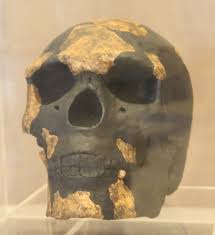
What made the Omo I skull remarkable was its shape. Unlike older, more primitive human ancestors who had heavy brow ridges and elongated heads, Omo I had a tall, rounded braincase and a prominent, bony chin. These are the defining physical hallmarks of a modern human being.
Pushing Back the Timeline
For decades, scientists struggled to date the Omo remains accurately. Initial estimates placed them around 197,000 years old. However, a major breakthrough occurred in 2022. By analyzing the layers of volcanic ash directly above the fossils, volcanologists matched the ash to a specific eruption of the Shala volcano, located 400 kilometers away.
By testing the pumice rock from that eruption, scientists confidently dated the ash layer to 233,000 years ago. Because the Omo I skeleton was buried below this ash, the person must have died before the eruption occurred. This groundbreaking research pushed the origin of anatomically modern humans back by tens of thousands of years.
Asia: The First Steps Out of Africa
For a long time, researchers believed modern humans successfully migrated out of Africa in a single massive wave around 60,000 years ago. However, the fossil record in Asia tells a story of earlier, smaller migrations—groups of pioneers who tested the waters long before the major exodus.
Misliya Cave (Israel)
Geographically, the Middle East is the crossroads between Africa and Asia. In 2018, archaeologists working in the Misliya Cave on Mount Carmel in Israel discovered a fossilized upper jawbone containing eight intact teeth.
Using three independent dating methods, scientists concluded the jawbone was between 177,000 and 194,000 years old. The teeth bore distinct characteristics belonging exclusively to Homo sapiens. This jawbone is currently the oldest modern human remain found outside of Africa, proving that our ancestors were exploring the Asian continent almost 100,000 years earlier than textbook histories suggested.
Tam Pa Ling (Laos)
Further east, the journey of early humans becomes even more fascinating. In 2009, deep within the Annamite Mountains of northern Laos, researchers discovered a partial human cranium in a cave called Tam Pa Ling (Cave of the Monkeys).
Unlike other ancient sites located along easy-to-travel coastlines, Tam Pa Ling is entirely landlocked and mountainous. The bones found here date between 46,000 and 86,000 years old. This discovery provided concrete proof that early humans in Asia were not just hugging the beaches as they migrated; they were actively navigating dense, inland tropical forests.
Europe: Overlapping with Neanderthals
When modern humans finally pushed into Europe, they did not step into an empty land. Europe and western Asia had been the absolute domain of the Neanderthals for hundreds of thousands of years. Uncovering the oldest human remains in Europe helps us understand the complex, overlapping relationship between our species and our extinct cousins.
Grotte Mandrin (France)
Until very recently, the oldest accepted modern human remains in Europe were found in Bulgaria (the Bacho Kiro cave) and the Czech Republic (Zlatý kůň), dating to roughly 45,000 years ago. But in 2022, a tiny discovery in southern France rewrote the history books.
In the Grotte Mandrin rock shelter, overlooking the Rhône River Valley, archaeologists found hundreds of stone tools and a single, well-preserved child’s tooth. Dental paleoanthropologists examined the tooth and confirmed it belonged to a Homo sapiens child, not a Neanderthal.
The sediment layer where the tooth was found dates back an incredible 54,000 years. Interestingly, the layers of dirt above and below this tooth contain Neanderthal tools and remains. This suggests that modern humans and Neanderthals did not just meet once; they took turns occupying the exact same caves over thousands of years before the Neanderthals eventually went extinct.
Australia: The Ancient Navigators
The human migration to Australia represents one of the greatest technological and physical achievements of the ancient world. Because Australia has never been connected to the Asian mainland by a land bridge—even when sea levels were at their lowest during the Ice Age—the first humans to arrive had to cross miles of open ocean. This required boats, planning, and extraordinary courage.
Mungo Man and Mungo Lady (New South Wales)
In the remote, arid outback of southwestern New South Wales lies the Willandra Lakes Region. Today, Lake Mungo is a dry expanse of sand and clay, but tens of thousands of years ago, it was a thriving, freshwater lake teeming with fish and wildlife.
In 1968, geologist Jim Bowler stumbled upon human bones emerging from the sand dunes. These cremated remains became known as Mungo Lady. Six years later, in 1974, he found a nearly complete male skeleton just a few hundred meters away, which became known as Mungo Man. Both individuals lived roughly 40,000 to 42,000 years ago.
A Legacy of Culture and Ritual
The Lake Mungo remains are scientifically and culturally monumental. Mungo Lady represents the oldest known human cremation in the world, proving that these early Australians engaged in complex, intentional burial rituals. Mungo Man was laid to rest on his back with his hands crossed over his lap, and his body was heavily sprinkled with red ochre—a pigment traded and transported from miles away.
After decades of housing the remains in universities, the Australian government officially returned Mungo Man to the traditional Aboriginal owners of the land in 2017, where he was rightfully laid to rest on his ancestral country.
North America: The Ice Age Pioneers
The peopling of the Americas has historically been one of the most fiercely debated topics in archaeology. For a long time, the dominant theory was the “Clovis-first” model, which argued that the first humans walked across a temporary ice bridge from Siberia into Alaska about 11,500 years ago. However, older remains have consistently challenged this theory.
Arlington Springs Man (California)
In 1959, an archaeologist named Phil C. Orr was exploring Arlington Canyon on Santa Rosa Island, part of the Channel Islands off the coast of Southern California. Buried deep in the earth, he discovered two human femur (thigh) bones.
Years later, modern radiocarbon dating revealed that the “Arlington Springs Man” lived roughly 13,000 years ago. Because Santa Rosa Island was separated from the North American mainland by several miles of ocean—even during the Ice Age—this person could not have walked there.
This discovery dealt a massive blow to the land-bridge-only theory and heavily supported the “Kelp Highway Hypothesis.” This theory suggests that the first Americans were maritime explorers who traveled in boats along the Pacific coastline, surviving on abundant marine life like seals, fish, and kelp forests, long before inland glaciers melted.
Submerged Caves in Mexico
It is worth noting that more recent discoveries continue to push timelines back. In the flooded underground caves (cenotes) of the Yucatán Peninsula in Mexico, highly skilled deep-water divers have recovered skeletons, such as “Eva de Naharon,” dating between 13,000 and 14,000 years old. These individuals died when the caves were still dry, before melting ice caps raised global sea levels and flooded the chambers.
South America: A Rapid Expansion
If early humans entered North America via the coast, they moved southward at an astonishing speed. The remains found in South America are nearly as old as those in North America, suggesting a rapid population expansion down the Pacific coast and into the dense jungles and savannas.
The Luzia Woman (Brazil)
In 1975, a joint French-Brazilian archaeological expedition explored a cave system in Lagoa Santa, located in the Brazilian state of Minas Gerais. There, they found the skull of a young woman in her early twenties who lived between 11,000 and 11,500 years ago. They named her “Luzia.”
Luzia is arguably the most famous fossil in South America. When scientists performed a facial reconstruction on her skull, they noticed that her cranial features were distinctly different from modern Indigenous South Americans. Her skull shape more closely resembled those of Indigenous Australians or Melanesians. This sparked massive debates among anthropologists, leading to theories that South America was populated by multiple distinct waves of human migration.
The National Museum Tragedy
For decades, Luzia was the crown jewel of the National Museum of Brazil in Rio de Janeiro. Tragically, in September 2018, a catastrophic fire engulfed the museum, destroying millions of priceless artifacts. The world watched in horror as Luzia was presumed lost forever. Miraculously, a few weeks later, rescue workers sifting through the ashes recovered 80% of her skull fragments. The extreme heat had damaged them, but scientists are currently working to reconstruct her once again.
Antarctica: The Final Frontier
When we think of Antarctica, we think of penguins, glaciers, and modern scientific research stations. Antarctica has no indigenous human population. It is the harshest, coldest, and driest continent on Earth. History books tell us that humans did not even lay eyes on the Antarctic mainland until 1820. Yet, hidden in the ice and rocks, scientists found a dark and unexpected piece of human history.
The Yamana Beach Skull (Livingston Island)
In January 1985, Daniel Torres Navarro, a biologist from the University of Chile, was walking along Yámana Beach on Livingston Island in the South Shetland Islands off the Antarctic Peninsula. Half-buried in the rocky sand, tinted green from microalgae, he found a human skull.
Finding human remains in Antarctica that did not belong to a modern explorer was completely unprecedented. Subsequent searches in the area turned up a few more fragments, including a femur.
A Tragic Mystery
Forensic analysis of the skull revealed a heartbreaking story. The bones belonged to a young woman, likely of Indigenous (Mestiza) descent from southern Chile. She was roughly 21 years old and died sometime between 1819 and 1825. Her bones showed severe signs of nutritional stress, anemia, and an ear infection.
How did a young Chilean woman end up dead on a frozen beach in Antarctica? Indigenous South Americans possessed bark canoes, but these were completely unsuited for crossing the violent, freezing waters of the Drake Passage.
Historians and archaeologists believe she was brought there by commercial sealers. In the 1820s, British and American sealing ships aggressively hunted in the South Shetland Islands. It was documented that sealers had violent interactions with Indigenous populations in Chile, frequently kidnapping people to use as guides or for forced labor. It is highly probable that this young woman was taken against her will, brought to the icy edges of the world, and either died of disease and malnutrition or was simply abandoned to freeze.
Today, her skull remains the oldest confirmed human fossil ever found on Antarctic soil—a somber reminder of human exploitation mixed with the relentless push into the unknown.
Frequently Asked Questions (FAQ)
1. What is the difference between early Homo sapiens and modern humans?
While early Homo sapiens belong to our species, they still retained some primitive physical traits from older ancestors, such as thicker brow ridges, elongated skull shapes, and larger teeth. Anatomically modern humans have the exact same skeletal structure as people living today: a high, rounded braincase (globular skull), a flatter face, and a distinct, protruding bony chin.
2. How do scientists date ancient human remains?
Scientists use several methods depending on the environment. Radiocarbon dating measures the decay of Carbon-14 in organic material like bone, but it is only accurate up to about 50,000 years. For older remains, scientists use Uranium-series dating on the bones or teeth, or they date the environment around the fossil. For example, they can date the geological layers of volcanic ash above and below a skeleton to determine the timeframe in which the person was buried.
3. Will we ever find older human remains?
Almost certainly. The fossil record is constantly changing. Because fossilization is a rare process that requires specific environmental conditions (like rapid burial in sediment without oxygen), the remains we have found represent only a tiny fraction of the people who actually lived. As archaeological technology improves, particularly in underwater diving and ground-penetrating radar, we are likely to find older remains that push our timelines even further back.
4. Why are skulls and teeth the most common human remains found?
Teeth are the hardest substance in the human body, coated in highly durable enamel. They can survive extreme weather, acidity, and time far better than porous bones. The skull is also a thick, robust bone structure. Smaller bones, like fingers, ribs, or toes, are fragile and easily scattered by scavengers, washed away by water, or dissolved by acidic soils over tens of thousands of years.
5. How did early humans cross the ocean to reach Australia and the Americas?
While sea levels were significantly lower during the last Ice Age—locking up water in massive glaciers and exposing more land—deep ocean channels still existed. To reach Australia, and to travel down the western coast of the Americas, early humans had to use watercraft. While no physical boats from 40,000 years ago have survived (wood rots quickly), the sheer presence of humans on isolated landmasses proves they built rafts or canoes from bamboo, reeds, or hollowed tree trunks, navigating by the stars and coastal currents

Team Random Read
Random Read is an independent general-interest blog covering history, current affairs, nature, psychology, science and pop culture. About us
More like this

Historical Myths Debunked: 15 Popular “Facts” Everyone Gets Wrong.
History is full of extraordinary stories. Some are so memorable that they become part of popular culture: Julius Caesar was born by…

5 Everyday Inventions That Were Total Accidents (Including Microwave Ovens & Post-it Notes)
We like to imagine that great inventions are born from brilliant minds following carefully drawn plans. A scientist develops a theory. An…
The Bayeux Tapestry: The 1,000-Year-Old Story of 1066, William the Conqueror and the Battle of Hastings
Few historical objects tell a story as vividly as the Bayeux Tapestry. Nearly 1,000 years old, this extraordinary piece of medieval embroidery…