The Psychology Behind Why We Love Watching Disasters Unfold
 By Team Random Read
Updated
13 min read
By Team Random Read
Updated
13 min read
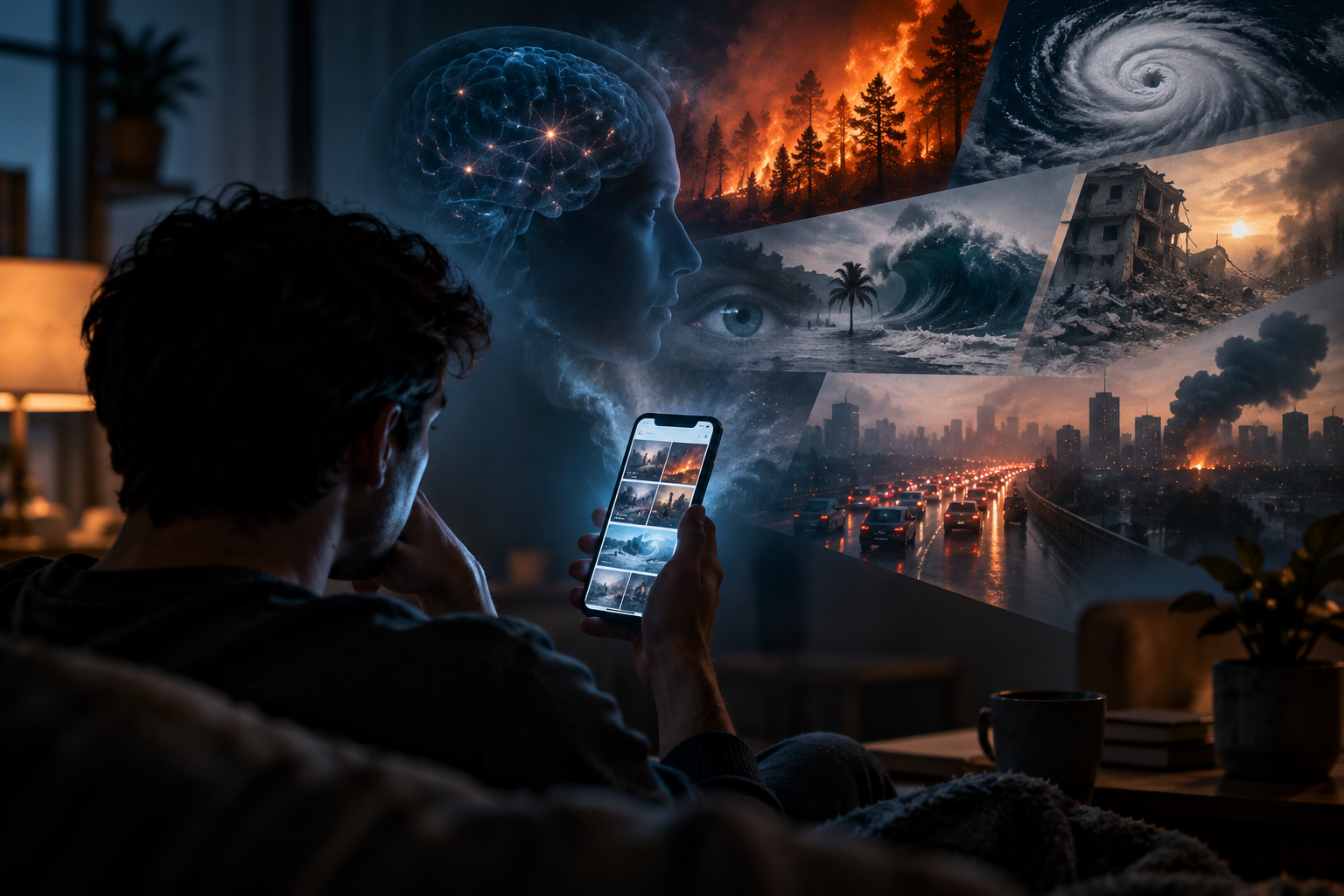
You are driving down the highway, and traffic suddenly grinds to a halt. For twenty minutes, you inch forward, frustrated, assuming there must be a lane closure ahead. But as you finally reach the bottleneck, you realize the road is completely clear. The traffic jam was caused by drivers slowing down to look at a car crash on the opposite side of the highway.
In this article
- The Evolutionary Roots of Disaster Obsession
- Survival of the Most Prepared
- Threat Simulation and the Brain
- The Neuroscience of the 'Car Crash' Syndrome
- Adrenaline, Dopamine, and the Reward Pathway
- The Role of the Amygdala
- The Paradox of Safe Danger
- Experiencing Thrills from the Couch
- Catharsis and Emotional Release
- Morbid Curiosity: A Natural Human Trait
- The Need to Make Sense of Chaos
- Empathy vs. Voyeurism
- How Modern Media Feeds the Fire
- The 24/7 News Cycle and "If it Bleeds, it Leads"
- Doomscrolling and Social Media Algorithms
- The Societal Impact of Watching Disasters
- Coming Together in Crisis
- Desensitization and Compassion Fatigue
- Healthy Limits: When to Look Away
- Recognizing the Signs of Overconsumption
- Practical Tips for a Media Diet
- Conclusion
- Frequently Asked Questions (FAQs)
- 1. Does having a morbid curiosity mean there is something wrong with my mental health?
- 2. Why do I feel guilty when I watch news about a tragedy?
- 3. What is doomscrolling, and why is it so hard to stop?
- 4. Can watching too much disaster news cause real trauma?
- 5. How can I stay informed without ruining my mental health?
You probably cursed the drivers in front of you for “rubbernecking”—right before you slowed down to take a look yourself.
We all do it. Whether it is staring at a fender bender, binge-watching true crime documentaries, or staying glued to the news during a catastrophic hurricane, humans are deeply fascinated by disaster. It feels almost shameful to admit, but chaos, destruction, and tragedy capture our attention like nothing else.
If you have ever felt guilty for not being able to look away from a trainwreck, you can give yourself a break. You are not a bad person, and you are not a sociopath. You are simply human. The psychology behind why we love watching disasters unfold is rooted deeply in our evolution, our neurology, and our innate need to make sense of a chaotic world.
The Evolutionary Roots of Disaster Obsession
To understand why a modern human sits on a comfortable couch and watches hours of earthquake footage, we have to look back thousands of years. Our brains have not changed much since we were hunter-gatherers trying to survive in a world filled with predators and natural threats.
Survival of the Most Prepared
In the days of early humans, information was literally a matter of life and death. If an early human saw a saber-toothed tiger attack someone in their tribe, the safest way to learn about the tiger’s hunting tactics was to watch from a safe distance.
Our ancestors who paid close attention to threats and disasters learned valuable lessons. They learned which berries were poisonous by watching others get sick. They learned how fast a flood could move by watching it wipe out a neighboring camp. Evolution favored the individuals who paid attention to danger, because they were the ones who gathered enough intelligence to avoid that same danger in the future.
Threat Simulation and the Brain
Psychologists refer to this as “threat simulation.” When we watch a disaster unfold on television or read about a terrible accident online, our brain is quietly taking notes. We are subconsciously asking ourselves, “What would I do in that situation? How would I escape? Could I survive?”
We are running mental simulations. By watching a tragedy happen to someone else, we are giving our brains a low-risk practice run for a worst-case scenario. It is a primal defense mechanism disguised as entertainment or news consumption.
The Neuroscience of the ‘Car Crash’ Syndrome
Beyond evolutionary survival tactics, there is a very real chemical reaction happening inside your body when you witness a disaster. Your brain is a complex chemistry lab, and tragedy mixes a surprisingly addictive cocktail of neurotransmitters.
Adrenaline, Dopamine, and the Reward Pathway
When you see something shocking, terrifying, or destructive, your body’s sympathetic nervous system kicks into gear. The “fight or flight” response is triggered, sending a rush of adrenaline through your veins. Your heart rate increases, your pupils dilate, and your focus narrows.
However, because you are watching this disaster on a screen or from behind the wheel of your locked car, your brain quickly realizes you are not in actual, immediate physical danger. Your prefrontal cortex—the logical, reasoning part of your brain—steps in and says, “Relax, we are safe.”
This rapid shift from high alert to absolute safety triggers the release of dopamine, the brain’s reward chemical. It is the exact same chemical process that makes riding a rollercoaster fun. You get the thrilling biological rush of facing death, immediately followed by the comforting realization that you are completely secure.
The Role of the Amygdala
The amygdala is the small, almond-shaped part of your brain responsible for processing emotions, especially fear and pleasure. It acts as the brain’s alarm system. When you scroll past a headline about a bridge collapsing or a wildfire raging, your amygdala lights up. It forces you to pay attention because it prioritizes negative information over positive information—a concept known as the “negativity bias.”
Your brain simply believes that bad news is more important than good news. Good news is nice, but bad news could kill you. Therefore, the amygdala essentially hijacks your attention span, making it physically difficult to look away.
The Paradox of Safe Danger
Why are horror movies a multi-billion dollar industry? Why do people flock to watch disaster films like Twister or Titanic? It all comes down to the concept of “safe danger.”
Experiencing Thrills from the Couch
Human beings crave stimulation. A life devoid of any risk or excitement quickly becomes boring and stagnant. However, seeking out real danger is foolish and life-threatening. Watching disasters allows us to explore the darkest, most terrifying parts of the human experience without ever putting our own lives on the line.
We get to feel the intensity of a hurricane, the suspense of a rescue mission, or the horror of a building collapse while wrapped in a blanket with a cup of tea. It is a way to push the boundaries of our emotional limits while maintaining total physical security.
Catharsis and Emotional Release
The ancient Greeks had a word for this: catharsis. Aristotle believed that watching tragic plays allowed citizens to purge themselves of negative emotions. By watching characters suffer immense tragedy on stage, the audience could experience fear, pity, and sorrow in a controlled environment.
The same applies today. When you watch a disaster unfold, it often brings up strong emotions. You might cry for the victims, feel anger toward whoever caused the incident, or feel profound relief that your loved ones are safe. This emotional rollercoaster allows you to process your own latent anxieties and stress. Crying over a news story about a natural disaster can sometimes be a subconscious way to release the pent-up tension from your own daily life.
Morbid Curiosity: A Natural Human Trait
Morbid curiosity is often viewed as a taboo subject. We do not like to admit that we are fascinated by death, destruction, and the macabre. Yet, true crime podcasts top the charts, and documentaries about cults and serial killers are consistently the most-watched content on streaming platforms.
The Need to Make Sense of Chaos
The world is an inherently unpredictable and sometimes terrifying place. Bad things happen to good people. Disasters strike without warning. This reality is very hard for the human brain to accept. We crave order, logic, and fairness.
When a disaster happens, it shatters our illusion of control. Morbid curiosity is our brain’s attempt to piece that illusion back together. By obsessively reading about a plane crash or watching the trial of a violent criminal, we are trying to find the “why.”
If we can figure out why the plane crashed, or why the criminal snapped, we can convince ourselves that the world makes sense. We can tell ourselves, “Ah, the plane crashed because of a faulty sensor. I will simply make sure I fly on airlines that check their sensors.” This gives us a false, but deeply comforting, sense of control over our own mortality.
Empathy vs. Voyeurism
It is important to draw a line between morbid curiosity and outright voyeurism. For the vast majority of people, watching a disaster is heavily laced with empathy.
When we watch a community come together after a tornado, we are not just watching the destruction; we are watching the humanity. We imagine ourselves in the shoes of the victims. We feel their pain, and by doing so, we reaffirm our own moral compass. We prove to ourselves that we are capable of deep compassion. The tragedy draws us in, but the human resilience keeps us watching.
How Modern Media Feeds the Fire
While our fascination with disaster is an ancient evolutionary trait, the way we consume disaster has drastically changed in the last few decades. The media ecosystem knows exactly how our brains work, and it is designed to exploit our negativity bias to keep us engaged.
The 24/7 News Cycle and “If it Bleeds, it Leads”
Before cable television and the internet, news was consumed in small, distinct blocks. You read the morning paper, and you watched the evening broadcast. Today, news is a 24/7, relentless stream of information.
News organizations operate on a simple, well-known industry principle: “If it bleeds, it leads.” They know that humans are biologically wired to pay attention to threats. A headline about a successful local bake sale will barely get a click, but a headline about a mysterious new virus or a massive pile-up on the interstate will generate millions of views. Because media companies rely on ad revenue driven by human attention, they are financially incentivized to highlight disaster, conflict, and tragedy over anything else.
Doomscrolling and Social Media Algorithms
This dynamic has been supercharged by social media. When you slow down to look at a car crash in real life, you eventually drive past it and the event is over. When you engage with a disaster on social media, the algorithm takes note.
If you click on a video of a wildfire, the algorithm assumes you want to see more wildfires. Suddenly, your entire feed is populated with videos of burning forests, collapsing buildings, and angry political riots. This creates a phenomenon known as “doomscrolling”—the act of endlessly scrolling through negative news, even when it is actively making you depressed or anxious.
The algorithm does not care about your mental health; it only cares about your engagement. And since your amygdala cannot look away from a threat, you fall into a feedback loop of perpetual digital disaster.
The Societal Impact of Watching Disasters
Our collective obsession with watching disasters has a profound impact on society as a whole. Sometimes this impact is incredibly positive, but other times, it can be deeply damaging to our collective psyche.
Coming Together in Crisis
On a positive note, widespread media coverage of a disaster can mobilize incredible amounts of aid and support. When a massive earthquake strikes a developing nation, the immediate global broadcast of the destruction taps into our collective empathy. Within hours, millions of dollars are raised, volunteers pack their bags, and governments mobilize rescue teams.
Shared viewing of a disaster also creates a sense of social cohesion. Think back to the days following the September 11 attacks, or the early months of the COVID-19 pandemic. The shared trauma, witnessed collectively through screens, often unites people, dissolving petty differences and creating a profound, albeit temporary, sense of global community.
Desensitization and Compassion Fatigue
However, there is a dark side to consuming too much disaster media. When we are constantly exposed to images of suffering and destruction, we run the risk of becoming desensitized.
The first time you see a video of a war zone, it might shock you to your core. The hundredth time you see it, you might just scroll past it while eating a sandwich. This emotional numbing is a defense mechanism. The human brain cannot sustain a state of high alert and deep grief indefinitely; eventually, it shuts off the emotional tap to protect itself.
This leads to “compassion fatigue.” We become so overwhelmed by the sheer volume of global suffering that we stop caring altogether. We feel helpless, cynical, and exhausted. When society reaches a state of compassion fatigue, real-world disasters fail to generate the aid and empathy they desperately need.
Healthy Limits: When to Look Away
Because you cannot change millions of years of human evolution, you are never going to completely eradicate your morbid curiosity. However, you can control your environment and your media diet. Knowing when to look away is a vital skill in the modern world.
Recognizing the Signs of Overconsumption
How do you know if your fascination with disasters has crossed the line from natural curiosity into unhealthy obsession? Look for the physical and emotional cues.
- Are you having trouble sleeping because you are lying in bed reading bad news?
- Do you feel a baseline level of anxiety or dread throughout your day?
- Are you snapping at your friends and family over minor inconveniences?
- Have you started to believe that the world is entirely evil and devoid of hope?
If you answered yes to these questions, your brain’s threat-detection system is stuck in overdrive. Your amygdala is telling you that a saber-toothed tiger is constantly in the room with you.
Practical Tips for a Media Diet
You do not need to bury your head in the sand and ignore the world, but you do need to set boundaries. Here are a few ways to manage your disaster consumption:
- Set News Timers: Allow yourself 15 to 30 minutes of news consumption in the morning and perhaps another 15 minutes in the evening. Once the timer goes off, close the apps.
- Turn Off Push Notifications: You do not need a breaking news alert every time something bad happens in the world. Read the news on your own terms, not when a corporation decides to interrupt your day.
- Curate Your Feed: Actively train social media algorithms by clicking “not interested” on sensationalist disaster videos, and purposefully engage with content related to your hobbies, nature, or positive human interest stories.
- Read Rather Than Watch: Text-based news is generally less emotionally manipulative than video-based news. Reading an article about a storm provides you with facts without subjecting your brain to the traumatic audio and visceral imagery of a shaky smartphone video.
Conclusion
The next time you find yourself slowing down to look at an accident, or spending an hour reading the Wikipedia page for a famous shipwreck, do not judge yourself too harshly. You are experiencing the very natural, deeply ingrained psychological impulse to protect yourself by understanding danger.
We love watching disasters unfold because it makes us feel alive, it answers our morbid curiosities, and it satisfies our evolutionary need to run threat simulations from a place of safety. But remember that while your brain is wired to look at the car crash, you also have the power, and the steering wheel, to eventually look forward and keep driving.
Frequently Asked Questions (FAQs)
1. Does having a morbid curiosity mean there is something wrong with my mental health?
No, absolutely not. Morbid curiosity is a completely normal evolutionary trait. Our brains are designed to gather information about threats and dangers so we can figure out how to avoid them. An interest in true crime, disaster movies, or breaking news is standard human behavior and does not mean you have psychological issues.
2. Why do I feel guilty when I watch news about a tragedy?
You feel guilty because you are experiencing a conflict between two natural instincts. One instinct is driving you to look at the disaster to gather survival information (morbid curiosity), while the other instinct is your natural human empathy, which makes you feel bad for the people suffering. The guilt is actually a sign of a healthy moral compass.
3. What is doomscrolling, and why is it so hard to stop?
Doomscrolling is the act of excessively scrolling through negative news feeds on social media or news apps. It is hard to stop because bad news triggers the amygdala—the brain’s alarm system. The brain interprets bad news as an active threat, making it physically difficult to look away because your body feels it needs this information to survive.
4. Can watching too much disaster news cause real trauma?
Yes, it can lead to what psychologists call “vicarious trauma” or secondary traumatic stress. Consuming highly graphic or emotionally distressing media over a long period can cause symptoms similar to PTSD, including anxiety, sleep disturbances, irritability, and a feeling of hopelessness.
5. How can I stay informed without ruining my mental health?
The key is intentionality. Turn off breaking news push notifications so you aren’t ambushed by bad news. Set specific, limited times during the day to check the news (e.g., 20 minutes in the morning). Finally, prioritize reading text-based articles over watching graphic videos, as videos trigger a much stronger, more stressful biological response.

Team Random Read
Random Read is an independent general-interest blog covering history, current affairs, nature, psychology, science and pop culture. About us
More like this
The Psychology of AI Companionship: Why Millions Are Quietly Bonding With Algorithms
We live in an era where millions of people don't just use AI to write emails or debug code. They talk to…
The Dark Triad in Everyday Life: Why You Keep Falling for Charming People.
You meet someone who is confident, funny, attentive, and unusually good at making you feel interesting. They remember small details, tell compelling…
Phantom Vibration Syndrome: The Psychology Behind Feeling a Buzz That Never Happened.
You're at your desk, or on the bus, or halfway through a meeting, and you feel it — that unmistakable little rumble…