Nature Facts That Sound Fake But Are 100% True
 By Team Random Read
12 min read
By Team Random Read
12 min read
TL;DR (Too Long; Didn’t Read)
In this article
- Introduction: The Weird and Wonderful Natural World
- Bizarre Animal Biology
- Wombats Poop in Perfect Cubes
- Sloths Can Hold Their Breath Longer Than Dolphins
- Octopuses Have Three Hearts and Nine Brains
- The Immortal Jellyfish Can Live Forever
- Tardigrades Can Survive in Outer Space
- Mind-Bending Plants and Fungi
- Trees Talk to Each Other Through a "Wood Wide Web"
- The Largest Living Organism on Earth is a Mushroom
- Bananas are Berries, But Strawberries Are Not
- Crazy Earth and Space Phenomena
- Sharks Are Older Than Trees (And Saturn’s Rings)
- It Literally Rains Diamonds on Jupiter and Saturn
- There is a Boiling River in the Amazon
- Water Can Boil and Freeze at the Exact Same Time
- The Weird Human Body
- Your Stomach Acid Can Dissolve Razor Blades
- You Share 50% of Your DNA With a Banana
- Conclusion
- Frequently Asked Questions (FAQ)
- 1. Can a human safely touch a tardigrade?
- 2. If a sloth holds its breath for 40 minutes, why doesn't it drown?
- 3. How do scientists know trees communicate?
- 4. Will the immortal jellyfish ever overpopulate the ocean?
- 5. If it rains diamonds on Jupiter, can we go mine them?
- Wombats poop in cubes to mark their territory and stop the droppings from rolling away.
- Sloths can hold their breath for 40 minutes, which is longer than most dolphins.
- Octopuses have three hearts, nine brains, and blue blood.
- Trees communicate and share nutrients through an underground fungal network.
- Sharks are older than trees and even older than the rings of Saturn.
- It literally rains diamonds on Jupiter and Saturn due to extreme atmospheric pressure.
- Your stomach acid is strong enough to dissolve a double-edged razor blade.
Introduction: The Weird and Wonderful Natural World
If you spend enough time looking at the world around us, you quickly realize that nature does not need a science fiction writer to be bizarre. The reality of how animals, plants, and our planet function is often far stranger than anything we could invent.
We grew up learning basic facts: the sky is blue, birds fly, and fish swim. But beneath the surface of basic biology and earth science lies a layer of natural phenomena that sounds like absolute nonsense. When you first hear these facts, your immediate reaction is probably going to be, “There is no way that is true.”
However, every single fact in this article has been observed, tested, and proven by scientists. From animals with biological superpowers to mind-bending geological events, nature is packed with plot twists. Here are the craziest nature facts that sound completely fake, but are 100% true.
Bizarre Animal Biology
Animals have evolved to survive in some of the harshest conditions on the planet. Sometimes, the solutions evolution comes up with are incredibly strange.
Wombats Poop in Perfect Cubes
Wombats are cute, furry marsupials native to Australia. But their most famous feature is not their appearance; it is their bathroom habits. Wombats are the only known animals in the world that produce cube-shaped poop.
They do not do this just to be interesting. Wombats have incredibly poor eyesight, so they use their droppings to mark their territory and communicate with other wombats. They often place their poop on top of rocks or logs so the scent travels further. If their droppings were round, they would simply roll off these elevated surfaces. The cube shape ensures the markers stay exactly where the wombat left them.
How do they do it? It takes up to 14 days for a wombat to digest its food. By the time the matter reaches the end of the intestines, it is extremely dry. The last part of a wombat’s intestine does not stretch evenly; it has stiff and flexible parts that rhythmically contract, sculpting the dry waste into sharp-edged blocks before it exits the body.
Sloths Can Hold Their Breath Longer Than Dolphins
When you think of aquatic animals that can hold their breath, you probably think of dolphins or whales. A dolphin usually surfaces for air every 8 to 10 minutes. However, the slow-moving tree-dweller of Central and South America—the sloth—can hold its breath for an astonishing 40 minutes.
Sloths are notoriously slow. Their metabolism operates at a fraction of the speed of most other mammals. When a sloth goes underwater, it has the ability to slow its heart rate down by more than two-thirds. Because their heart is beating so slowly, their body requires very little oxygen to keep functioning. This allows them to stay submerged for nearly an hour, a handy trick when they need to cross rivers in the rainforest.
Octopuses Have Three Hearts and Nine Brains
Octopuses are about as close to aliens as we will ever find on Earth. Their biology is entirely different from ours. For starters, an octopus has three hearts. Two of these are “branchial hearts” that pump blood through the gills to pick up oxygen. The third is a “systemic heart” that pumps that newly oxygenated blood through the rest of the body. Interestingly, when an octopus swims, the systemic heart actually stops beating, which explains why they prefer to crawl along the ocean floor—swimming literally exhausts them.
If three hearts weren’t enough, they also have nine brains. There is one central brain shaped like a donut located in their head. The other eight “mini-brains” are located at the base of each of their eight arms. This means each arm can touch, taste, and react independently without having to wait for a command from the main brain.
The Immortal Jellyfish Can Live Forever
In the waters of the Mediterranean Sea and Japan lives a tiny creature called Turritopsis dohrnii, better known as the immortal jellyfish. It is the only known animal that has figured out how to beat death.
When this jellyfish faces extreme stress, physical damage, starvation, or simply gets old, it does not die. Instead, it alters its cells and reverts completely back to its earliest stage of life—a tiny blob of tissue called a polyp. It is the biological equivalent of a human aging to 90 years old, and then suddenly turning back into an embryo to start life over again. Biologically speaking, this cycle can repeat forever, making the jellyfish functionally immortal.
Tardigrades Can Survive in Outer Space
Tardigrades, also known as water bears, are microscopic animals that look like eight-legged, pudgy sleeping bags. They are widely considered the toughest animals on planet Earth.
If you put a tardigrade in a pot of boiling water, it survives. If you freeze it to absolute zero, it survives. If you expose it to massive doses of deadly radiation, it walks away unharmed. Scientists even dried out some tardigrades, loaded them onto a rocket, and exposed them to the freezing vacuum and extreme radiation of outer space. When they brought them back to Earth and added water, the tardigrades woke up and started reproducing.
They survive by entering a state called “cryptobiosis.” They curl up into a tiny, dehydrated ball called a tun, slowing their metabolism to 0.01% of normal. They can stay in this suspended animation for decades until conditions improve.
Mind-Bending Plants and Fungi
Plants might seem like silent, stationary objects, but they lead incredibly active, dramatic lives right beneath our feet.
Trees Talk to Each Other Through a “Wood Wide Web”
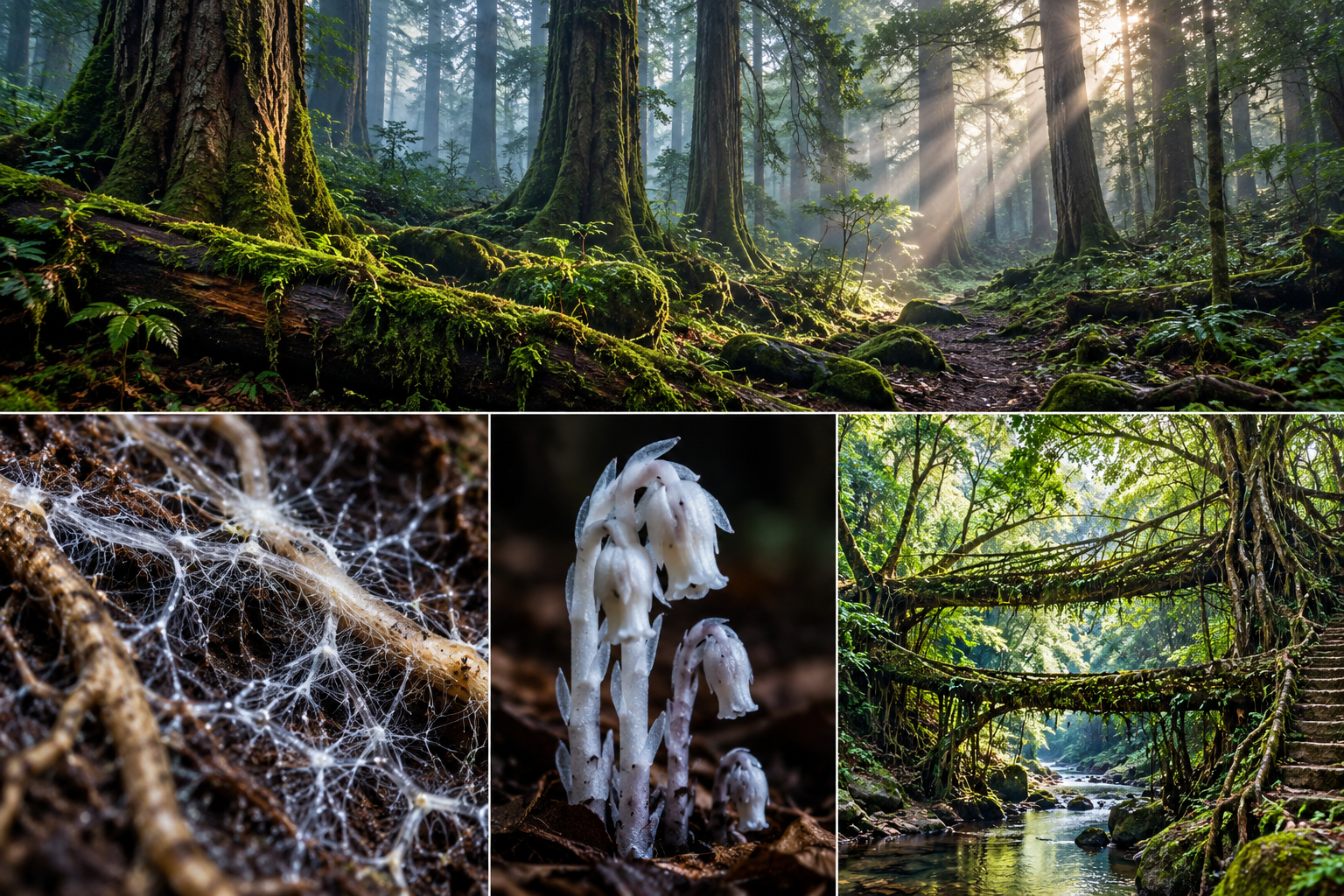
If you walk through a forest, you are not looking at a bunch of isolated trees; you are looking at a massive, interconnected community. Beneath the soil, tree roots connect to a vast underground network of highly complex fungi called mycorrhizal networks.
Scientists have dubbed this the “Wood Wide Web.” Through this fungal network, trees can actually communicate and share resources. An older, stronger tree (often called a “Mother Tree”) can pump excess sugar and nutrients into the fungal network to feed younger, shaded saplings that can’t get enough sunlight. If a tree is attacked by insects, it can send chemical warning signals through the roots, prompting neighboring trees to pump defensive, bad-tasting chemicals into their own leaves before the bugs arrive.
The Largest Living Organism on Earth is a Mushroom
If someone asks you what the largest living creature is, you might guess the blue whale. You would be wrong. The largest single living organism on the planet is a fungus.
Specifically, it is a honey fungus (Armillaria ostoyae) located in the Malheur National Forest in the Blue Mountains of Oregon. This single, connected organism covers an unbelievable 2,385 acres (about 4 square miles) of land. Scientists discovered it by mapping the DNA of fungi across the forest and realizing it was all the exact same genetic organism. It is estimated to be between 2,400 and 8,600 years old, and it weighs hundreds of tons.
Bananas are Berries, But Strawberries Are Not
Botanical classification can be incredibly confusing because the scientific definition of fruits and berries is completely different from how we use those words in the kitchen.
To a botanist, a true berry is a fleshy fruit produced from a single ovary of a single flower, and the seeds must be on the inside. Based on this strict scientific rule, grapes, eggplants, tomatoes, and bananas are all technically berries.
On the other hand, a strawberry does not fit the rule. A strawberry flower has multiple ovaries. Furthermore, the fleshy part of the strawberry that we eat is not actually the plant’s ovary; it is the “receptacle” tissue that holds the ovaries. The actual botanical fruits of the strawberry are those tiny little seed-like specks on the outside. Therefore, a strawberry is an “aggregate fruit,” not a berry.
Crazy Earth and Space Phenomena
Our planet, and the solar system it sits in, are capable of creating chemistry and physics that sound like pure magic.
Sharks Are Older Than Trees (And Saturn’s Rings)
Sharks are the ultimate survivors of the natural world. If you look at the fossil record, the first ancestors of modern sharks appeared in our oceans around 400 to 450 million years ago.
To put that massive amount of time into perspective, trees did not exist yet. The very first tree-like plants (which reproduced via spores, not seeds) did not appear on land until the Devonian period, about 350 million years ago. This means sharks had already been swimming in the oceans for 50 million years before the Earth saw its first tree.
Even crazier, sharks are older than the rings of Saturn. Recent data from the Cassini spacecraft suggests that Saturn’s iconic rings were formed relatively recently, likely between 10 million and 100 million years ago, long after sharks survived multiple mass extinctions on Earth.
It Literally Rains Diamonds on Jupiter and Saturn
The weather on Earth can be bad, but it has nothing on the gas giants of our solar system. Deep within the atmospheres of Jupiter and Saturn, scientists calculate that it rains literal diamonds.
Both of these planets have atmospheres packed with methane gas. During massive lightning storms, lightning strikes the methane, turning it into soot (carbon). As this soot falls deeper into the planet’s atmosphere, the temperature and pressure become unimaginably intense. The pressure crushes the soot into chunks of graphite, and as it falls even further, the pressure compresses that graphite into solid diamonds. It is estimated that Saturn creates about 1,000 tons of diamond rain every single year.
There is a Boiling River in the Amazon
In the depths of the Peruvian Amazon, there is a river called Shanay-Timpishka, which translates roughly to “boiled with the heat of the sun.” But the sun isn’t doing the boiling.
This river runs for about 4 miles, and the water reaches temperatures up to 200 degrees Fahrenheit (93 degrees Celsius)—just shy of boiling. It is so hot that any small animal that accidentally falls into the water is boiled alive instantly. Normally, hot springs and boiling rivers are located right next to active volcanoes. What makes this river so strange is that the nearest active volcano is over 400 miles away. Scientists believe the water is heated deep underground by the Earth’s geothermal gradient and is pushed back up to the surface through fault lines, creating a massive, natural hot tub of death.
Water Can Boil and Freeze at the Exact Same Time
In physics, there is a phenomenon known as the “triple point.” This is the specific temperature and pressure at which a substance can exist as a solid, a liquid, and a gas all at the exact same time, in perfect thermodynamic equilibrium.
For water, this happens at a temperature of exactly 0.01 degrees Celsius (32.018 degrees Fahrenheit) and a very specific, low atmospheric pressure. If you place water in a vacuum chamber and hit this exact pressure and temperature, the water will simultaneously bubble and boil while ice crystals freeze across the surface. It completely breaks our everyday understanding of how hot and cold work.
The Weird Human Body
You don’t have to look to deep space or the Amazon rainforest to find weird nature facts. You just have to look in the mirror.
Your Stomach Acid Can Dissolve Razor Blades
Human digestion is an incredibly aggressive chemical process. The acid sitting in your stomach right now—gastric acid—is primarily composed of hydrochloric acid. On the pH scale, where 1 is battery acid and 14 is a highly alkaline drain cleaner, human stomach acid usually sits between 1.5 and 2.0.
It is so corrosive that it can easily break down heavy metals. In an actual study published in the Journal of Gastrointestinal Surgery, scientists placed double-edged razor blades into a simulation of human stomach acid. After just 24 hours, the razor blades had lost over a third of their weight and became incredibly fragile and dissolved. The only reason your stomach does not digest itself is that your body constantly produces a thick layer of mucus to line the stomach walls.
You Share 50% of Your DNA With a Banana
Humans are highly complex creatures, but at a fundamental genetic level, we are not as unique as we like to think. All living things on Earth evolved from a common ancestor billions of years ago. Because of this, we share a massive amount of our genetic code with everything else that is alive.
You share about 98.8% of your DNA with a chimpanzee, which makes sense. But you also share about 50% of your DNA with a banana. This is because the genes required for basic cellular functions—like replicating DNA, controlling the cell cycle, and producing basic proteins—are exactly the same whether you are building a human body or a piece of fruit.
Conclusion
Nature is the ultimate rule-breaker. Just when we think we have categorized how life and physics work, the natural world throws us a curveball. From immortal jellyfish and cube-pooping marsupials to diamond rain and rivers that boil without volcanoes, the facts of our reality are far more entertaining than fiction. The next time you step outside, remember that the seemingly normal trees might be talking to each other, and the dirt beneath your feet is teeming with microscopic bears that could survive a trip to outer space.
Frequently Asked Questions (FAQ)
1. Can a human safely touch a tardigrade?
Yes, absolutely. Tardigrades are entirely harmless to humans. In fact, they are microscopic (about 0.5 millimeters long), meaning you have probably touched, or even accidentally swallowed, tardigrades without ever knowing it. They live in moss, soil, and water all over the world.
2. If a sloth holds its breath for 40 minutes, why doesn’t it drown?
Sloths do not drown because they have evolved a unique way to manage oxygen. By drastically slowing down their heart rate to one-third of its normal pace, their organs consume oxygen at a crawling pace. This allows the single breath of air they took before going underwater to sustain their body for up to 40 minutes.
3. How do scientists know trees communicate?
Scientists discovered tree communication by tracing radioactive carbon. Dr. Suzanne Simard injected a specific radioactive gas into one tree and later found that same radioactive carbon in a completely different, neighboring tree. This proved that the trees were actively moving nutrients back and forth through the underground fungal network connecting their roots.
4. Will the immortal jellyfish ever overpopulate the ocean?
No. While they are biologically immortal and do not die of old age, they can still be killed. They are a common food source for sea turtles, larger fish, and other jellyfish. Furthermore, they can still die from diseases or drastic changes to their environment before they have a chance to reverse their aging process.
5. If it rains diamonds on Jupiter, can we go mine them?
Unfortunately, no. While the diamonds are very real, the environment is completely unsurvivable. The atmospheric pressure that creates the diamonds would instantly crush any spacecraft or probe we send down there. Even if a probe survived the pressure, the temperatures reach thousands of degrees, which would melt the machinery before it could collect a single stone.

Team Random Read
Random Read is an independent general-interest blog covering history, current affairs, nature, psychology, science and pop culture. About us
More like this
The Wood Wide Web: Do Trees Really Talk to Each Other?
Beneath most forests, tree roots are linked to fungi in a partnership that’s hundreds of millions of years old. Some researchers say…
What’s Happening in the Amazon Rainforest Right Now – The Good, The Bad, and The Ugly
Welcome to 2026. The Amazon rainforest is currently experiencing one of the most volatile and decisive periods in its recorded history. If…

Places on Earth Where the Laws of Nature Feel Broken
We go through life trusting a basic set of rules. Water flows downhill. Lava is red. Rocks are silent. Gravity pulls us…